Editorial · Transport & Logistics
Baltic Aviation Has a New Passenger Leader: What April Airport Data Revealed
Lithuania moved ahead in passenger traffic, Riga retained its cargo advantage, and Tallinn continued reshaping its route map through low-cost expansion.
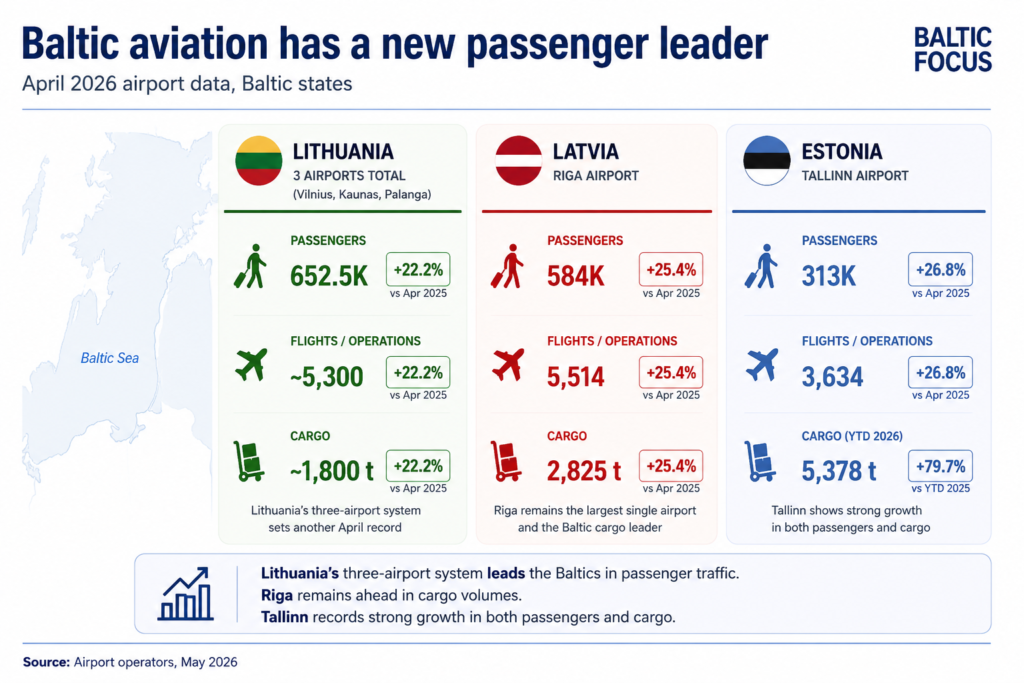
Lithuania moved ahead in passenger traffic, Riga retained its cargo advantage, and Tallinn continued reshaping its route map through low-cost expansion.
April confirmed an important shift in Baltic aviation. Lithuania’s three-airport system has become the clear passenger leader in the region, while Riga remains the largest single airport and the strongest cargo node.
The change is not simple decline for Riga. It is a more specific story: Baltic aviation is becoming less centred on one airport.
Data card — Baltic airports, April 2026
| Market | April passengers | Flights / operations | Cargo |
|---|---|---|---|
| Lithuania airports | 652.5K | almost 5,300 | almost 1,800 t |
| Riga Airport | 584K | 5,514 | 2,825 t |
| Tallinn Airport | 313K | 3,634 | n/a |
Lithuania: the passenger leader
Lithuanian Airports handled 652.5K passengers in April, setting another all-time record for this month. This was 8.2% more than in April 2025, which had already been a record month.
The more important point is the four-month picture. Since the beginning of 2026, Lithuania’s three-airport system has strengthened its position as the Baltic leader in passenger traffic.
This is not only a Vilnius story. Vilnius carries the main capital-city and business demand, Kaunas adds scale and low-cost capacity, while Palanga supports western Lithuania and seasonal traffic.
The contrast with Riga is notable: Riga recorded more flights in April than the Lithuanian airport network, but Lithuania carried more passengers.
Riga: cargo strength and hub exposure
Riga Airport handled 584K passengers and 5,514 flights in April. Since the beginning of the year, it has already served 2 million passengers.
But the strongest Riga signal in April was cargo. Air cargo volumes reached 2,825 tonnes, an increase of 95% compared with April 2025. In the first four months of 2026, Riga handled 9,757 tonnes of air cargo, 61% more than a year earlier.
So Riga has not lost its aviation role. It remains the largest single airport in the Baltics and a key cargo node. But its model is more concentrated than Lithuania’s.
Riga depends heavily on one airport, one dominant airline and a hub model built around frequency and network connections. That makes it more sensitive to airline economics, especially if jet fuel pressure continues.
Tallinn: route map reshaping
Tallinn Airport handled 313K passengers in April, 12% more than a year earlier. Flight operations rose by 4% to 3,634.
The key detail was not only growth, but geography. Warsaw became Tallinn’s busiest destination for the first time, overtaking the traditionally strong Riga and Helsinki routes.
Wizz Air is central to Tallinn’s current expansion. The airline has rapidly widened its route network from Tallinn, while airBaltic, Eurowings and charter operators also added capacity during the summer season.
This gives Tallinn a different profile from both Lithuania and Latvia. Its growth is smaller in absolute terms, but the route map is changing quickly.
The jet fuel question
April also raises a practical question: which Baltic aviation model is most exposed if jet fuel pressure continues?
Riga is the model to watch.
Lithuania has the largest passenger platform, but its risk is spread across three airports and several types of traffic. Tallinn is more exposed to low-cost carrier decisions, but its smaller scale limits the wider regional impact.
Riga is different. Its exposure is concentrated in one airport and one network carrier. If fuel pressure forces airlines to protect margins, the first effect may not be dramatic collapse. It may be quieter: fewer marginal routes, weaker frequencies, thinner connections and more careful capacity allocation.
What April showed
April did not show one Baltic aviation story. It showed three different models.
Lithuania is now the Baltic passenger leader through scale and distribution. Riga remains the strongest single aviation hub and cargo node, but its model carries higher exposure to fuel and airline economics. Tallinn is growing through route reshaping, low-cost expansion and a more visible Central European direction.
The April data do not show Riga losing relevance. They show something more specific: Riga is no longer the default centre of Baltic aviation growth.