Editorial · Transport & Logistics
Rail Baltica in Latvia: the airport viaduct construction the government says it did not control
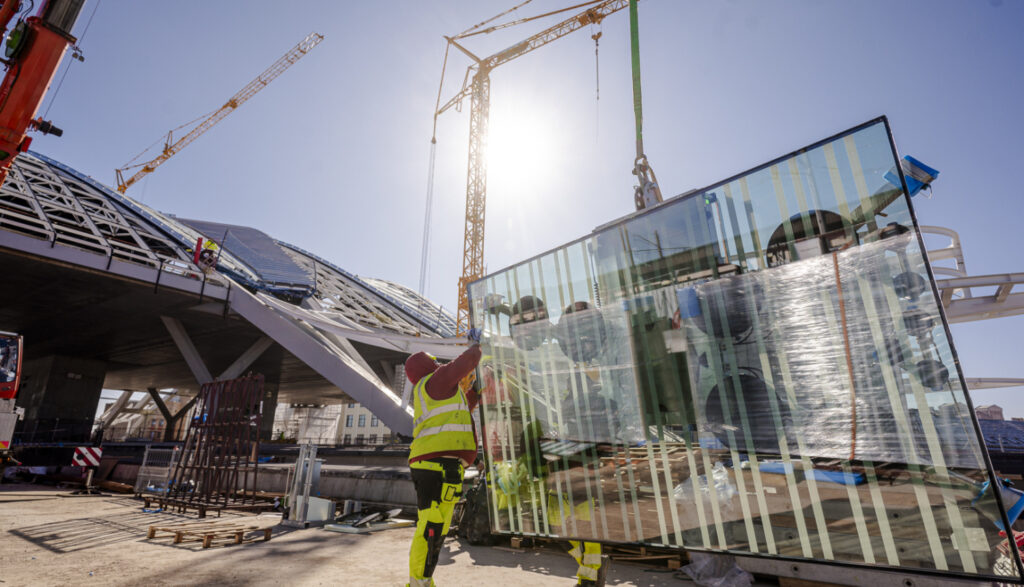
In December 2024, the Latvian government changed Rail Baltica priorities because the project no longer had funding for everything. According to the service investigation discussed by the Cabinet last Tuesday, that decision should have stopped or at least forced a new political confirmation for several controversial works, including the viaduct near RIX Riga Airport.
Last Tuesday, the Cabinet was told that the construction had nevertheless continued.
It had continued through 2025 and into 2026, inside a public project chain financed by EU funds and Latvian state co-financing. And it had continued in one of the most visible places in Latvia: on the road to the country’s main airport.
By the time the government discussed the service investigation, the airport structure was not only visible. It had already become a public symbol.
In March 2026, journalist and producer Pauls Timrots mocked the Rail Baltica construction near Riga Airport as “the world’s most pointless concrete pyramid”. The phrase was not a technical assessment. It was a symptom. For many project critics, the structure had stopped looking like a future rail connection and had started to look like a monument to a project whose sequence no longer made sense.
The political issue is therefore not only that works continued. It is that they continued in plain sight.
From the moment the government changed Rail Baltica priorities in December 2024 until this week’s admission that “builders had proved stronger than politicians” in parts of the project, Latvia’s political leadership had almost a year and a half to notice what was happening near Riga Airport.
The works were not hidden. Ministers, senior officials and members of government continued to use RIX Riga Airport during that period. Each trip to or from the airport meant passing one of the most visible Rail Baltica construction sites in the country: the airport viaduct, its structures, machinery, traffic changes and diversions.
Yet until this week, the continued construction did not appear to be treated as a political problem.
This makes the current surprise difficult to sustain. The viaduct was not discovered by the service investigation. The investigation only revealed the administrative chain behind a structure that had long been standing in public view.
How much money was already tied to Riga?
The airport viaduct was not an isolated object. It was part of a wider Riga funding problem.
As the available Rail Baltica funding proved insufficient for the full Latvian scope, already-started Riga objects — Riga Central Station, the airport section and the connection between them — required additional allocations, reallocations and national co-financing.
In late 2024, the Ministry of Transport proposed reallocating €114.63 million to Rail Baltica-related works in the southern part of Riga Central Station, so the station could be used for passenger transport before the full completion of Rail Baltica. A wider reallocation proposal also envisaged directing €419.49 million towards the Rail Baltica section in Riga and railway passenger infrastructure modernization.
In 2024–2025, additional sums were also approved or discussed for the Riga objects and related project costs: €33.306 million for the Riga Central hub and Riga Airport station part, €3.34 million for Latvia’s co-financing costs for RB Rail, and €29.252 million for works to ensure a rail connection between Riga Central Station and Riga Airport.
These figures do not mean that all the money went into one viaduct. But they show the scale of the Riga commitment. By the time the government was discussing whether controversial works should have continued, Riga’s Rail Baltica objects were already financially difficult to stop.
| Riga-related funding item | Amount |
|---|---|
| RRF reallocation to Rail Baltica works in southern part of Riga Central Station | €114.63m |
| Wider EU funds reallocation proposal for Riga Rail Baltica section and passenger infrastructure modernization | €419.49m |
| Additional state funding for Riga Central hub and Riga Airport station part | €33.306m |
| Ministry of Transport internal reallocation for RB Rail co-financing | €3.34m |
| Riga Central Station–Riga Airport rail connection works | €29.252m |
Estonia and Lithuania: delivery risk, not the same problem
The regional contrast is now hard to avoid.
Lithuania and Estonia also face delays, cost pressure and funding risks. Rail Baltica is difficult everywhere. But their current problem is different.
Estonia is arguing about delivery. Lithuania is arguing about delivery. Latvia is arguing about control.
Lithuania is moving the Kaunas–Panevėžys section forward and preparing the line towards the Latvian border. Estonia has more than 100 km of mainline under construction and is working through its own legal and environmental delays on the southern section.
Neither country is free of risk. But the visible political question there is how to complete the corridor.
In Latvia, the question has become more basic: who controlled the sequence of construction at all?
Two years ago, Estonia’s prime minister joked that Estonia could continue building Rail Baltica in Latvia if needed. At the time, it sounded like Baltic political humour.
After the airport viaduct dispute, it reads less like a joke.
Data card: Rail Baltica progress across the Baltics
| Country / layer | What has been done / is under way | What comes next | Main risk |
|---|---|---|---|
| Lithuania | 114 km of the Kaunas–Panevėžys section are under construction or contracted; preparatory and construction works are under way, with track superstructure works already started on the most advanced 9 km section. | Design and preparation continue towards the Latvian border; work is also under way on the Polish border–Kaunas corridor modernization. | Delivery and funding risk, but the focus is still on building the main north–south corridor. |
| Estonia | Over 100 km of mainline are under construction; major works are advancing around Ülemiste and on sections towards Pärnu. | Continue construction towards the Latvian border and keep the 2030 operational target in place. | Environmental/legal delays and funding pressure, but the problem is mainly delivery. |
| Latvia | More than 200 km of mainline outside Riga are covered by construction contracts, but only around 30 km are actively under way; Riga Central Station and the airport connection are progressing in parallel. | Build the southern section towards Lithuania, resolve the northern continuation towards Estonia, and address critical links such as the Salaspils / Daugava reservoir crossing. | Not only delay, but sequencing and control: visible Riga-hub fragments advanced while the continuous 1435 mm corridor remains incomplete. |
| Regional operation layer | Elron, Vivi and LTG Link have launched a joint procurement for up to 20 Rail Baltica regional electric trains compatible with 1435 mm European gauge and up to 200 km/h. | Estonia plans 5 trains plus an option for 2; Latvia may acquire up to 5; Lithuania up to 8. | The region is preparing for trains, while Latvia still lacks a continuous European-gauge route through its territory. |
The region is already preparing for trains
The contrast becomes sharper when the operational layer is added.
The passenger railway companies of Estonia, Latvia and Lithuania have already launched a joint procurement for Rail Baltica regional trains. The tender covers up to 20 electric trains for the future European-gauge network: Estonia initially plans five trains with an option for two more, Latvia may acquire up to five, and Lithuania up to eight.
In other words, the region is already preparing for rolling stock.
But Latvia will not be able to run those trains through its section unless the continuous European-gauge corridor is actually completed.
Even the much-discussed Riga Central Station–Riga Airport connection is no substitute for that. Latvia’s interim airport link relies on a 1520 mm broad-gauge solution between Riga Central Station and Riga Airport, using the existing railway network and a new link from Imanta to the airport before the European-gauge Rail Baltica line is completed.
That means the airport viaduct may stand next to a future Rail Baltica station, but it does not solve the core problem. It does not give Latvia a completed European-gauge north–south corridor. It does not allow Rail Baltica regional trains to run from Lithuania to Estonia through Latvia. And it does not immediately turn the new airport infrastructure into a functioning part of the 1435 mm Rail Baltica system.
The absurdity is therefore not only visual.
It is operational.
Late 2025 already showed the gap
This was not invisible in late 2025.
At that point, the regional Rail Baltica narrative could still be described as a divergence of schedules. Estonia was discussing annual investments of €500–600 million through 2030 and presenting the railway as operational within five years. Lithuania was advancing its construction sections. Latvia was already seen as the weaker link on timing.
That was already a warning sign.
But the Latvian issue now looks deeper than a slower construction schedule. It is no longer only a question of whether Latvia can build its section by 2030 or closer to 2035.
It is a question of whether the state controlled the sequence of construction at all.
Visibility is not connectivity
The airport viaduct is not politically damaging because it is made of concrete. It is damaging because it exposes the gap between construction and connectivity.
The structure was visible. The money was public. The government decision had already been taken. Yet the sequence continued as if visibility itself created progress.
It did not.
Rail Baltica is not a monument project. It is a corridor project.
If Lithuania and Estonia are moving towards tracks, border connections and future trains, while Latvia is still trying to establish who controlled the construction sequence at one of its most visible sites, then the question is no longer only whether Latvia is late.
The question is whether Latvia can still manage the part of Rail Baltica on which the whole Baltic corridor depends.
Latvia may have built the most visible object.
But visibility is not connectivity.
And until Latvia can connect its borders, its gauges and its construction priorities, the airport viaduct near RIX will remain a symbol of the wrong thing built at the wrong speed.