Baltic Focus Week Map
Baltic Focus Week Map, 8–14 June 2026: the week’s key Baltic economic signals in numbers.
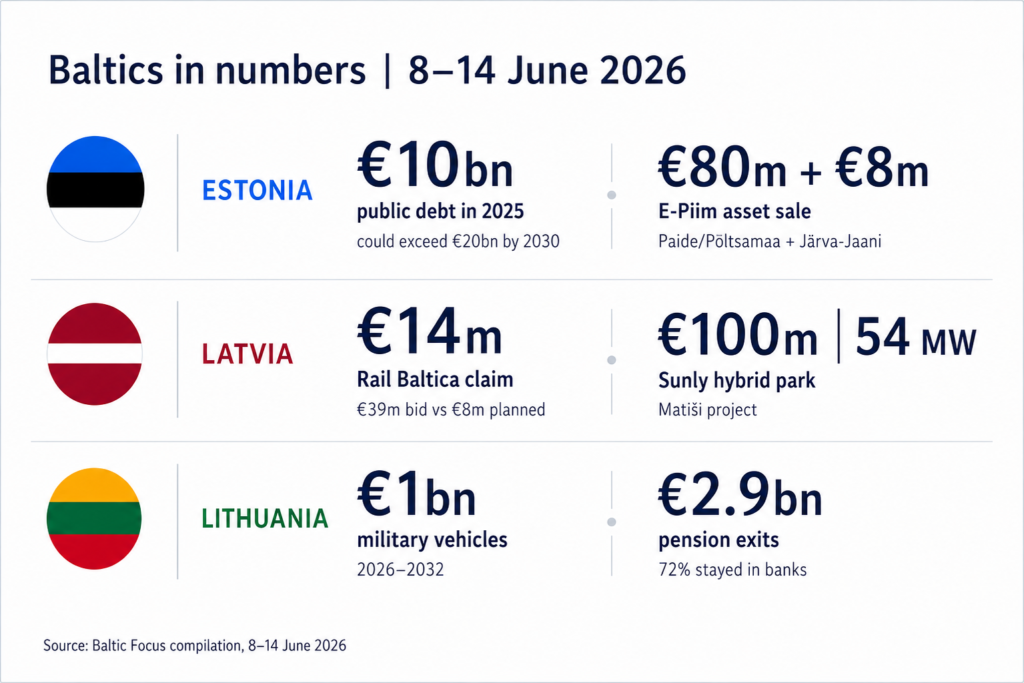
8–14 June 2026
Week overview
The week of 8–14 June shifted several coordinates on the Baltic economic map at once: capital became more expensive, fiscal pressure more visible, regulation moved closer to business operations, and infrastructure projects exposed both ambition and execution risk.
The ECB’s 25 basis point rate increase set the financial background for credit, IPO demand, fleet financing and infrastructure costs. OECD and IMF messages added pressure: Estonia faces debt and tax-reform questions, Latvia is pushed toward healthcare, public-administration and tax-base efficiency, while Lithuania’s growth is supported by consumption, defence spending and one-off pension withdrawals.
The strongest map coordinates came from infrastructure and strategic sectors. Rail Baltica Latvia moved deeper into procurement risk; Sunly’s €100m, 54 MW hybrid park showed energy capital following grid and permitting conditions; Lithuania’s €1bn military vehicle contract pointed to defence as a multi-year logistics and maintenance market.
Food, logistics and household finance added the sector layer. E-Piim’s dairy assets entered sale, Balticovo opened a €120m complex, Girteka cut losses while revenue fell, and Lithuania’s second-pillar pension exits released €2.9bn, mostly still held in banks.
Regional signals
Cost of capital
The ECB raised its three key interest rates by 25 basis points. From 17 June, the deposit facility rate moves to 2.25%, the main refinancing rate to 2.40%, and the marginal lending rate to 2.65%.
For the Baltics, this sets the financial background for the week. Credit, IPO appetite, mortgage demand, fleet financing, infrastructure costs and corporate borrowing all become more sensitive to capital costs.
OECD and external diagnosis
OECD and IMF messages pointed to different pressure points across the Baltic economies.
In Estonia, the fiscal warning is becoming more visible: public debt rose from about €2.5bn in 2019 to around €10bn in 2025, and could exceed €20bn by 2030 if the trajectory is not corrected.
In Latvia, OECD messaging focused on healthcare, public administration and tax-base efficiency. The business signal is not one reform, but the state’s capacity to finance higher spending while keeping the tax and regulatory environment workable.
In Lithuania, the outlook remains more resilient, but growth is supported by consumption, defence spending and one-off pension withdrawals. That makes household balance sheets and fiscal capacity part of the same map.
Baltic capital market
The three Baltic states and the EBRD signed a memorandum on developing a more integrated Baltic capital market.
The signal is regional, not symbolic. The Baltics are trying to become more readable as one market for capital. The test will come through IPOs, liquidity, cross-border investment and SME access to financing.
Estonia
Government, regulation and legislation
Beneficial ownership access
Estonia plans to restrict public access to beneficial ownership data from mid-July. Under the planned model, access would remain possible for justified users, including authorities, AML and anti-corruption actors, transaction checks and journalism or public-interest reporting.
Applicants would need to explain why they need the data. The draft regulation was open for feedback until 16 June, with entry into force planned for 10 July.
The signal is wider than media freedom. It affects corporate transparency, due diligence and investor checks, especially where Estonian companies are owned through foreign structures.
Central bank and macro-financial signals
Public debt trajectory
Eesti Pank highlighted IMF concerns about Estonia’s fiscal trajectory. The numbers are the key point: public debt increased from about €2.5bn in 2019 to around €10bn in 2025, and could exceed €20bn by 2030.
The IMF also expects Estonian growth of around 2% in 2026, while inflation is projected at 4.3%.
Estonia still has a relatively strong fiscal reputation, but public debt, defence spending and the tax base are now investor-relevant watch items.
Offline card payments
Eesti Pank and major supermarket chains tested offline card payments during the national defence exercise ILVES 2026.
The signal is small but practical: payment-system resilience is becoming part of civil-defence infrastructure. The goal is that people can still buy food, medicines and fuel during internet outages, IT failures or cyberattacks.
Crypto-asset services
Assets of licensed Estonian crypto-asset service providers fell 42% year-on-year.
Together with Lithuania’s Bifinity/Binance exit, this points to a Baltic crypto and fintech market being filtered by regulation and market pressure.
M&A and major companies
E-Piim asset sell-off
Bankrupt E-Piim Tootmine began the sale of major dairy-processing assets.
The Paide and Põltsamaa cheese factories have a starting price of €80m. The Järva-Jaani dairy processing plant has a starting price of €8m. The Paide factory can process up to 1,200 tonnes of raw milk per day, and E-Piim exported more than 90% of its production in 2025.
Interest has been reported from Estonia, Finland, the Netherlands, Lithuania and Germany.
This is a Baltic dairy-capacity item with pan-European buyer interest. The buyer will show whether the asset remains local, moves into a Baltic or Nordic structure, or attracts wider European consolidation.
Energy, infrastructure, industry and agriculture
Sunly: Estonian capital builds in Latvia
Estonian renewable-energy company Sunly is investing €100m in a 54 MW hybrid energy park near Matīši in northern Latvia. The project combines solar generation, wind turbines and battery storage.
The park is expected to supply around 15,000 households. Sunly says its total investment in Latvia, together with other parks, will reach €200m.
Sunly frames Latvia as attractive for large energy projects because of grid capacity, permitting and local support. The wider signal is that Baltic energy capital follows execution conditions, not just national origin.
Latvia
Government, regulation and legislation
New Immigration Law
Latvia adopted a new Immigration Law covering entry, residence, employment, integration and return procedures.
The business angle is third-country labour, employer compliance, education institutions, startup and investor channels, and stricter investor-permit conditions.
A softer investor-permit proposal was rejected. The supported route is tied to at least €150,000 invested for at least five years through a state-created alternative investment fund manager, plus a €10,000 payment to the state budget.
The law is therefore not only a migration or security story. It changes the compliance and labour-access environment.
Diesel excise
The coalition supports keeping the reduced diesel excise rate until the end of 2026.
The temporary reduction lowered the diesel excise rate from €467 to €396 per 1,000 litres. The measure matters for transport, agriculture and logistics cost structures.
Insolvency administration reform
Latvia is liquidating the Insolvency Control Service from 1 October 2026 and redistributing its functions between the Ministry of Justice, Court Administration and the insolvency administrators’ association.
This is a legal-infrastructure signal for creditor and debtor procedures.
Central bank and financial stability
Deposit Guarantee Fund
Latvijas Banka reported that active management added €6m to the Deposit Guarantee Fund in 2025.
The fund stood at €302m at the end of 2025 and almost €315m by June 2026. Amendments supported by Saeima set a new target of 3% of total deposits in Latvian credit institutions and credit unions, expected to be reached in 2027.
This is a banking-sector safety-net and financial-stability signal.
M&A and major companies
LAU Infra IPO
LAU Infra Group opened subscriptions for the first IPO of a state-owned company in Latvia.
The offer includes up to 6.4 million shares at €1.57 per share, with listing planned on the Nasdaq Riga Baltic Main List. The Latvian state will keep at least 75.01%.
LAU Infra works in road construction, road maintenance, mineral materials and defence infrastructure.
The IPO is a test of Latvian capital-market appetite and investor interest in infrastructure and defence-linked exposure.
Balticovo investment
Balticovo opened a new production complex in Iecava worth around €120m.
The complex includes 3 broiler houses, 12 laying-hen houses and a sorting facility. It is designed for almost 2 million birds and can produce around 1.7–1.8 million eggs per day.
Balticovo reported €161.55m turnover and €35.95m profit in 2025.
The investment points to food-production scale, cage-free transition and commercial adaptation ahead of full regulatory pressure.
Brīvais vilnis buys Saare Kala Tootmine
Latvian fish processor Brīvais vilnis acquired Estonian fish processor Saare Kala Tootmine from Saaremere Kala.
The reported transaction value was around €2m. The seller is using proceeds in the context of debt restructuring.
This is a Latvia-led cross-border food-processing consolidation signal.
Energy, fuel, infrastructure, industry and agriculture
Rail Baltica arbitration
Spanish firms IDOM and INECO have taken Latvia and RB Rail to ICC arbitration over the terminated Riga-section design and supervision contract.
The consortium is seeking more than €14m. Latvia has filed a counterclaim for a €3.37m contractual penalty.
The sharper signal is procurement risk. After the termination, the replacement tender failed: the planned contract value was around €8m, while the only bid was around €39m.
This is not another generic Rail Baltica delay. It is a contract-governance, procurement and cost-control risk signal.
Lithuania
Government, regulation and legislation
Social Climate Fund
Lithuania’s Social Climate Fund plan totals €884m for 2026–2032.
The plan includes €663m from the EU and €221m in national co-financing. Around €440m is planned for transport and €422m for housing-related measures.
The money is linked to housing renovation, public transport, electric buses and vehicles, bicycles, cycling infrastructure and regional mobility.
This is not only social policy. It is a pipeline for municipal infrastructure, retrofit work and transport investment.
Platform work and algorithmic labour
Lithuania is preparing to transpose EU platform-work rules.
The issue matters for gig-economy models, algorithmic pricing and labour classification. It is relevant for platform companies and labour-market compliance.
Protected area
Lithuania created the 320 ha Strėvininkai botanical-zoological reserve in Kaišiadorys district.
The reserve includes 118 private land plots, mostly forestry land. Owners are expected to receive compensation for economic-activity restrictions.
This is a small land-use and forestry-regulation signal.
Central bank and macro-financial signals
Second-pillar pension withdrawals
After more than 500,000 people left Lithuania’s second-pillar pension system, residents received €2.9bn in payouts.
According to Bank of Lithuania data, 72% of the withdrawn money — more than €2bn — was still held in bank and credit-institution accounts in April. Around €450m was withdrawn in cash. About €160m went to repaying housing and consumer loans. Only around €30m went into third-pillar pension funds and investment life insurance.
The key story is not an immediate consumption boom. It is the split between deposits, cash withdrawals, debt repayment and weak return into long-term investment products.
M&A and major companies
Girteka
Girteka Group reduced its 2025 net loss 2.3 times to €12.41m, while consolidated revenue fell 9% to €1.31bn.
The group continues to finance fleet renewal and expansion. Recent financing includes a €173m loan from OP Corporate Bank’s Lithuanian branch and a €74m loan from Germany’s AKA Bank to buy 1,200 new-generation trucks.
Girteka says it operates around 6,000 trucks and 7,000 semi-trailers, delivers about 600,000 cargoes across Europe annually, and had 11,670 employees at year-end.
The signal is that European road freight remains under margin pressure, while Baltic logistics scale is still being financed by banks. The question is whether bank-financed fleet renewal remains comfortable if freight margins stay weak and capital costs rise.
Bifinity / Binance
Bifinity, linked to Binance, is exiting Lithuania under MiCA and licensing pressure.
The company did not receive the crypto-asset service provider licence required under the new regime. In 2024, Bifinity generated €123.98m in revenue and €62.2m in net profit, and was among major Lithuanian taxpayers.
Lithuania’s fintech reputation is meeting a stricter crypto-licensing filter.
Avia Solutions Group / Helisota
Avia Solutions Group is liquidating Helisota, its Kaunas-based helicopter-maintenance company.
Helisota stopped servicing Russian helicopters after Russia’s full-scale invasion of Ukraine in 2022. The company now has 3 employees, down from about 30 a year earlier. In 2025, revenue fell to €75,000, while the company posted a €1.5m net loss.
The case is small, but it shows how the exit from Russian and Soviet helicopter maintenance affected a legacy aviation-services niche.
Energy, fuel, infrastructure, industry and agriculture
Military vehicles
Lithuania signed a military vehicle procurement contract worth about €1bn.
The contract covers military SUVs and lorries, with deliveries planned for 2026–2032.
Defence demand is becoming a logistics, maintenance and supply-chain market.
Jonava Defence Hub
A Canadian-backed company plans a defence-industrial and logistics park near Jonava and Rukla.
The potential investment scale is up to €500m. The site covers around 180 ha and could create 200–500 jobs.
The project is not yet a confirmed investment. It still depends on zoning, environmental assessment, design and permits. But it shows Lithuania trying to build defence geography, not only buy equipment.
Electricity prices
Lithuania’s average wholesale electricity price rose 41% month-on-month in May to €82.33/MWh. Latvia’s price rose 43% to €82.26/MWh, while Estonia’s rose 11% to €60.26/MWh.
Lithuania produced 103% of its own electricity demand in May, yet prices still rose sharply. Prices ranged from –€13.55/MWh to €330.53/MWh in 15-minute trading intervals.
Domestic generation does not equal price insulation. Weather, interconnectors, hydro, regional flows and market structure still matter. The mechanism behind this divergence was covered in our May electricity analysis.
Gas flows
Lithuanian gas consumption fell to 1.1 TWh in May, down 8% year-on-year.
At the same time, flows to Latvia through Kiemėnai rose 39% to 1.6 TWh, supported by Inčukalns storage filling and lower imports through Finland’s Inkoo LNG terminal. Klaipėda LNG remained the main source, with about 2.8 TWh delivered in May.
This shows Lithuania’s role as a regional gas node, not only a national gas market.
Feed shortage
Lithuanian farmers warned about feed-shortage risks after late spring, frosts and lower fertiliser use.
One cattle farmer reported that the first grass harvest was about half of last year’s level. Farmers expect at least one-third less grass overall.
This is an early food-chain pressure signal. It may affect livestock margins, milk production and next-year crop expectations.
Sources of information
This Week Map is based on official data, central-bank releases and reporting from public and business media in Estonia, Latvia and Lithuania.