Estonia: recovery returns as the funding model shifts
The central bank expects the economy to expand by 2.4% in 2026, supported mainly by stronger spending from households and the general government.
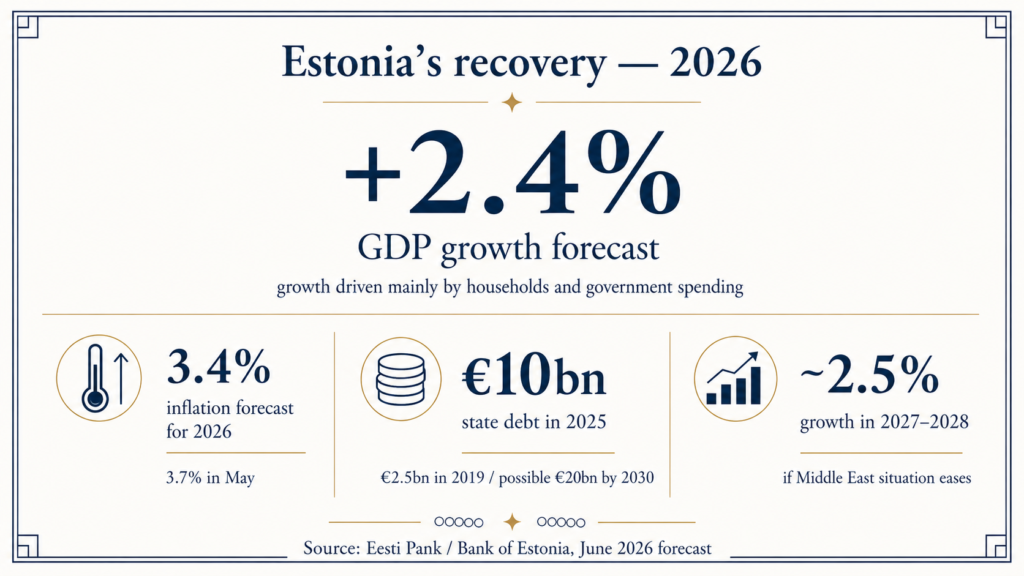
Eesti Pank’s latest forecast shows Estonia moving back into growth. The central bank expects the economy to expand by 2.4% in 2026, supported mainly by stronger spending from households and the general government. If the situation in the Middle East eases, growth could remain at around 2.5% in 2027–2028.
That is a recovery, but not yet a simple investment-led rebound. Eesti Pank’s message is more cautious: short-term demand is improving, but lasting growth will depend on productivity, investment and the ability of companies to move towards higher value added. Tax changes are increasing household net income, and public spending is supporting domestic demand. The question is whether this turns into a broader private investment cycle.
The first structural issue is public debt. Estonia still has a stronger fiscal position than many European economies, but its previous advantage is narrowing. State debt was around €2.5bn in 2019, had grown to €10bn by 2025, and the Ministry of Finance estimates it could reach €20bn by 2030. Eesti Pank links this not only to fiscal discipline, but also to investment confidence. Businesses are less likely to commit to long-term investment if they do not know what future tax increases or spending cuts may be needed to stabilise public finances.
Inflation is no longer the same type of shock as in 2022, but it remains exposed to external risks. Consumer price inflation reached 3.7% in May, partly reflecting higher energy prices after the outbreak of war in the Middle East. Eesti Pank expects inflation at 3.4% in 2026 and around 2.5% in the following two years. The bank also notes that without tax rises, inflation in recent months would have been around 2%. This makes the current inflation picture mixed: partly domestic and tax-related, partly linked to external energy and geopolitical conditions.
The financial-stability layer is where the Estonian case becomes more interesting. Eesti Pank does not describe an immediate banking problem. The banks remain liquid and well capitalised. Liquid assets were 27% of banking-sector assets at the end of February, and Eesti Pank’s liquidity stress test suggests that banks could withstand at least 60 days without additional liquidity.
The signal is not liquidity stress. It is a shift in the funding model of credit growth.
Loans to domestic households and companies grew by 8% year-on-year in February, while deposits grew by just over 4%. The resident loan-to-deposit ratio has moved above one. In the euro area context, a ratio slightly above 100% is not unusual; the aggregate ratio for significant banking institutions was also just above 100% at the end of 2025. What matters in Estonia’s case is the direction: credit is growing faster than the domestic deposit base. Eesti Pank’s conclusion is clear: local deposits are no longer sufficient to fund local lending.
This does not make Estonia an outlier. It does show that the country’s credit growth increasingly depends on a broader funding mix: intragroup funding, covered bonds, unsecured bonds and foreign deposits. For banks with Swedish parent groups, intragroup funding remains important. Other banks use bond markets or deposits from other EU countries. Several banks also operate through foreign branches, where they both issue loans and take deposits.
The regional point should be read carefully. Eesti Pank notes that for Estonian banks operating through foreign branches, Lithuania and Latvia account for half of non-resident deposits. This does not prove that deposits raised in Latvia or Lithuania directly finance lending in Estonia. Banking balances do not work as a simple one-to-one route from one country’s deposits to another country’s loans. The more defensible conclusion is narrower: the funding geography of Estonian banking groups is partly regional, and the scale of that channel needs to be checked against absolute deposit and loan positions by country.
Latvia and Lithuania also matter on the asset side. Loans to companies and households in those two countries account for around 27% of the aggregate loan portfolio of Estonian banking groups. Eesti Pank also notes rapid loan growth in both markets. This does not yet prove a single Baltic credit cycle; Latvia and Lithuania need their own separate review. But it does mean that the risk map of Estonian banking groups is already wider than Estonia alone.
Real estate is the main domestic risk channel. Commercial real estate and housing should not be mixed into one story, but both matter for banks. On the commercial side, lending to real estate and construction companies has grown quickly, and these loans made up 49% of the corporate loan portfolio of banks in Estonia at the start of 2026. Eesti Pank also notes that the amount of commercial property standing empty has increased, which can weaken the cash flow of real estate companies.
Housing is a different channel. Housing loans continue to grow quickly, and household indebtedness has started to rise. Current loan quality remains strong, so this is not a story about present repayment stress. The issue is forward-looking: if housing credit continues to grow faster than incomes and household buffers, the repayment burden can become more important in the next phase of the cycle.
There is also a policy twist. Estonia’s 2026 tax-free income reform was not designed as a housing-credit measure, but it increases net incomes and therefore borrowing capacity. Eesti Pank estimates that the reform may increase the volume of new housing loans by 6.1%, with the strongest effect among households with net income of €1,000–1,999 per month. In practice, an income-tax measure can also support housing demand. This is not a problem by itself, but it is relevant in a market where housing loans are already growing fast.
Geopolitical risk enters the Estonian story through funding conditions. Eesti Pank notes that after the outbreak of war in the Middle East, activity in primary bond markets used by banks for funding stopped sharply, several planned bond issues were postponed, and bond yields increased. The market later partly recovered, and covered bonds remained more stable than unsecured bonds. The point is not that geopolitical risk has stopped Estonia’s credit cycle. It has affected the price, timing and planning of the funding on which that cycle increasingly depends.
This is the central transition in the Estonian case. Estonia is recovering, but the recovery is running through a more complex financial structure than before: stronger domestic demand, rising public debt, faster credit than deposit growth, external funding, real estate exposure and regional banking links.
For Baltic Focus, the key signal is not drama. It is structure. Estonia’s banks remain resilient, and a loan-to-deposit ratio above one is not in itself exceptional in Europe. But the direction matters. Estonia’s credit growth is becoming less purely domestic in its funding base and more exposed to the conditions of external and regional finance. Latvia and Lithuania should be analysed separately, but Eesti Pank’s review already shows why they cannot be treated as background only: they are part of the balance-sheet geography of Estonian banking groups.