Baltic retail split widened in May as Lithuania pulled ahead and Estonia slipped
May retail data show a widening split inside the Baltic consumer market.
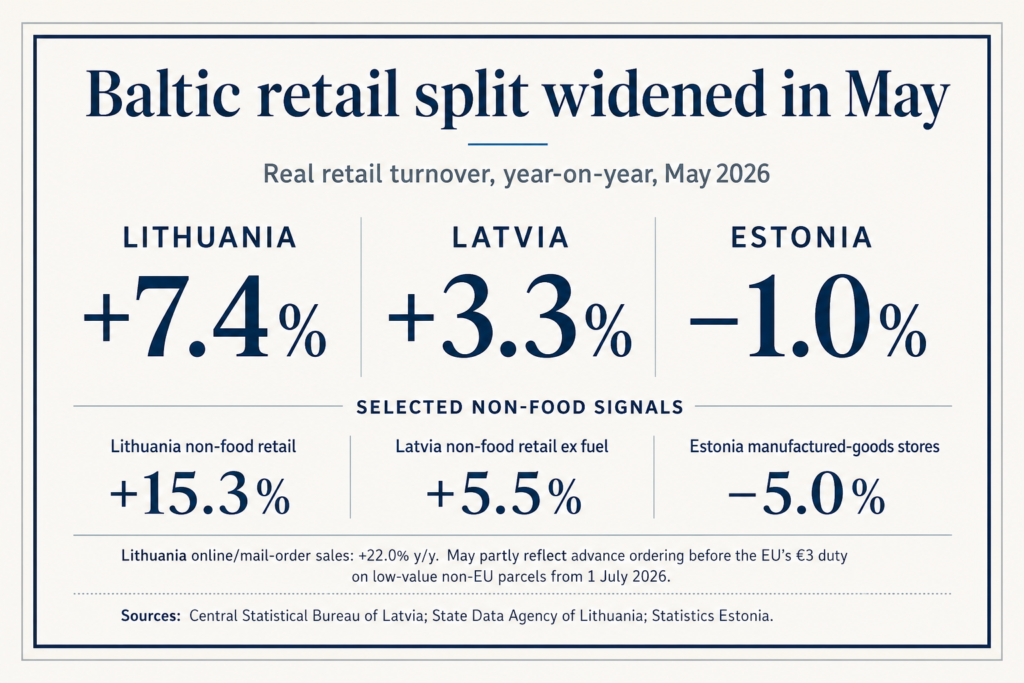
May retail data show a widening split inside the Baltic consumer market.
Lithuania remained the strongest of the three markets. Retail turnover rose by 7.4% year-on-year in real terms, with non-food retail up 15.3%. Latvia also stayed in positive territory, but with a more moderate 3.3% annual increase. Estonia moved in the opposite direction: retail trade volume fell by 1% year-on-year after growth earlier in the year.
The clearest signal is not a Baltic-wide consumer boom, but a split in retail momentum.
Baltic retail, May 2026 — real year-on-year change
Lithuania: +7.4%
Latvia: +3.3%
Estonia: −1.0%
Selected non-food signals
Lithuania non-food retail: +15.3%
Latvia non-food retail excluding fuel: +5.5%
Estonia stores selling manufactured goods: −5.0%
The difference is sharpest outside basic food sales. In Lithuania, non-food retail remained in double-digit growth, while mail-order and internet sales rose by 22.0% year-on-year. Latvia’s non-food retail also grew, but at a more restrained 5.5%, with online and mail-order sales up 12.3%. In Estonia, by contrast, stores selling manufactured goods saw turnover volume fall by 5%.
Lithuania’s online figure needs a customs-policy footnote. From 1 July 2026, the EU applies a temporary €3 customs duty to low-value e-commerce consignments from outside the EU. Some advance ordering before the change may have lifted online and mail-order sales, especially in categories exposed to platforms selling low-cost imported goods.
That makes the next data releases important. If Lithuania’s online retail growth slows sharply after the duty takes effect, part of the May surge may have been front-loaded demand. If it remains strong, the signal would point more clearly to resilient discretionary consumption and a stronger Lithuanian retail cycle.
Fuel sales add another distinction. In Latvia and Lithuania, automotive fuel retail declined year-on-year in real terms. Estonia reported growth among fuel-retail enterprises, but Statistics Estonia notes that this category includes more than fuel itself, such as food service and other goods or services sold by those companies.
For now, the May retail map is clear enough: Lithuania is still pulling ahead, Latvia is growing but more cautiously, and Estonia’s recovery looks less stable. The Baltic consumer market is no longer moving as one block.
Sources: Central Statistical Bureau of Latvia, State Data Agency of Lithuania, Statistics Estonia, Council of the EU.