Who Eats Baltic Sprat and Cod: Baltic Consumers or Export Markets?
On 26 October 2026, EU fisheries ministers reached a political agreement to increase Baltic sprat catches by 44% next year. Latvia, Lithuania and Estonia are set to receive a combined quota of more than 88,000 tonnes. But the Baltic fishing industry serves far more than local consumers. Its catches supply export markets, food processors and manufacturers of fishmeal and fish oil, while the sea’s depleted cod populations remain subject to scientific advice calling for zero catches.
The agreement, reached in Luxembourg, still requires formal adoption. Its main provisions, however, are settled.
The EU’s total allowable catch of sprat will rise from 201,975 tonnes in 2026 to 291,590 tonnes in 2027. The central Baltic herring quota will increase by 71% to 165,228 tonnes, while the Gulf of Riga herring limit will rise by 11% to 38,183 tonnes.
Ministers also rejected European Commission proposals to reduce permitted bycatch of eastern and western Baltic cod.
The agreement raises two questions: how much fish can the Baltic Sea sustain, and who stands to benefit from the additional catches?
Who receives the quotas?
Latvia, Lithuania and Estonia together account for approximately 30.3% of the EU’s agreed sprat quota for 2027.
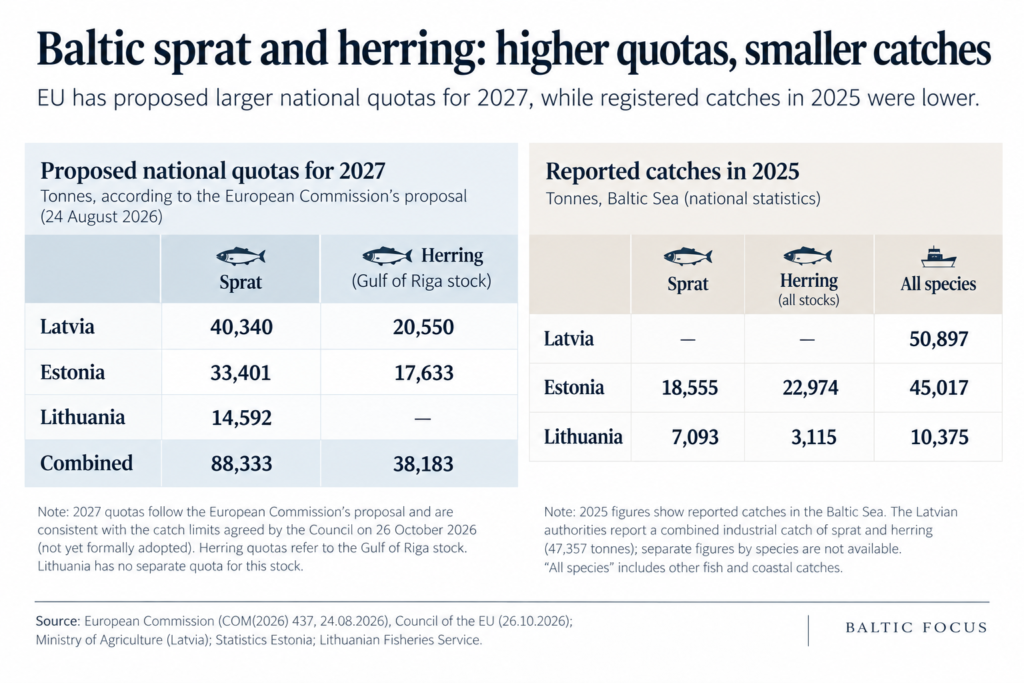
The proposed national allocations are:
| Country | Sprat, 2027 | Gulf of Riga herring, 2027 |
|---|---|---|
| Latvia | 40,340 t | 20,550 t |
| Estonia | 33,401 t | 17,633 t |
| Lithuania | 14,592 t | — |
| Combined | 88,333 t | 38,183 t |
These figures follow the European Commission’s proposed distribution. The Council accepted the same overall limits for both stocks, although the regulation has yet to be formally adopted.
Latvia holds the largest sprat quota of the three countries, followed by Estonia and Lithuania.
Yet a national quota says little about where the fish eventually goes. Fishing rights are allocated to commercial operators, and catches may be landed, processed or sold in another country.
How much Baltic fish is actually caught?
Official statistics for 2025 provide a baseline for comparing national fishing activity.
| Country | Baltic Sea catch, 2025 |
|---|---|
| Latvia | 50,897 t |
| Estonia | 45,017 t |
| Lithuania | 10,375 t |
| Combined | 106,289 t |
These figures cover fishing in the Baltic Sea, including coastal waters, but exclude distant-water operations.
Latvia and Estonia have Baltic fisheries of broadly similar size, while Lithuania’s catch is considerably smaller.
In Estonia, fishermen caught 18,555 tonnes of sprat and 22,974 tonnes of Baltic herring in 2025.
Lithuanian vessels caught 7,093 tonnes of sprat and 3,115 tonnes of herring, alongside approximately two tonnes of cod.
In Latvia, vessels operating outside the coastal zone caught 47,357 tonnes of sprat and herring combined — approximately 93% of the country’s total Baltic catch.
Small pelagic fish therefore dominate the Baltic fisheries of all three countries. But national catch statistics do not reveal where the fish is ultimately consumed.
Coastal fishermen or industrial fleets?
The distinction matters because the fishing industry is often presented as a single economic sector.
At the end of 2025, Latvia’s Baltic fleet comprised 626 coastal boats and 36 larger vessels operating outside the coastal zone.
The coastal boats landed approximately 2,575 tonnes of fish during the year, compared with 48,321 tonnes caught by the larger vessels.
In other words, 36 vessels accounted for roughly 95% of Latvia’s Baltic catch, while the much more numerous coastal boats contributed about 5%.
The difference is particularly striking for sprat: only 18 tonnes of Latvia’s 2026 national quota were allocated to coastal fishing.
Industrial vessels also account for the overwhelming majority of sprat catches in Estonia and Lithuania.
This does not imply that industrial fishing companies are necessarily owned by large outside investors. Some are locally owned businesses or fishermen’s cooperatives. It does, however, show that the commercial interests associated with pelagic fishing quotas extend well beyond small coastal operators.
Where does the fish go?
Baltic catches move through a regional trading and processing network that crosses national borders. Lithuania offers a particularly clear example.
Lithuania: sprat for Denmark and Estonia
Lithuania’s Fisheries Service publishes detailed information on the destinations of Baltic catches sold through foreign ports.
Of approximately 7,093 tonnes of sprat caught by Lithuanian vessels in 2025, the principal first-sale destinations were:
| Destination | Sprat, 2025 |
|---|---|
| Denmark — Skagen | 3,762 t |
| Estonia — Dirhami, Mõntu, Rohuküla and Saaremaa | 2,531 t |
| Latvia — Liepāja and Ventspils | 650 t |
| Sweden — Västervik | 149 t |
Almost the entire reported catch was sold outside Lithuania.
Denmark received approximately 53%, followed by Estonia with 36%.
Crucially, these are figures for sprat caught in the Baltic Sea, not for Lithuania’s much larger distant-water fishing industry.
The records establish where the fish was landed and initially sold, although they do not trace every subsequent transaction.
Denmark is a major European producer of fishmeal and fish oil, and Baltic sprat is among the raw materials supplying that industry.
Estonia: frozen exports and fishmeal production
Estonia combines frozen fish exports with industrial processing.
According to Statistics Estonia, the country exported approximately 14,660 tonnes of frozen sprat in 2025, with Ukraine and Latvia among its main destinations.
In Paldiski, Eesti Kalatootjate Keskühistu operates a fishmeal and fish oil factory owned by fishing cooperatives. The facility processes approximately 40,000 tonnes of raw material annually, mainly Baltic sprat and herring.
Annual production includes around 7,000 tonnes of fishmeal and 3,000 tonnes of fish oil.
Its products reach customers in the EU and markets including Ukraine, the United States, Turkey and South Korea.
The factory illustrates how fishermen’s cooperatives can combine access to fishing rights with industrial processing, producing ingredients for international feed manufacturers rather than fish for direct human consumption.
Latvia: traditional processing and regional supplies
Latvia has a long-established industry producing smoked, salted and canned fish, including traditional Baltic sprat products.
Unlike fisheries primarily supplying fishmeal factories, Latvian sprat fishing has historically been oriented towards food processing. Much of that production, however, serves foreign markets rather than domestic consumers.
Latvia also receives fish caught by neighbouring fleets.
Statistics Estonia identifies Latvia as a major destination for frozen sprat exports, while Lithuanian fishing records confirm deliveries to Liepāja and Ventspils.
These flows point to Latvia’s possible role as a regional processing and distribution centre. Yet the available figures do not establish how much imported Baltic sprat is processed locally, consumed domestically or exported again.
Nor can Latvia’s total seafood export figures answer that question, since the industry also handles imported and non-Baltic raw materials.
One fish, several statistical records
Cross-border trade creates a risk of double counting.
Fish caught by a Lithuanian vessel may appear in Lithuania’s catch statistics, another country’s landing records and, later, in processing or export statistics.
These figures represent different stages of the supply chain and cannot be added together to calculate the total amount removed from the Baltic Sea.
Catch statistics measure extraction from the marine resource. Trade and processing data describe the economic activity that follows.
From Baltic sprat to aquaculture
Sprat is an important raw material for European fishmeal and fish oil production.
According to EUMOFA, a substantial proportion of EU sprat catches is used for industrial purposes rather than direct human consumption. Denmark is a major processing centre, while Latvia and Poland retain significant food-processing industries.
The supply chain also extends to aquaculture.
Norwegian feed producer Skretting identifies Baltic sprat among the raw materials used in fishmeal and fish oil, including ingredients supplied from Denmark.
Baltic sprat can therefore enter the production chain for farmed salmon and other aquaculture products.
This does not mean that all Baltic sprat is destined for animal feed. It does establish that industrial feed production is an important market alongside traditional food processing.
What do scientists and conservation groups say?
The higher sprat quota is consistent with scientific advice from the International Council for the Exploration of the Sea (ICES).
Strong recruitment in recent years has improved the stock’s outlook, and the agreed catch level falls within the permitted management range.
Conservation organisations question whether these improvements justify a rapid increase in fishing pressure, particularly given sprat’s role as prey for larger fish.
The disagreement was evident in recommendations submitted through the Baltic Sea Advisory Council.
The Latvian Fishermen’s Association advocated an EU sprat quota of 299,330 tonnes, near the upper end of the permitted range.
WWF, Coalition Clean Baltic, BalticWaters and other environmental organisations supported a limit of no more than 228,234 tonnes.
Some representatives of small-scale fisheries also favoured more cautious catch levels, citing uncertainties in stock forecasts.
The debate is not simply between fishing and conservation. It concerns how much risk should be accepted when recent improvements in a fish stock have yet to establish a sustained recovery.
Cod presents a different and more severe problem.
ICES recommends zero catches of both eastern and western Baltic cod. Targeted fishing remains prohibited, but the Council retained bycatch allowances of 430 and 266 tonnes, rejecting the Commission’s proposals to reduce them to 211 and 31 tonnes respectively.
Bycatch refers to fish caught unintentionally while targeting another species. For fishing operators, retaining these allowances reduces the risk that incidental cod catches will force restrictions on other commercial fisheries.
For conservation organisations, the decision maintains fishing pressure on populations that remain severely depleted.