EU review exposes gaps in Baltic building renovation plans
The European Commission has flagged conflicting climate targets in Lithuania, an €8.23 billion gap between Estonia’s renovation cost estimates and Latvia’s plan to defer more than 80% of investment until after 2040.
The European Commission has reviewed the Baltic states’ draft national plans for renovating residential and commercial buildings by 2050. The plans set out the scale and cost of renovation, proposed sources of financing, energy efficiency targets and measures to phase out fossil-fuel heating.
The assessments, published on 30 October, reveal significant gaps between ambition and implementation. Lithuania has conflicting climate targets, Estonia presents two different estimates of renovation costs, while Latvia expects more than 80% of its investment needs to arise after 2040.
Lithuania: the largest programme, but conflicting targets
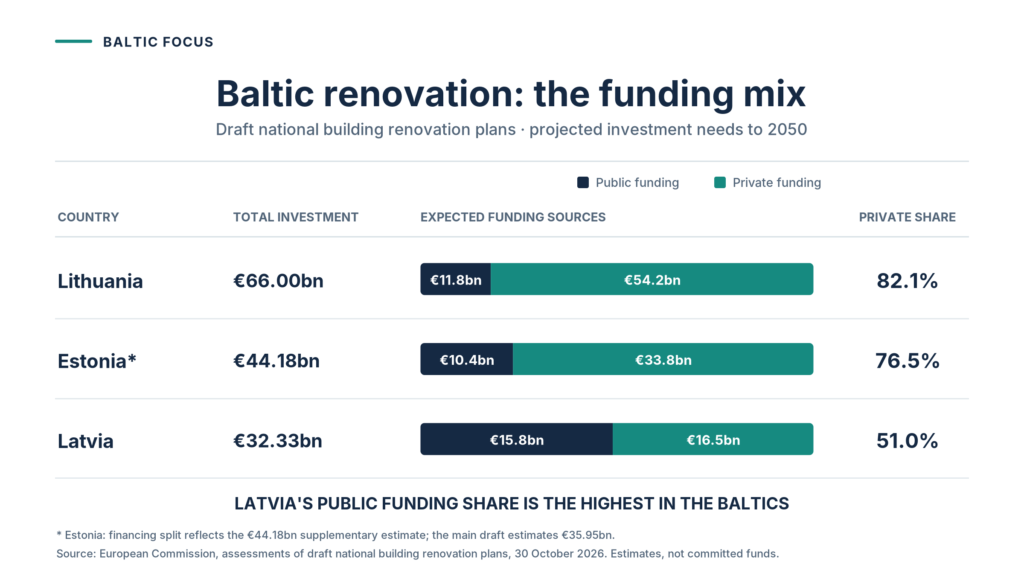
Lithuania estimates that building renovation will require €66 billion between 2026 and 2050. Around 82% of this investment is expected to come from private financing.
The Commission considers Lithuania’s financial framework relatively well developed but identifies a fundamental inconsistency in the country’s climate targets.
The draft renovation plan envisages a 41% reduction in greenhouse gas emissions from buildings by 2050, compared with 2020 levels. Lithuania’s national energy and climate plan, however, calls for full decarbonisation of the sector.
The two documents also differ on energy efficiency. The renovation plan targets a 45% reduction in primary energy consumption by 2050, against 60% in the national energy and climate plan.
Lithuania must therefore reconcile its targets and demonstrate how its investment programme will deliver the country’s long-term climate objectives.
Estonia: an €8 billion discrepancy in renovation costs
Estonia’s draft renovation plan puts total investment needs at €35.95 billion between 2026 and 2050. Yet an accompanying spreadsheet gives a substantially higher estimate of €44.18 billion, a difference of €8.23 billion.
Most of the discrepancy concerns non-residential buildings.
The Commission calls for the figures to be reconciled and for clearer links between proposed measures, expected results and available budgets. It also seeks clarification of energy performance standards for non-residential buildings.
The supplementary spreadsheet assumes €10.4 billion in public funding and €33.8 billion in private financing. These figures correspond to the higher investment estimate, rather than the amount presented in the main draft.
The discrepancy does not necessarily indicate a funding shortfall. It does, however, leave uncertainty about the financial assumptions behind Estonia’s long-term renovation programme.
Latvia: €32 billion programme faces a delivery challenge
Latvia estimates that renovating its building stock will require €32.33 billion by 2050, covering nearly 98,000 residential and 39,000 non-residential buildings.
Unlike Lithuania and Estonia, Latvia expects almost half of the investment to come from public funding, predominantly EU funds. Private financing is expected to cover the remaining 51%.
The Commission finds that Latvia has identified potential funding sources but has not developed a sufficiently detailed strategy for mobilising them. The plan itself acknowledges constraints on public budgets, limited household purchasing power and difficulties accessing long-term credit.
There are also questions about the cost estimates. Latvia assumes an average renovation cost of approximately €440 per square metre, based on recent apartment-building projects. The calculations do not account for inflation or additional costs that may arise from implementing EU building energy requirements.
The central issue, however, is the timetable. Latvia expects the overwhelming majority of its renovation investment to take place in the final decade before 2050.
Deferred investment: most of the spending lies beyond 2040
All three Baltic states expect most of their renovation investment needs to arise after 2040, although the extent varies considerably.
Lithuania projects cumulative investment of €22.7 billion by 2040, leaving approximately 66% of its €66 billion programme for 2041–2050.
Estonia’s main draft envisages €16.3 billion by 2040, implying that around 55% of its €35.95 billion investment requirement falls in the final decade.
Latvia stands out. Its cumulative investment needs reach just €710 million by 2030 and €6.32 billion by 2040. That leaves approximately €26 billion, or more than 80% of the total, for 2041–2050.
The planned renovation rates reflect this concentration of activity. Latvia expects its annual residential renovation rate to increase from 0.25% in 2027–2030 to 7.5% in 2046–2050, partly through wider use of industrialised renovation technologies.
The Commission questions whether the proposed measures provide a sufficiently convincing basis for such rapid acceleration.
For construction companies, equipment suppliers, financial institutions and property owners, these investment trajectories matter. They indicate not just the potential size of future renovation markets, but when demand might materialise.
The figures remain projections rather than firm spending commitments. In Latvia’s case, the unusually steep increase planned for the 2040s makes the timing of that demand particularly uncertain.
Fossil-fuel boilers: Lithuania is further ahead
The Commission also examines how the Baltic states intend to phase out fossil-fuel boilers, including heating systems that burn natural gas, with 2040 serving as the EU’s indicative target date.
Lithuania has the most developed approach of the three countries. Its draft includes measures to replace 50,000 fossil-fuel boilers by 2030 and install 11,305 heat pumps between 2025 and 2030.
The Commission considers these measures broadly credible and consistent with Lithuania’s other energy policies. However, it remains unclear what proportion of the existing boiler stock they will cover and how the remaining fossil-fuel systems will be replaced.
Estonia also plans to move away from fossil-fuel heating and provides financial incentives for cleaner alternatives. But the Commission asks for a clearer timetable for the complete phase-out, including an estimate of the proportion of boilers that would still burn fossil gas in 2040.
Latvia faces a similar requirement. Its existing measures support the replacement of fossil-fuel heating systems with biomass boilers, heat pumps and district heating connections. Nevertheless, the Commission finds that these measures do not yet amount to a comprehensive national roadmap.
It wants Latvia to establish intermediate milestones, quantify the expected reduction in fossil-fuel boilers and identify how many would remain in use by 2040.
The distinction is important. EU legislation requires countries to develop credible policies for phasing out fossil-fuel heating, but the 2040 date is indicative rather than a binding deadline requiring every existing gas boiler to be removed.
The Commission is therefore asking Estonia and Latvia to demonstrate how they intend to manage the transition, rather than enforcing an already adopted national timetable for replacing individual heating systems.
The Baltic signal: ambitious programmes, uncertain delivery
The Commission’s assessments reveal three different weaknesses in the Baltic countries’ renovation strategies.
Lithuania has the largest investment programme and a relatively developed financing framework, but its long-term climate targets are not fully aligned. Estonia still needs to reconcile conflicting cost estimates. Latvia has a smaller programme, but the most heavily back-loaded investment profile and the greatest reliance on public funding.
The differences also extend to heating policy, with Lithuania presenting more concrete replacement measures while Estonia and Latvia still need to develop detailed phase-out roadmaps.
The national investment estimates are based on different building stocks and assumptions and should not be treated as directly comparable measures of market opportunity.
All three countries must submit their final building renovation plans by 31 December 2026.
For investors, contractors and policymakers, the central question is no longer simply how much the Baltic states intend to spend on renovation. It is how much of that investment can realistically be financed, when it will reach the market, and whether governments can turn long-term targets into projects ready for implementation.