Is the Baltic Gas Market Ready for Winter?
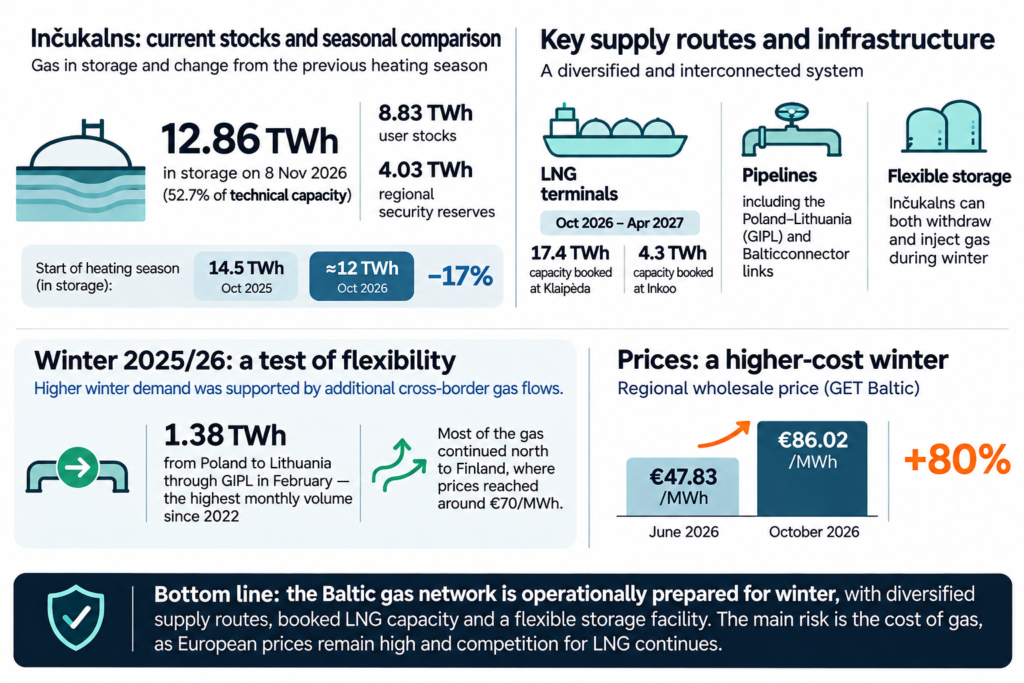
In the Baltic states, preparations for winter have traditionally been judged by one figure: the amount of natural gas stored at Inčukalns in Latvia. On 8 November 2026, the underground facility held 12.86 TWh, equivalent to 52.7% of its technical capacity. The total included 4.03 TWh of regional security reserves, with another 8.83 TWh held by storage users.
Stocks were lower at the start of this heating season than a year earlier: approximately 12 TWh compared with 14.5 TWh in October 2025. Yet the regional gas infrastructure enters winter with several established supply routes, and the previous cold season demonstrated how effectively they can support one another when demand rises.
Gas supplies to the Baltic states now depend on an interconnected system stretching from Poland to Finland, with LNG terminals providing access to international suppliers and pipelines carrying gas across national borders. Inčukalns remains its principal storage facility, but it is no longer the only measure of the region’s readiness for winter.
The supply network has already proved its ability to respond to periods of unusually high demand. The greater uncertainty this winter lies in the cost of obtaining gas, with European prices rising sharply before the heating season has fully begun.
A cold winter and a changing market
The winter of 2025/26 brought prolonged cold weather and increased gas demand across the Baltic states and Finland. January and February accounted for 7.3 TWh of withdrawals from Inčukalns, 19% more than a year earlier.
According to Conexus Baltic Grid, 12.36 TWh was withdrawn over the entire season. At the same time, another 4.5 TWh was injected, as traders used the facility’s ability to switch between withdrawal and injection. By the end of the heating season, stocks stood at just over 6.4 TWh.
The regional network handled the additional demand without a reported supply shortfall. One of the clearest examples of its flexibility came from the Polish-Lithuanian border.
In February, 1.38 TWh of gas entered Lithuania from Poland through the GIPL pipeline, the largest monthly volume recorded in that direction since the connection opened in 2022. According to Lithuanian transmission operator Amber Grid, most of the gas continued north to Finland, where prices had reached around €70/MWh early in the month.
The price difference was large enough to make the journey commercially attractive despite the additional transportation costs.
The Polish connection thus provided additional supplies precisely when northern demand was particularly strong. The increased flows were not an emergency intervention but a commercial response to changing market conditions, made possible by the existing pipeline network.
The pattern was also unusual for the season. Traditionally, winter flows from Inčukalns have supplied Lithuania from the north. In February, however, 1.75 TWh moved in the opposite direction, from Lithuania into Latvia.
The episode demonstrated the value of a regional market in which gas can move towards demand rather than being tied to traditional seasonal routes.
From LNG ports to regional pipelines
Klaipėda and Inkoo are the principal maritime entry points for LNG into the Baltic-Finnish gas system. Poland provides another connection to European supplies through GIPL, while Balticconnector links Estonia and Finland.
At Klaipėda, business expanded strongly during the first half of 2026. KN Energies reported 20.9 TWh of LNG handled through regasification and reloading operations, 30% more than a year earlier. The terminal received 54 LNG carriers, compared with 43 in the corresponding period of 2025.
Its customer base also reflects the changing geography of demand. Alongside companies from the Baltic states, terminal services were used by customers from Poland, Ukraine and Norway. Ukraine’s Naftogaz and Finland’s Gasum secured long-term capacity for future years, extending the terminal’s commercial reach beyond its immediate neighbours.
Transmission figures from Amber Grid show how extensively Lithuania’s infrastructure is already being used.
During January–September, Klaipėda supplied 25.43 TWh to Lithuania’s gas transmission network, an increase of 18% year on year. Of the gas moving through Lithuania’s system, 12.86 TWh was transmitted to Latvia, up 28%.
The Polish connection was busy in both directions. Lithuania sent 2.39 TWh to Poland during the nine months, while 1.89 TWh arrived from Poland, more than three times the volume recorded a year earlier.
These movements reflect the growing importance of Lithuania as a regional gas transit hub, serving markets well beyond its domestic consumption. The route through Poland also provides access towards Ukraine, although transmission data do not identify the final destination of every shipment.
At the northern end of the system, Finland’s Inkoo terminal provides an additional source of flexibility.
Inkoo can supply up to 140 GWh of gas per day, while Balticconnector normally provides transmission capacity of 70.5 GWh per day towards Finland. During periods of high Finnish demand, the pipeline alone cannot cover the country’s needs. The terminal and Balticconnector therefore complement each other, allowing supplies to be adjusted according to market conditions.
This northern connection also gives Estonia access to gas arriving through Finland, while the pipeline network to the south links it with Latvian storage and LNG supplies entering through Lithuania.
International traders have organised their purchases around both ports.
Elenger, one of the region’s major gas suppliers, brought five LNG cargoes to Inkoo and Klaipėda during spring 2026. Three arrived in Finland and two in Lithuania. The company sourced its gas primarily from the United States and Norway.
By late June, Elenger reported that half of the gas required by its customers for the coming heating season had already arrived in the region, while contracts had been concluded for the remaining autumn deliveries. For a supplier operating across several national markets, securing gas months before winter provides greater certainty over volumes, even if the final cost remains exposed to international prices and contractual arrangements.
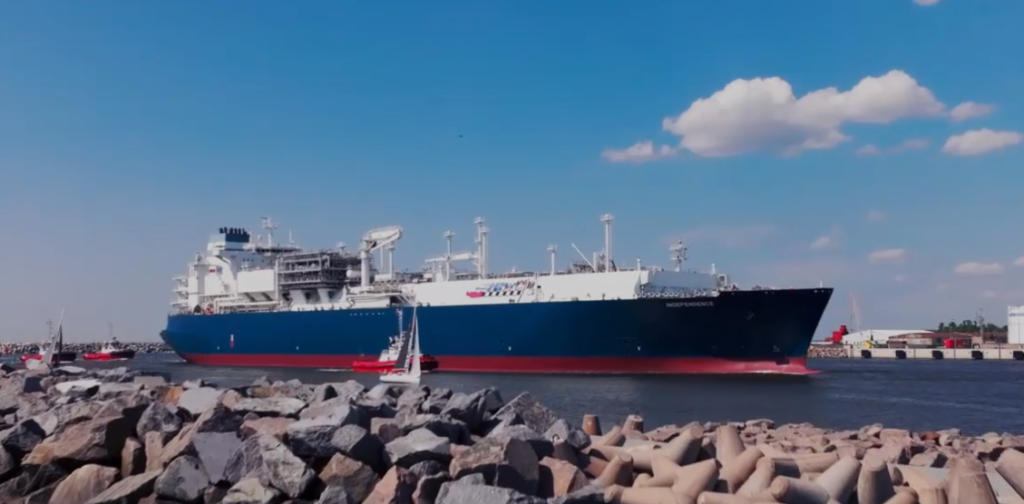
One of those shipments offers a particularly clear illustration of the supply chain. In April, the tanker Arctic Aurora delivered Norwegian gas purchased from Equinor to Klaipėda. From the floating terminal Independence, the gas was destined for Inčukalns through the Lithuanian and Latvian pipeline systems.
American LNG was also arriving directly at Inkoo. Elenger’s spring deliveries included the Marvel Swallow, showing how the Finnish port provides another entry point for transatlantic gas supplies.
For winter 2026/27, the wider regional market has already booked substantial LNG capacity. According to Amber Grid, 17.4 TWh of regasification capacity was reserved at Klaipėda and another 4.3 TWh at Inkoo for October–April. These are capacity bookings rather than confirmed deliveries, but they demonstrate how suppliers are preparing to use both terminals during the heating season.
Inčukalns enters a different kind of winter
The new withdrawal season officially began at Inčukalns on 15 October, with approximately 12 TWh in storage, compared with 14.5 TWh at the beginning of the previous season.
However, the traditional distinction between summer injection and winter withdrawal has become less rigid.
Following its modernisation, Inčukalns can accommodate additional injections during the winter, allowing traders to bring in gas when market conditions and available capacity permit.
Conexus has reported growing interest in booking winter injection capacity. Inčukalns is therefore serving not only as a seasonal reserve but also as a means of balancing supplies arriving through the wider network.
The first weeks of the season illustrated this flexibility. Despite the formal start of withdrawals, inventories continued to rise, reaching 12.86 TWh by 8 November.
The figure included 4.03 TWh of regional security reserves. These volumes form part of the physical gas stock but are subject to security-of-supply arrangements rather than ordinary commercial use. The remaining 8.83 TWh was held by storage users.
Winter injections are particularly relevant to the changing pattern of supply. LNG cargoes arrive according to shipping schedules and commercial contracts, while consumption fluctuates with temperature, electricity generation and industrial demand.
The possibility of adding gas during winter reduces the need to rely entirely on stocks accumulated in summer. It also makes the timing of LNG deliveries and pipeline availability increasingly important.
Still, the existence of several supply routes does not mean that every route can be used without restriction. Terminal capacity, maintenance schedules, pipeline bookings and transmission tariffs all influence where gas can move and how much the journey costs.
The price of winter security
While the Baltic region has several ways to obtain gas, it remains exposed to the international market.
European prices rose sharply during 2026 as disruptions to LNG supplies linked to the conflict in the Middle East tightened the market. Reduced Qatari exports increased Europe’s reliance on alternative suppliers, particularly the United States, while competition for available cargoes intensified.
According to the EU Agency for the Cooperation of Energy Regulators, the disruption added an estimated €18–33 billion to Europe’s gas import bill during the 2026 summer season.
For the Baltic market, which receives substantial LNG supplies from the United States and Norway, the main consequence is not direct dependence on Middle Eastern gas but exposure to the same international price pressures.
The increase was clearly visible in regional trading.
In the Latvia–Estonia gas market area, the monthly average calculated from published daily reference prices rose from €47.83/MWh in June to €86.02/MWh in October, an increase of almost 80%.
On 28 October, the Dutch TTF benchmark briefly exceeded €100/MWh in intraday futures trading, reaching a level last seen during the European energy crisis in 2022. Prices subsequently retreated, with the nearest futures contract closing at around €85.6/MWh on 6 November.
The Latvia–Estonia market followed a similar pattern. The daily reference price reached €99.26/MWh on 31 October and €101.35/MWh on 1 November before falling back to €87.57/MWh by 8 November.
The European storage situation adds another dimension to the price risk.
ACER reported that EU gas storage was 75% full on 21 October, below its historical average. The agency also found that the average cost of gas injected into storage during 2026 was the second highest in the past decade.
For the Baltic states, the implications extend beyond household heating bills. Higher wholesale gas prices also affect industrial consumers, gas-fired electricity generation and the wider cost of energy.
The region therefore enters winter in a stronger position than the traditional focus on Inčukalns alone might suggest. The previous cold season demonstrated that LNG terminals, pipelines and storage can operate together to meet rising demand. Operators have maintained that infrastructure, while suppliers have secured substantial LNG capacity and arranged further deliveries.
But lower storage stocks at the beginning of the season, higher international prices and competition for LNG leave the region exposed to further increases in energy costs.
The Baltic gas network is operationally prepared for winter, with several established supply routes and the flexibility to respond to changes in demand. What it cannot guarantee is affordable gas. After a year of sharply rising prices, that is the greater risk facing consumers and businesses across the region.