Central Europe Is Rerouting Gas. Will the Baltics Get a Share?
Gas transmission operators from Poland, Czechia, Slovakia and Hungary have agreed to develop more competitive gas transport routes and make better use of existing pipeline infrastructure as Central Europe adjusts to the loss of traditional Russian gas transit.
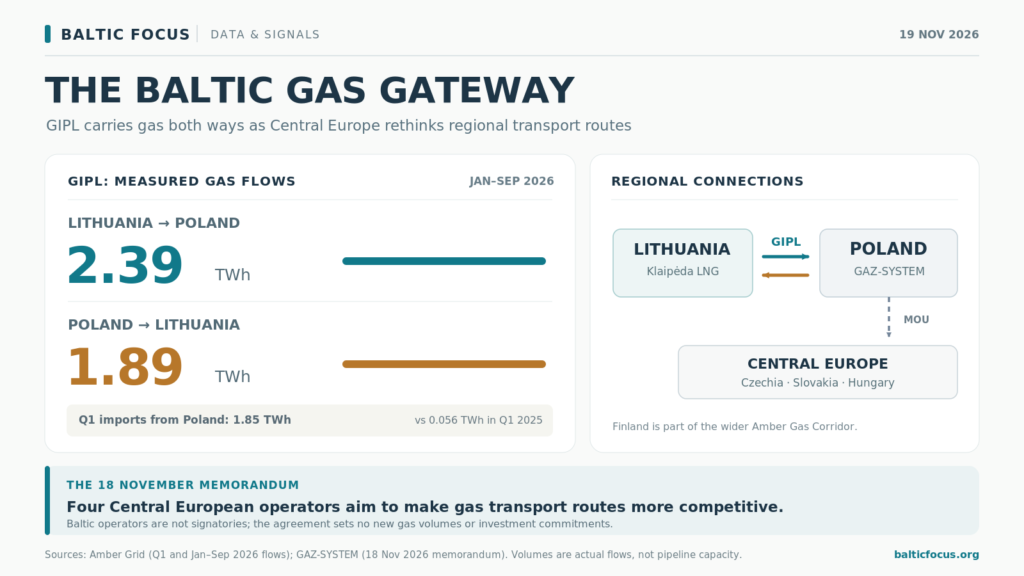
The memorandum, signed in Warsaw on 18 November by GAZ-SYSTEM, NET4GAS, Eustream and FGSZ, focuses on coordinating regional gas flows and improving access to alternative supplies, particularly LNG. The four operators intend to work within existing national tariff and regulatory frameworks. No specific volumes, investments or tariff reductions have been agreed.
The Baltic states already have a physical connection to this changing market. The Gas Interconnection Poland–Lithuania (GIPL), operating since 2022, can transport up to 21 TWh of gas annually from Lithuania to Poland.
Actual flows remain considerably smaller, but their direction has become more flexible. According to Amber Grid, Lithuania transmitted 2.39 TWh to Poland during January–September 2026, while 1.89 TWh flowed in the opposite direction, more than three times the previous year’s figure. During the particularly cold first quarter, flows from Poland to Lithuania reached 1.85 TWh, compared with just 56 GWh a year earlier.
The Baltic region is also developing its own commercial route. The Amber Gas Corridor links the LNG terminals in Klaipėda and Finland’s Inkoo with Baltic transmission networks, Latvia’s Inčukalns storage facility and Poland, providing access to markets further south, including Ukraine.
Transport costs are already part of this competition. Amber Grid’s published estimates indicate that transporting gas from Klaipėda to Ukraine using annual capacity bookings could cost €4.10/MWh in 2027, down from €4.69/MWh in 2026, excluding regasification charges.
The new four-country agreement does not include Baltic operators or guarantee additional flows through GIPL. Its significance for the Baltic market will depend on whether the region’s existing infrastructure and transport tariffs can attract more commercial traffic.
Separately, GAZ-SYSTEM signed a memorandum with Lithuania’s Amber Grid and KN Energies on protecting critical gas infrastructure, including LNG facilities and transmission networks. The companies plan joint work on physical security, cybersecurity, information exchange and emergency preparedness.