A drone brought down Latvia’s government — with a delay
Latvia’s government has collapsed five months before the next parliamentary election. Formally, Prime Minister Evika Siliņa announced her resignation after the coalition lost its political capacity to continue. In substance, the fall came after two shocks converged: a security crisis triggered by drone incidents in Latgale and a criminal investigation linked to state support for the wood-processing sector.
The immediate political crisis began after Defence Minister Andris Sprūds resigned, while Siliņa also announced that she had lost confidence in him. The decision followed drone incidents in Latgale and exposed a deeper conflict between Siliņa’s New Unity and the Progressives, Sprūds’ party. The Progressives then called on the president to start consultations on forming a new government, saying the cabinet had effectively lost its ability to act.
A second shock came on 14 May. Latvia’s anti-corruption authorities, acting on the instruction of the prosecutor’s office, detained Agriculture Minister Armands Krauze from the Greens and Farmers Union and Raivis Kronbergs, the former state secretary of the Agriculture Ministry and current head of the State Chancellery. They were detained for the duration of procedural actions in the so-called wood-processing case.
The criminal process concerns possible offences related to abuse of office and alleged inaction in connection with unlawful support to wood-processing companies. The issue is linked to price adjustments in long-term contracts with the state-owned company Latvijas valsts meži.
Siliņa suspended Krauze before signing her resignation, saying she could not tolerate any shadow of suspicion over ministers. At the same time, the agriculture portfolio was temporarily transferred to Economy Minister Viktors Valainis, also from the Greens and Farmers Union.
This is politically significant. The case hits ZZS, but it does not remove the party from control of the sector. The party is now both damaged and central.
ZZS parliamentary leader Harijs Rokpelnis has said that all sides would benefit from a new government, even with less than five months left before the election. He also said the party would not avoid responsibility if it were offered the chance to form a cabinet and if a parliamentary majority could be assembled.
The opposition is already testing a new coalition formula. Edvards Smiltēns from the United List has suggested that the core of a new government could be formed by the United List, the National Alliance and the Greens and Farmers Union.
But this is only a core, not a majority. Together, these three forces do not have enough votes in the 100-seat Saeima. They would need a fourth partner.
The most obvious fourth partner is New Unity, but Smiltēns has set a condition: not Evika Siliņa, and not New Unity as the leading force of the next cabinet. The National Alliance has already invited the United List and ZZS for initial talks. New Unity was not invited to the first meeting.
This means the crisis is no longer about whether Siliņa stays. That question has been answered. The real question is who controls the next political centre: New Unity in a reduced role, or a new axis built around the United List, the National Alliance and ZZS.
Under Latvia’s Cabinet Structure Law, the resignation of the prime minister means the resignation of the entire Cabinet. However, the current government will continue to perform its duties until the Saeima approves a new Cabinet, unless parliament decides otherwise and appoints temporary office-holders.
Latvian central bank governor Mārtiņš Kazāks has warned that the period of political instability must be as short as possible. His message was direct: Latvia cannot afford to waste the remaining five months before the election. The state still faces unresolved issues in security, military industry, public finances and pension policy.
For investors, the crisis does not mean a reversal of already approved projects. Latvia is not entering an institutional vacuum: ministries remain formally operational and existing commitments should continue. The risk is a mandate gap — a pause in new approvals and slower decisions on politically sensitive files, especially those requiring budget commitments, regulatory changes or clear ownership by a future majority. Some of the most sensitive economic decisions may now be pushed closer to the parliamentary election in autumn, or beyond it.
The drone did not bring the government down immediately. It broke the coalition first. The government fell with a delay.
Caption for the Saeima graphic:
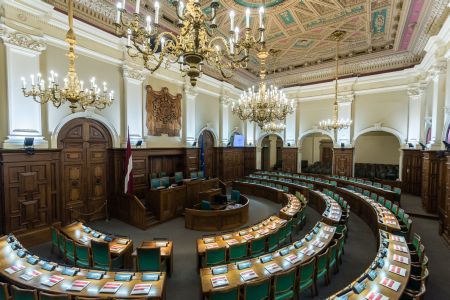
Latvia’s 14th Saeima: a new coalition requires not only a political agreement, but difficult majority arithmetic.