Autumn of Baltic Services: Job Cuts Behind the Investment Headlines

The Baltic states continue to attract international technology companies and business service centres. Yet some of the employers that helped establish the region’s reputation are now cutting staff. The reductions have continued for at least two years, often as part of wider international restructuring.
On 26 October, Latvia’s Investment and Development Agency (LIAA) announced the opening of Epson’s European Business Services Centre in Riga. The Japanese company invested €6 million and assembled a team of 134 employees to support operations across 25 European countries.
Three days later, Estonian-founded software company Pipedrive announced plans to eliminate 267 positions in Estonia, approximately 70% of its local workforce.
Both announcements belong to the same Baltic economy. International investment continues, but a succession of corporate announcements reveals a less visible development: established technology companies, banks and international service providers have been reducing their Baltic workforces.
The decisions vary in scale and have different explanations. Viewed over 2025–2026, however, they form a recurring pattern.
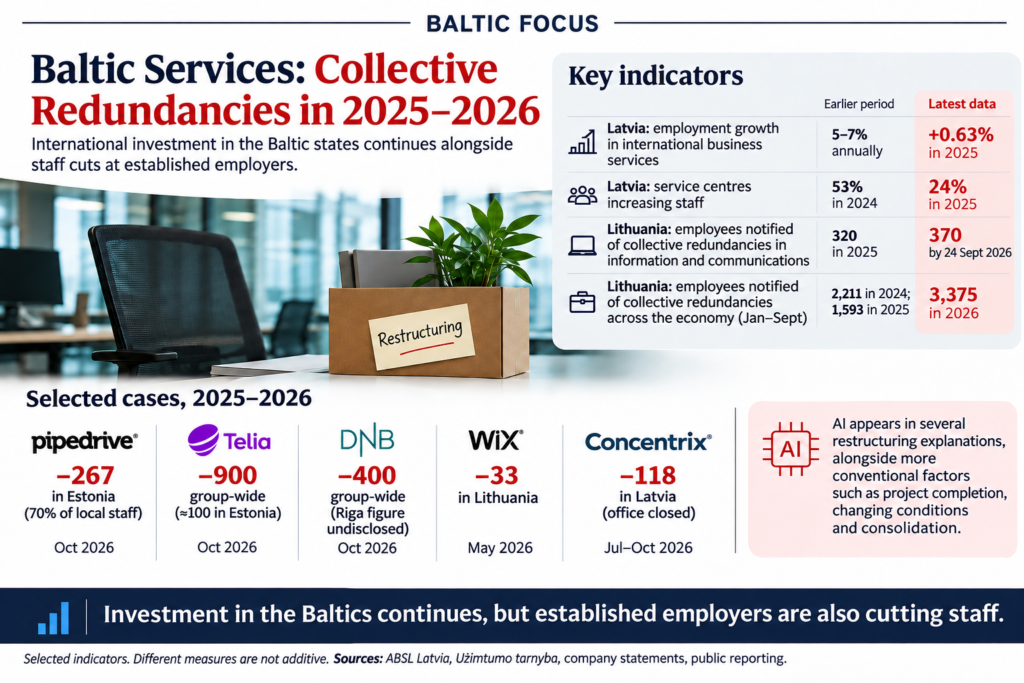
Employment growth slows as redundancies continue
The available statistics do not indicate a general collapse in employment. They show slower expansion in Latvia’s international business services industry, repeated collective redundancy notifications in Lithuania and substantial reductions at individual employers.
| Indicator | Earlier period | Latest data |
|---|---|---|
| Latvia: employment growth in international business services | 5–7% annually in preceding years | +0.63% in 2025 |
| Latvia: surveyed service centres increasing staff | 53% in 2024 | 24% in 2025 |
| Lithuania: employees notified of collective redundancies in information and communications | 320 in full-year 2025 | 370 by 24 September 2026 |
| Lithuania: employees notified of collective redundancies across the economy, January–September | 2,211 in 2024; 1,593 in 2025 | 3,375 in 2026 |
Sources: ABSL Latvia, Business Services Sector in Latvia 2026; Lithuania’s Employment Service (Užimtumo tarnyba), September 2026 Labour Market Report and ICT sector review. Indicators cover different populations and periods.
Latvia’s figures are particularly revealing. Its international business services industry employed approximately 20,000 people across 57 centres by March 2026. Employment growth had slowed almost to a standstill, although the sector remained economically significant.
The share of surveyed centres expanding their workforce fell from 53% to 24% in one year. Meanwhile, the proportion reporting staff reductions changed only slightly, from 17% to 19%. The most pronounced shift was therefore the loss of much of the previous hiring momentum.
Lithuania provides a different perspective. By late September 2026, collective redundancy notifications in information and communications had already exceeded their full-year 2025 level.
Across the Lithuanian economy, the number of employees warned of collective redundancies more than doubled year on year during January–September 2026. Yet overall employment continued to rise. On 1 October, Lithuania had approximately 1.47 million employed people, 10,700 more than a year earlier.
The corporate reductions have therefore not translated into a comparable deterioration in national employment figures.
Two years of workforce reductions
The current autumn wave follows a series of earlier announcements. Some companies have reported successive rounds of reductions rather than a single restructuring event.
| Employer | Period | Announced reductions or workforce change |
|---|---|---|
| Yolo Group, Estonia | September 2025 | 280 planned job cuts |
| Shift4 Payments Lithuania | March 2025 / August 2026 | 32 and 53 planned redundancies |
| Intrum Global Business Services, Lithuania | September 2025 / August 2026 | 33 and 76 planned redundancies |
| Wix.com, Lithuania | May 2026 | 33 planned redundancies |
| Concentrix, Latvia | July–October 2026 | 118 planned cuts in Daugavpils; office subsequently closed |
| DNB, Norway / Latvia | October 2026 | Around 400 positions group-wide; Latvian figure undisclosed |
| Telia Group | October 2026 | Around 900 positions group-wide, including approximately 100 in Estonia |
| Pipedrive, Estonia | October 2026 | 267 planned cuts, or 70% of local staff |
| Swedbank, Baltic states | October 2026 | Around 100 positions within a wider expected group workforce reduction |
Selected examples. The figures include announced redundancies and expected workforce changes, not exclusively completed dismissals. They are not directly additive.
Many of these employers belong to international groups, and some were previously promoted by Baltic investment agencies as examples of successful foreign investment. Their current workforce reductions, including those at DNB and Telia, are partly linked to restructuring programmes extending beyond the Baltic region.
Wix’s Lithuanian development operation forms part of an Israeli-founded international software business. DNB’s Riga office is an international service centre supporting the Norwegian banking group, rather than a bank serving Latvian customers.
Pipedrive is a distinctive case: founded in Estonia in 2010, it became one of the country’s best-known technology success stories and has been controlled by American private equity firm Vista Equity Partners since 2020. The planned reduction would leave about 113 employees in Estonia. There is no public confirmation that Vista initiated the cuts.
Other developments reinforce the picture. In Latvia, CCC Riga Digital Services entered liquidation proceedings in June 2026. Quarterly tax data show that its registered workforce had already fallen from 538 in the final quarter of 2025 to 417 in the second quarter of 2026, a reduction of 22.5%.
Some cuts have taken place at profitable businesses. Telia Lietuva’s workforce declined from 1,865 in September 2024 to 1,615 in September 2026, a reduction of 13.4%. During the first nine months of 2026, its net profit increased by 16.5% year on year.
The figures demonstrate that workforce reductions are not necessarily confined to financially distressed companies.
AI becomes part of the explanation
Artificial intelligence now features prominently in several corporate restructuring announcements, although its role differs.
DNB identifies AI as one factor in reorganising technology and internal processes. Telia Lietuva explicitly linked its January 2026 plan to reduce 59 technology positions with digitalisation and AI deployment. Pipedrive, in contrast, describes AI primarily as a force changing customer behaviour and the market for business software, rather than directly replacing employees.
Other employers cite more conventional factors: completed projects, changing business conditions, corporate consolidation or lost contracts.
The evidence does not establish how much of the overall workforce reduction is attributable to AI. What it does show is that the latest AI-related explanations accompany a sequence of staffing reductions already visible in 2025.
The other side of the investment story
The Baltic states have spent years attracting international technology businesses and service operations. Some of those companies are now reducing their local workforce, often within wider restructuring programmes that extend beyond the region.
The scale of these reductions has not fundamentally changed the regional labour market. Their recurrence over two consecutive years, however, has become a feature of the Baltic services economy that is increasingly difficult to overlook.