Investment fell, transport weakened: what Q1 GDP reveals about the Baltic economies
All three Baltic economies reported positive annual GDP growth. But the internal structure of that growth was uneven.
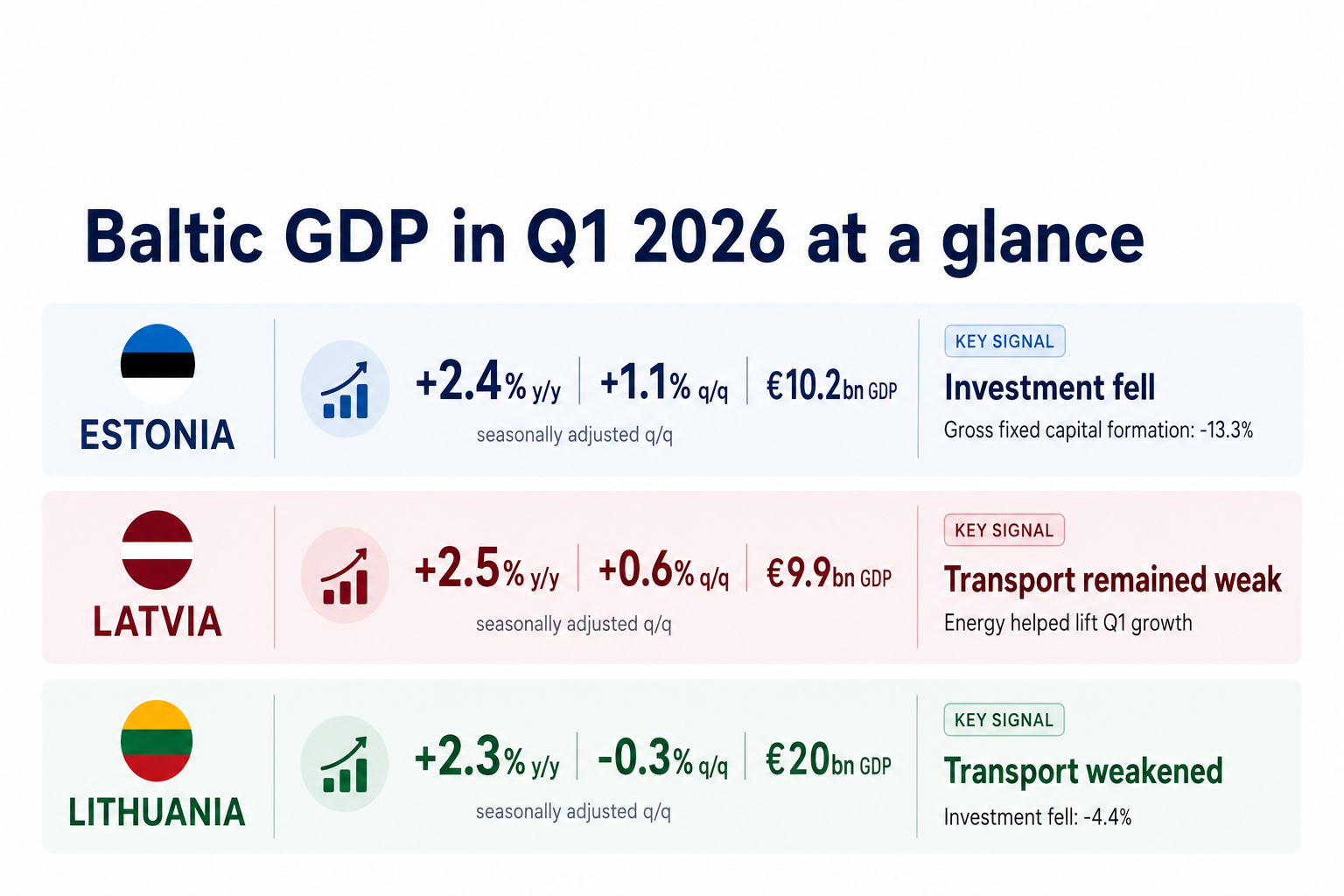
The Baltic economies entered 2026 with positive annual GDP figures, but the first-quarter data do not show one regional growth story. Estonia had the strongest quarterly momentum, Latvia’s growth was supported by energy, product taxes and trade, while Lithuania combined an active energy layer with weaker transport, construction, investment and exports.
The first quarter of 2026 did not produce a simple “Baltic growth” story.
All three Baltic economies reported positive annual GDP growth. But the internal structure of that growth was uneven. Estonia looked strongest in quarterly terms. Latvia’s result was supported by energy, product taxes and domestic trade. Lithuania still grew year-on-year, but its second GDP estimate showed a quarterly contraction and weaker signals from transport, construction, investment and exports.
This matters because the Baltic economies are often discussed as one regional block. The Q1 data show something more complex: three economies with different growth engines, but also some shared weak points.
Estonia: growth returned, but investment fell sharply
According to Statistics Estonia, Estonia’s GDP increased by 2.4% year-on-year in the first quarter of 2026. GDP at current prices reached €10.2 billion. Seasonally and working-day adjusted GDP rose by 1.1% compared with the fourth quarter of 2025.
Manufacturing was again the main driver of growth. Its value added rose by 7%, making it the largest positive contributor for the third consecutive quarter. Private consumption also improved, increasing by 4.2%, the fastest growth since the second quarter of 2022. Government final consumption rose by 4.8%, partly influenced by defence expenditure.
But Estonia’s stronger headline came with a clear warning signal. Investment fell by 13.3%, and Statistics Estonia noted that first-quarter investment had not been this low since 2017.
The weakness was not limited to one sector. Investment declined in non-financial corporations, financial corporations and households. There was a particularly sharp fall in non-financial corporations’ investment in other buildings and structures, as well as weaker spending on machinery and equipment. Household investment in dwellings also declined.
That changes the reading of Estonia’s Q1 result. It was not a clean investment-led recovery. It was an output-and-consumption rebound with a capital formation problem.
Latvia: energy and taxes helped GDP, but transport remained weak
Latvia also reported positive first-quarter growth. According to the Central Statistical Bureau, real GDP increased by 2.5% year-on-year in unadjusted terms and by 0.6% quarter-on-quarter after seasonal and calendar adjustment. GDP at current prices stood at €9.9 billion.
The largest upward contribution came from electricity, gas, steam and air conditioning supply. Product taxes also supported GDP growth. The energy result was strongly affected by low temperatures in January and February, which pushed value added in electricity, gas, steam and air conditioning supply up by 41.6%.
This was a real GDP contribution, but not a structural growth signal in the same sense as trade, construction or investment. It should be read as a weather-sensitive support to the first-quarter number.
Latvia’s more durable picture was mixed. Wholesale and retail trade, real estate and construction supported value added. Construction increased by 2.8%, helped by infrastructure projects such as roads, bridges and power supply. Gross fixed capital formation rose by 3.2% year-on-year, and exports of goods and services increased by 1.4%.
At the same time, transport and storage declined. That matters because logistics, ports, transit flows and regional services are not marginal parts of Latvia’s economic map. In Q1, Latvia’s GDP was positive, but one of the country’s key regional interface sectors remained weak.
Lithuania: an energy node, but a weaker quarterly GDP structure
Lithuania showed the most contradictory first-quarter picture.
The State Data Agency’s second estimate put Lithuania’s GDP at current prices at €20 billion. Annual growth remained positive: real GDP increased by 2.3% in unadjusted terms and by 2.6% after seasonal and working-day adjustment. But compared with the fourth quarter of 2025, seasonally and working-day adjusted real GDP fell by 0.3%.
Lithuania should not be read as a non-energy story. The country was an active energy node in the first quarter. Cold weather pushed up energy demand in the region, and Klaipėda LNG remained part of the Baltic gas supply layer. In January, gas supplied through the Klaipėda LNG terminal fully covered Lithuania’s natural gas consumption needs, according to Lithuania’s energy data review.
But that energy layer did not prevent a weaker GDP structure.
By production approach, the largest negative impact on Lithuania’s GDP change came from transport and storage and construction. By expenditure approach, household and government final consumption still increased, by 1.0% and 0.9% respectively compared with the previous quarter. But gross fixed capital formation fell by 4.4%, exports of goods and services declined by 1.0%, and imports increased by 0.3%.
This means Lithuania’s Q1 was not simply a transport story. It was also an investment story.
The country still had positive annual growth and an important regional energy role. But the quarterly structure showed pressure in several places at once: transport, construction, investment and exports.
Data Card — Baltic GDP, Q1 2026
| Country | Real GDP, y/y | Real GDP, q/q adjusted | GDP at current prices | Main signal |
|---|---|---|---|---|
| Estonia | +2.4% | +1.1% | €10.2bn | Manufacturing and consumption supported growth; investment fell sharply |
| Latvia | +2.5% | +0.6% | €9.9bn | Energy, product taxes and trade supported growth; transport remained weak |
| Lithuania | +2.3% unadjusted / +2.6% adjusted | –0.3% | €20bn | Energy layer active, but transport, construction, investment and exports weakened |
The common weak points are investment and transport
The Baltic GDP picture becomes clearer when the countries are not forced into one ranking.
Estonia had the strongest quarterly GDP momentum, but investment fell sharply. Lithuania also reported a decline in gross fixed capital formation. Latvia, by contrast, saw gross fixed capital formation rise in annual terms.
Transport tells a different regional story. Latvia and Lithuania both reported weakness in transport and storage, though in different contexts. In Latvia, transport declined while GDP was supported by energy, taxes, trade and real estate. In Lithuania, transport weakened alongside construction, investment and exports. Estonia was different: transportation and storage made only a small positive contribution to GDP growth, while investment was the larger warning signal.
Energy also needs a more careful reading. Latvia’s energy sector visibly lifted GDP value added in Q1, helped by colder weather. Lithuania’s energy role was also important, especially through winter demand and Klaipėda LNG’s supply function, but the official GDP estimate did not identify energy as the main positive driver in the same way. Energy security and GDP structure are related, but they are not the same thing.
Why it matters
The first-quarter data show that the Baltic recovery is real, but not yet fully structural.
Estonia is growing again, but not yet through a strong investment cycle. Latvia grew, but part of the result came from weather-sensitive energy demand and product taxes, while transport remained weak. Lithuania still showed annual growth and retained an important energy role, but the quarterly data exposed weaker transport, construction, investment and exports.
The strongest Baltic growth signal would be one where investment, transport, construction and exports start moving in the same direction.
Q1 did not show that yet.
Instead, it showed a region where headline GDP growth has returned, but the internal machinery remains uneven. Estonia’s weak point was investment. Latvia’s and Lithuania’s shared warning signal was transport. Lithuania also joined Estonia in showing weaker investment. And energy, while important in both Latvia and Lithuania, did not remove the broader question about the quality of growth.
For the next quarters, the key issue is not whether the Baltic economies can keep GDP positive on paper. The key issue is whether the growth becomes investment-backed, logistics-supported and export-capable — or remains dependent on consumption, taxes, weather-sensitive effects and separate sector rebounds.
Baltic Focus comparison of official Q1 releases from Statistics Estonia, Latvia’s Central Statistical Bureau and Lithuania’s State Data Agency; adjusted and unadjusted rates are identified separately.
Primary source
The economy grew for the fourth quarter in a row: GDP up by 2.4% in Q1
https://stat.gov.lv/en/statistics-themes/economy/gross-domestic-product-quarterly-data/press-releases/27584-gross-domestic?themeCode=IS — Latvia Q1 2026 GDP release
https://osp.stat.gov.lt/en/statistiniu-rodikliu-analize?id=3442&status=A — Lithuania official GDP database