Baltic fish economy: Estonia’s trout, Latvia’s carp and Lithuania’s catfish signal
Farmed fish remains a small part of the Baltic seafood economy, but in Estonia, Latvia and Lithuania aquaculture has a specific regional meaning: freshwater infrastructure, local food production, energy, processing and fish-resource management.
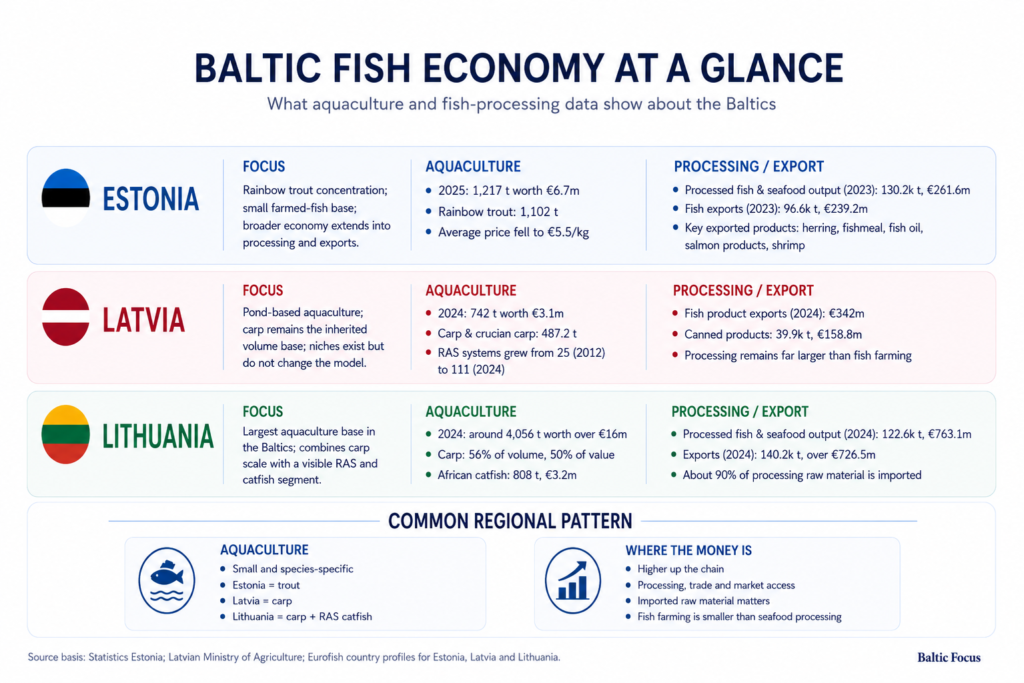
Farmed fish remains a small part of the Baltic seafood economy, but in Estonia, Latvia and Lithuania aquaculture has a specific regional meaning: freshwater infrastructure, local food production, energy, processing and fish-resource management.
Aquaculture does not always mean sea-based fish farms. In the Baltic context, it is mostly inland and freshwater-based: ponds, flow-through systems, hatcheries and recirculating aquaculture systems. That changes both the economic and environmental reading of the sector.
The Baltic aquaculture story is therefore not only about producing fish for sale. It is also connected to water management, hatcheries, juvenile releases, fish-resource compensation, local food production and pressure on wild fish stocks. Freshwater aquaculture does not replace clean rivers, restored spawning grounds or a healthier Baltic Sea. But “wild fish only” is not a realistic strategy either, especially when natural fish stocks are under pressure.
This is why the species structure matters. Latvia’s carp points to inherited pond infrastructure. Estonia’s rainbow trout points to controlled-water production, hatcheries, cold-chain logistics and energy costs. Lithuania’s African catfish points to RAS, capital, electricity, processing and added-value products. In the Baltics, fish species are not just biological choices. They are indicators of infrastructure models.
Estonia’s latest aquaculture data looks, at first, like a simple growth story. In 2025, Estonian fish and crayfish farms sold 1,217 tonnes of farmed product worth €6.7 million, with volumes up by 26% compared with 2024. But the more interesting detail is the species behind the growth: rainbow trout accounted for 1,102 tonnes, or about 90% of all farmed fish sold in Estonia.
Latvia looks different. In 2024, the country sold 742 tonnes of aquaculture fish products worth €3.1 million, with only 41.3 tonnes sold on foreign markets. The main species listed by the Latvian Ministry of Agriculture were carp, Arctic char, catfish, sturgeon, trout, tench, zander, pike and other species. But the volume base remains carp and related pond fish.
The figures are not a strict same-year comparison: Estonia’s latest data are for 2025, while the Latvian and Lithuanian figures used here are for 2024. The comparison is therefore structural rather than cyclical.
Data card: Baltic aquaculture is not one market
| Country | Latest available data | Aquaculture volume | Value | Main signal |
|---|---|---|---|---|
| Estonia | 2025 | 1,217 t | €6.7m | rainbow trout = 1,102 t, about 90% of volume |
| Latvia | 2024 | 742 t | €3.1m | carp/crucian carp = 487.2 t, still the volume base |
| Lithuania | 2024 | around 4,056 t | over €16m | carp remains largest, but RAS/catfish is the growth pocket |
The split is not just about national taste preferences. It reflects inherited infrastructure, production systems, energy exposure and market positioning.
Latvia’s carp base reflects an older pond-farming model. Carp is practical for that system: familiar to producers and consumers, robust, and well suited to freshwater ponds and local or regional sales. This does not make carp a growth product. Latvian data show that carp and crucian carp still dominate, but their sold volume fell from 620.5 tonnes in 2022 to 487.2 tonnes in 2024.
Across the sector, the discussion points less to simple volume growth and more to a search for a stronger model. Traditional pond carp remains familiar and saleable, but it is a low-margin product with limited market expansion and visible pressure from neighbouring producers. Higher-value species and RAS-based production offer another path, but they require capital, energy, technical knowledge, controlled water systems and stronger links to processing and retail.
Data card: Latvia is carp-led, but not carp-only
| Species | 2022 | 2023 | 2024 |
|---|---|---|---|
| Carp and crucian carp | 620.5 t | 578.2 t | 487.2 t |
| Arctic char | 86.7 t | 59.6 t | 87.9 t |
| Catfish | 58.0 t | 39.5 t | 54.4 t |
| Sturgeon | 45.8 t | 28.5 t | 38.7 t |
| Trout | 27.9 t | 36.0 t | 30.6 t |
Latvia is therefore not a carp-only aquaculture economy. Arctic char, trout, catfish and sturgeon are present, and RAS infrastructure has expanded: the number of recirculation systems rose from 25 in 2012 to 111 in 2024. But these niches do not change the basic structure. Latvian aquaculture remains small, mostly freshwater-based and carp-led.
The newer part of the sector points in a different direction. Where RAS producers can build retail formats — fillets, portions, smoked or lightly salted products and direct sales — aquaculture starts to look less like raw fish output and more like a small food-processing and brand-building business.
Energy then becomes the dividing line between the older pond model and the newer controlled-water model: carp depends more on ponds, water and seasonality, while trout and RAS catfish depend more directly on power, equipment and technical control.
Estonia’s trout concentration follows a different logic. It is not simply that Estonia is “colder” than Latvia. Rather, rainbow trout fits cold-water, flow-through and RAS-based production systems, and it also belongs to the salmon/trout retail segment. Estonian sector material links rainbow trout marketing to global salmon prices: when salmon prices are high, domestic rainbow trout becomes easier to position and sell.
Energy is part of the trout story. Rainbow trout fits the salmon/trout retail segment, but it is not a low-input pond fish. Intensive trout production depends on controlled water, hatchery work, oxygenation, filtration and cold-chain logistics. That makes Estonia’s trout model more exposed to electricity prices and power availability than traditional pond carp.
The average Estonian farmed-fish price fell to €5.5/kg in 2025, almost 30% below 2024. Without a wider trout-market benchmark, this should not be read automatically as a margin problem. But it does show that volume growth did not translate into proportional value growth.
Lithuania adds a third model. It has the largest aquaculture base in the Baltics. In 2024, Lithuanian aquaculture produced around 4,056 tonnes of fish for human consumption, valued at over €16 million. Ponds still accounted for around 63% of production, but recirculating aquaculture systems reached 35%. Common carp remained the largest species, representing around 56% of volume and 50% of value.
African catfish is Lithuania’s most important species after carp by value. It is produced exclusively in RAS systems, and between 2020 and 2024 its production volume increased by 70%, while value grew by 90%, reaching 808 tonnes and €3.2 million in 2024. This is small next to the country’s total fish-processing economy, but significant inside aquaculture.
In Lithuania, the energy question is less about one farm’s electricity bill and more about the scale of the model. RAS-based African catfish can grow as a segment only if power, capital, technical know-how and processing capacity are available together. That is why the Lithuanian catfish signal matters: it is not large compared with the country’s whole seafood-processing economy, but it shows the direction of a more industrial aquaculture model.
So the Baltic aquaculture map is not one regional story. Estonia is highly concentrated around rainbow trout. Latvia remains tied to pond carp. Lithuania combines a larger carp base with a more visible RAS and catfish segment.
But aquaculture is only the smaller part of the Baltic fish economy. The larger export weight lies in processing, canned products, imported raw material and access to foreign markets.
Data card: the real export business is processing
| Country | Processing and export signal |
|---|---|
| Latvia | Fish product exports, including canned products, reached €342m in 2024; canned products alone accounted for 39.9 thousand t and €158.8m |
| Lithuania | Processed fish and seafood production reached 122.6 thousand t, worth €763.1m in 2024; exports reached 140.2 thousand t, worth over €726.5m |
| Estonia | Processed fish and seafood production reached 130.2 thousand t, worth €261.6m in 2023; fish exports reached 96.6 thousand t, worth €239.2m |
Latvia’s fish processing sector has a long tradition in preservation, canning and smoking. In 2024, the export value of fisheries and aquaculture products, including canned products, reached €342 million. Canned products were the largest category both in value and volume, at €158.8 million and 39.9 thousand tonnes.
Lithuania is larger still as a processing hub. In 2024, its processed fish and seafood production reached 122.6 thousand tonnes worth €763.1 million. About 90% of the fish and seafood used by Lithuania’s processing sector was imported, and total fish and seafood exports reached 140.2 thousand tonnes worth over €726.5 million. Major exported products included salmon, surimi, cod and herring.
Estonia also shows why aquaculture alone cannot explain the fish economy. In 2023, Estonian processing enterprises produced 130.2 thousand tonnes of processed fish and seafood worth €261.6 million. Fish exports totalled 96.6 thousand tonnes worth €239.2 million, with exported products including herring, fishmeal, fish oil, salmon products and shrimp.
There is also a quieter resource-management layer. The Baltic countries release millions of juveniles into inland waters every year, while hatcheries, fish passes and compensation measures are used to support salmon, trout, eel, whitefish, pikeperch and other species. Latvia’s current fish reproduction planning points to around 18 million fish larvae and juveniles released annually into inland waters. Lithuania released more than 14 million juveniles in 2024 and planned more than 17 million for 2025. Estonia’s fishery system also includes restocking of salmon, eel, sturgeon and whitefish.
This is not a licence to damage habitats. Restocking only works together with water-quality measures, river restoration, fish passes and science-based stock management. But it shows that Baltic aquaculture is not only about producing fish for sale. It is also part of freshwater fish-resource management.
That is the real regional distinction. Baltic fish farming is small and species-specific. Baltic fish processing is much larger, export-oriented and often dependent on raw material flows beyond the region. And Baltic aquaculture, properly understood, is freshwater infrastructure: ponds, RAS, hatcheries, energy, processing and fish-resource policy.
In short: Latvia’s carp is inherited pond infrastructure. Estonia’s trout is salmon-market adaptation constrained by energy costs. Lithuania’s catfish is a RAS signal — small in the wider seafood economy, but visible inside aquaculture. The money in the Baltic fish economy still sits higher up the chain: in processing, trade and market access. But the aquaculture layer matters because it links local food production with water management and fish-resource policy in a region where natural fish stocks, energy costs and processing chains are all part of the same economic map.