Baltic Focus Map: 15–21 June 2026
Ahead of the midsummer slowdown, the Baltic map remained unusually dense: central-bank forecasts, political resets, security-linked regulation, new energy and industrial capacity, pan-Baltic M&A, tighter credit controls and defence-tech signals all pointed to a region still being redrawn.
By late June, the Baltic region does not stop — but it clearly slows down. The 23–24 June midsummer holidays thin out meetings, announcements and investor attention, while officials, executives and business owners move into long-weekend mode. In 2026, the formal working week resumes on Thursday, 25 June. In practice, especially in Latvia, that often means people are back in offices or online before the normal business rhythm has fully returned.
However, ahead of the holidays, the Baltic map showed an unusual density of business and political signals for the season. The week brought updated central-bank forecasts, political resets in Latvia and Lithuania, security-linked regulation, new energy and industrial capacity, pan-Baltic M&A, tighter credit and public-office controls, construction and food-chain regulation, and defence-tech signals.
Source information: official public-holiday calendar; Baltic public media; Baltic central banks.
1. Macro baseline: three Baltic growth profiles
The central banks gave the week its numerical baseline. Latvia’s central bank cut its 2026 GDP growth forecast to 2.0%, down from 2.8% in the previous projection, while inflation is now projected at 3.6% in 2026, 3.8% in 2027 and 3.4% in 2028.
Estonia’s central bank expects 2.4% growth in 2026. The recovery is linked mainly to household and general government spending, but the same macro layer carries a debt warning: Estonia’s state debt rose from about €2.5bn in 2019 to €10bn in 2025 and could exceed €20bn by 2030.
Lithuania’s central bank expects 2.7% growth in 2026. The stronger headline is supported by investment growth of 10.1%, but the forecast also carries pressure points: inflation at 5.1% and exports growing by only 0.4%.
The regional reading is uneven but clear: all three economies are still growing, but not in the same way. Latvia looks more cautious; Estonia is leaning on domestic and public-sector demand while facing a debt question; Lithuania looks stronger on investment, but carries an energy-inflation shock and weak export growth.
Source information: Latvijas Banka; Eesti Pank; Lietuvos bankas; ERR / Estonian public media.
2. Governance and delivery capacity
The governance signal of the week came first from Lithuania. By 15–21 June, the country was moving toward a prime-ministerial handover: Social Democrat leader Mindaugas Sinkevičius was expected to replace Inga Ruginienė and lead a reshuffled coalition. The new coalition agreement forms a 75-seat majority in the 141-seat Seimas.
Latvia’s government change belongs to the immediate background rather than to the week’s event list. The country entered the midsummer period with a new four-party government led by Andris Kulbergs, approved by the Saeima on 28 May by 66 votes to 25 after the resignation of Evika Siliņa’s cabinet. For the 15–21 June map, the Latvian point is therefore not the vote itself, but the fact that the new cabinet is facing its first summer delivery period almost immediately after taking office.
For Baltic Focus Map, this is not domestic political chronology. One Baltic state was actively moving toward a government reset during the week, while another had just completed one. That matters for defence spending, infrastructure delivery, EU funds, energy security, regulatory continuity and investor confidence.
Source information: LRT / Lithuanian public media; LSM / Latvian Public Media.
3. Security becomes economic policy
The second layer is security-linked regulation. Lithuania is deploying up to 30 troops to strengthen protection of critical energy infrastructure, including the Klaipėda LNG terminal, LitPol Link, Alytus transformer substation, Kruonis HPP and Klaipėda fuel terminal. Lithuania is also moving to bar companies with commercial ties to Russia or Belarus from operating at critical infrastructure sites, including airports.
Latvia’s immigration-law signal is more complex than simple tightening. On 19 June, President Edgars Rinkēvičs returned the new Immigration Law to the Saeima for reconsideration, asking lawmakers to revisit the provision on temporary residence permits in exchange for investment. The disputed mechanism would allow a foreigner to request a permit of up to five years after investing at least €150,000 for at least five years in a state-created alternative investment fund manager and paying €10,000 into the state budget.
The regional signal is clear: security is no longer a separate defence topic. It is becoming a filter for capital, contracts, infrastructure access and residency.
Source information: LRT / Lithuanian public media; LSM / Latvian Public Media; President.lv; Saeima documents.
4. Energy: new solar capacity and nuclear legal infrastructure
Energy produced two different types of signal.
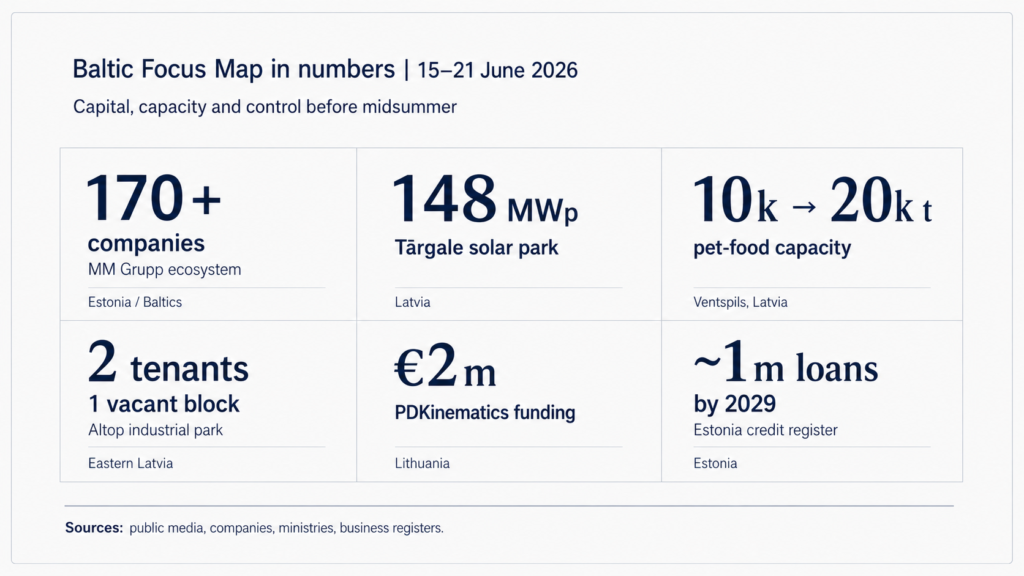
In Latvia, the Tārgale solar park near Ventspils added a large renewable-energy asset to the map. The park has 148 MWp of installed capacity, a 110 MW grid connection and projected annual output of about 154,550 MWh — enough for roughly 60,000 households. Total investment reached €80m. A follow-up hybrid solar-and-battery project is planned in Saldus for autumn 2026.
In Estonia, the signal was not a built asset but legal infrastructure. On 17 June, the Riigikogu adopted the Nuclear Energy and Safety Act, creating Estonia’s first comprehensive legal framework for peaceful nuclear energy. The act covers site selection, construction, testing, operation, decommissioning and final disposal of nuclear waste. The Ministry of Climate has stressed that this does not mean Estonia has decided to build a nuclear plant immediately; possible electricity generation would not start before the mid-2030s at the earliest.
The Baltic reading is that controllable capacity is entering the discussion in different forms: Latvia is adding renewables and preparing hybrid solar-plus-storage, while Estonia is building the legal frame for a possible nuclear option.
Source information: LSM / Latvian Public Media; European Energy corporate information carried by public media; Riigikogu; Estonian Ministry of Climate.
5. Industrial and food-processing capacity
Despite the seasonal slowdown, the week produced several real-economy signals.
Ventspils saw the opening of a wet pet-food facility in the Freeport area. Pet Science Develop invested more than €15m. The first phase is planned at 10,000 tonnes of finished products per year, with capacity expected to double to 20,000 tonnes in 2027. The export market is expected to be mainly European.
Eastern Latvia added the Altop industrial park in Lociki, Augšdaugava Municipality. Two tenants have been secured: EndLine received a 30-year lease, while Magistr received a 15-year lease. The monthly rent is €1.03 per square metre, excluding VAT. The third block remains vacant.
The signal is modest but concrete: outside Riga, Latvia is still trying to turn industrial space, port areas and EU-supported infrastructure into production capacity.
Source information: LSM / Latvian Public Media; LSM Latgale editorial team; Freeport of Ventspils information carried by public media.
6. Pan-Baltic capital and visibility infrastructure
MM Grupp’s acquisition of Bauer Media Group’s outdoor advertising businesses in Estonia, Latvia and Lithuania is a pan-Baltic M&A signal, but it needs scale. The deal value was not disclosed, so the transaction should be read through the buyer’s size, portfolio and the regional position of the assets acquired.
MM Grupp is a large diversified Estonian business group. After structural changes, including the separation of Magnum, its latest annual turnover fell from about €938m to about €379m, while total assets stood at about €665m and liabilities at about €325m. The group employed 3,820 people. Its portfolio covers more than 170 companies across health care, media, real estate, entertainment, retail and other sectors.
The most relevant assets for this deal are the attention and consumer-flow businesses. MM Grupp’s media layer includes Postimees Group, Duo Media Networks and the Latvian TVNET Group. Its entertainment and retail layer includes Apollo Group, the largest entertainment and restaurant group in the Baltics, with Apollo Kino, Apollo bookstores, cafés, cinemas and restaurant brands such as KFC, MySushi and Lido. Apollo Group has around 170 locations and more than 1m Apollo Club members.
The Baltic outdoor units are much smaller in turnover but strategically placed. Available public-company data show roughly this scale: the Estonian outdoor unit had about €1.2m in 2024 sales revenue and an operating loss of about €366,000; the Latvian unit had €868,136 turnover in 2025, up 21.5% from 2024; the Lithuanian unit reported about €639,000 in 2024 revenue and a negative net result of about €358,000.
The Baltic Focus reading is therefore precise: this is not a large disclosed-value M&A story. It is a regional consolidation signal. Estonian capital is adding outdoor advertising assets in all three Baltic states to a wider ecosystem of media, screens, restaurants, cinemas, retail, loyalty programmes and urban consumer traffic.
Source information: Bauer Media Group corporate announcement; MM Grupp portfolio information; ERR / Estonian public media; Apollo Group corporate information; TVNET Group corporate information; Lithuanian business press; company-register and business-data sources.
7. Financial and regulatory control
The week also carried a quieter but important control layer.
In Latvia, more than €1bn was issued last year in online loans, quick loans, leasing and other non-bank loans. Discussions continue over transferring supervision of this sector to the Bank of Latvia, but the process is moving slowly.
Estonia is preparing a national credit register. By 2029, nearly 1m loans, leases and debts are expected to be consolidated into a single register, including credit cards and debt-collection claims. Access is meant to be limited to cases where a formal loan application is made.
Estonia also discussed a cooling-off rule for senior public officials moving to the private sector. The draft would allow restrictions of up to one year before an official could take a job with an employer linked to a sector they previously oversaw.
The signal is broader than one country: the Baltic states are tightening the data and accountability layer around debt, credit, public office and financial risk.
Source information: LSM / Latvian Public Media; ERR / Estonian public media; Estonian parliamentary and ministry information.
8. Construction regulation and regional housing
Latvia’s Ministry of Economics added a construction-sector signal. The ministry pointed to a plan of almost 60 measures to reduce administrative barriers in construction and move toward a more digitalised building process. It also linked the investment environment to regional housing, including more than 1,200 planned low-rent apartments in the regions.
Latvia’s Ministry of Economics added a construction-sector signal. The ministry pointed to a plan of almost 60 measures to reduce administrative barriers and move toward a more digitalised building process. It also linked the investment environment to regional housing, including more than 1,200 planned low-rent apartments in the regions.
For the map, this is a delivery-capacity marker. Latvia is trying to simplify construction procedures at a moment when housing, infrastructure and industrial space all require more predictable implementation.
Source information: Latvian Ministry of Economics; Latvian business press; Latvian construction-sector organisations cited in public materials.
9. Agriculture and food-chain pressure
Agriculture remained a secondary but visible Baltic layer, with different stress points by country.
In Estonia, the issue was EU funding. Farmers may receive less support in real terms in the next budget period: the current period gives access to about €2.3bn in EU funding, while the next one may bring €2.4–2.6bn, or 5–10% more in nominal terms, which does not compensate for inflation over a seven-year period.
In Lithuania, the pressure was physical and climatic. Apple growers reported severe winter damage, with some losses reaching up to 90% of trees. One major orchard case involved more than 200 hectares where trees have to be felled or restored; sector estimates suggest that replanting 30 hectares alone could cost about €1.2m before clearing and restoration costs. Lithuania’s Agriculture Ministry also increased support for climate-risk prevention in horticulture by €1.3m, from €7.5m to €8.8m.
In Latvia, the week brought a food-chain regulation signal. On 17 June, the Saeima committee supported amendments to the Unfair Trading Practices Prohibition Law before the third reading. The proposed changes would introduce a definition of agricultural and food supply forecasts, require at least 30 days’ written notice before changing assortment, remove the possibility of payment terms longer than 20 days for fresh vegetables and berries, and exempt forecast deviations of up to 10% from sanctions.
The Baltic reading is broader than harvest damage. Estonia points to CAP funding pressure, Lithuania to climate damage and adaptation funding, and Latvia to bargaining power between producers and retailers.
Source information: ERR / Estonian public media; LRT / Lithuanian public media; Lithuanian Ministry of Agriculture; Latvian Ministry of Agriculture; Latvian agriculture-sector organisations.
10. Defence tech and civilian sensor experiments
Lithuania added several defence-tech signals.
PDKinematics raised €2m in seed funding to scale precision targeting systems across NATO member states. Lithuania’s state-owned Giraitė Armament Plant began producing anti-drone cartridges, with test batches already dispatched to Sweden and France. Separately, a Lithuanian open-source drone-detection initiative is trying to build a civic acoustic network to detect Shahed-type drones, with a target of 10,000 active participants and future expansion across the Baltic states and Poland.
None of these should be overstated as a mature security system. But together they show how the Baltic defence-tech layer is expanding: from formal procurement toward battlefield-tested tools, anti-drone production, distributed sensing and civilian resilience experiments.
Source information: LRT / Lithuanian public media; Lithuanian company and state-enterprise information carried by public media.
11. Coming next: EU–China–Poland, customs, retail and logistics
A smaller consumer-retail signal is approaching from the EU-China trade side. From 1 July 2026, low-value consignments from outside the EU — up to €150 — will face a new customs cost. This is likely to affect platforms such as Temu, Shein and AliExpress.
For this Baltic Focus Map, the issue should be mentioned only briefly. It is not yet the main story of the week. The stronger treatment belongs in a separate material before the rule takes effect.
Poland matters for that future story because it shows the larger regional scale: Chinese goods are tied not only to online shopping, but also to customs, warehouses, container flows, rail corridors, maritime logistics and e-commerce fulfilment. The Baltic angle will be consumer cost and local retail pressure; the Polish angle will show physical logistics scale.
Source information: EU customs guidance; national customs authorities; Polish logistics and business media; Chinese cross-border e-commerce industry sources for market reaction.
What the map shows
The 15–21 June week was unusually dense for the Baltic pre-midsummer period. The region was already moving into holiday mode, but the map did not empty out.
Instead, it showed updated central-bank forecasts, political resets, security-linked economic filters, new energy and industrial capacity, pan-Baltic M&A, tighter credit and public-office controls, construction and food-chain regulation, defence-tech signals and early signs of a coming EU-China retail-logistics shift.
The main Baltic Focus reading is therefore not “summer slowdown”. It is more precise: even as the region slows for midsummer, the underlying map is still being redrawn.