Baltic inflation in May: monthly calm, annual pressure
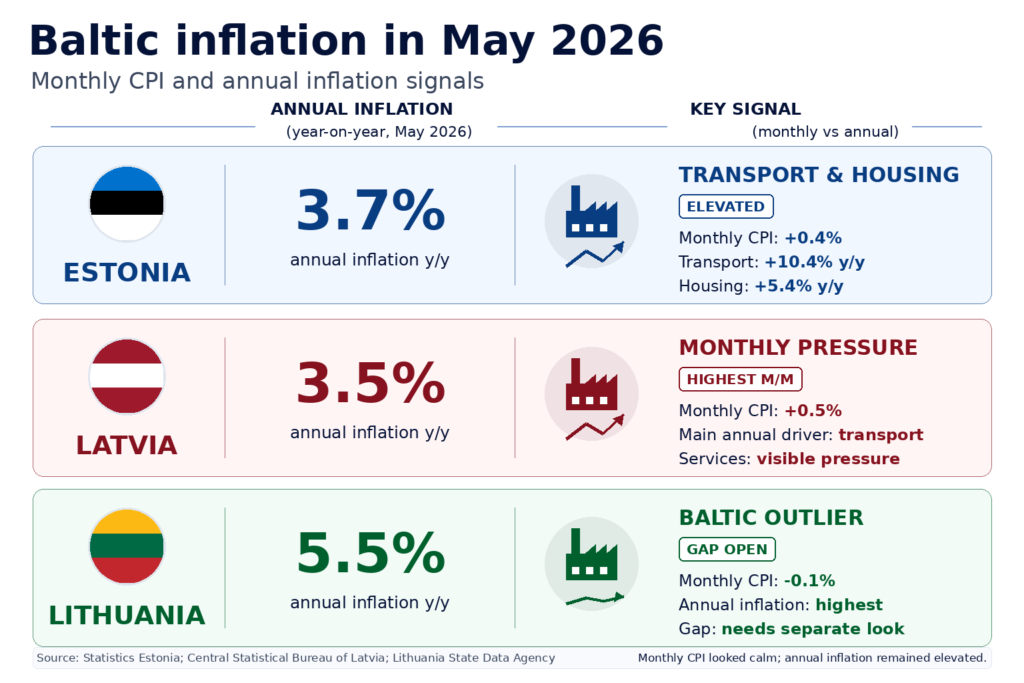
May inflation data from the three Baltic statistical offices show that price pressure has not disappeared.
Annual inflation remained unexpectedly high across the region:
- Lithuania: 5.5%
- Estonia: 3.7%
- Latvia: 3.5%
The monthly picture looked much calmer. Latvia recorded the strongest month-on-month rise, at 0.5%, Estonia followed with 0.4%, while Lithuania even saw a small monthly decline of 0.1%.
This contrast matters.
All three statistical offices placed noticeable emphasis on monthly price changes in their May releases. Technically, this is correct: monthly CPI shows the latest movement. But it also softens the reading. Month-on-month figures suggest moderation. Year-on-year figures show that the price level is still rising faster than would be comfortable.
Lithuania remains the clearest outlier. Even after a small monthly decline in May, annual inflation stood at 5.5%, well above Latvia and Estonia. That gap should not be reduced to electricity or heating tariffs. Energy prices are part of the basket, but they do not explain the full regional pattern.
For Lithuania, the structure needs a separate look. The May release points not only to housing and energy-related items, but also to transport, fuel, services, restaurants, excise-sensitive goods and administered prices. The question is not whether energy matters. It does. The question is why Lithuania’s annual inflation remains so much higher than in Latvia and Estonia even when the monthly movement turns negative.
Estonia’s annual inflation was strongly affected by transport and housing costs. Latvia’s May increase was more visibly linked to services, housing-related costs, restaurants and accommodation. Lithuania, meanwhile, continued to show the highest annual inflation in the region despite a monthly fall.
For the Baltic region, this is the more important signal: as the acute phase of the energy shock fades, inflation is not simply disappearing. It is becoming more structural — shaped by domestic cost pressures, taxes, services, transport prices and administered prices.
The key question for the coming months is whether Lithuania’s inflation gap narrows — or whether it becomes a more persistent Baltic divergence.
Sources: Statistics Estonia, Central Statistical Bureau of Latvia (CSP), Lithuania State Data Agency