EPPO turns to Latvian hospitals: what the EU prosecutor has investigated in the Baltics this year
Latvia’s anti-corruption authority KNAB said on 21 May that it is investigating possible unlawful advantages granted to selected medical goods suppliers in four hospital procurements.
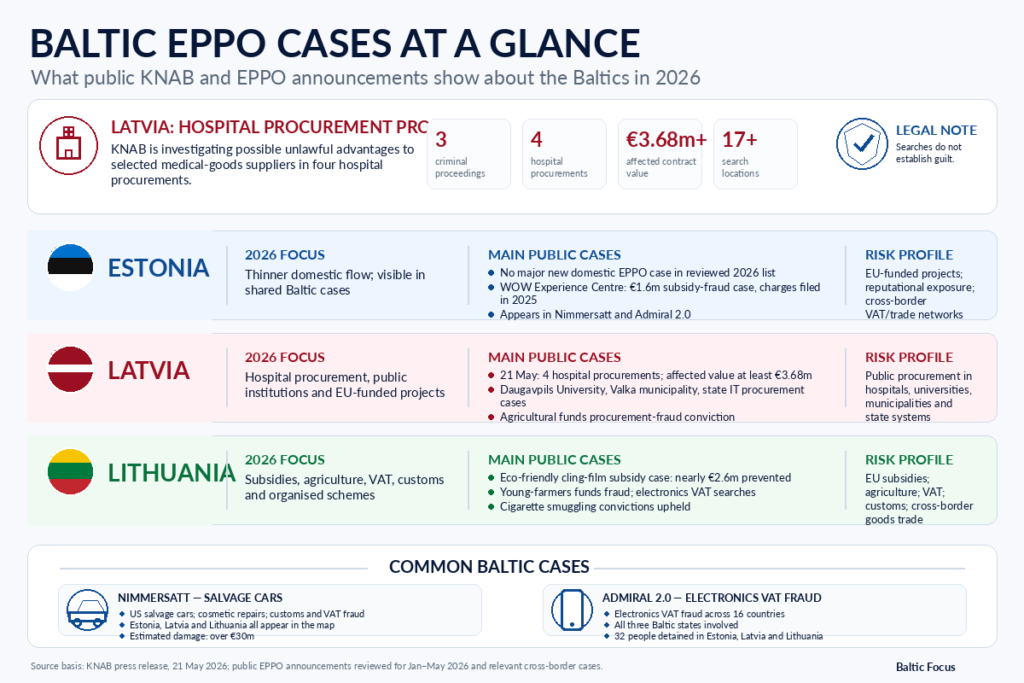
Latvia’s anti-corruption authority KNAB said on 21 May that it is investigating possible unlawful advantages granted to selected medical goods suppliers in four hospital procurements. The criminal-procedural activities are being carried out in three criminal proceedings involving SIA Vidzemes slimnīca, VSIA Traumatoloģijas un ortopēdijas slimnīca and VSIA Paula Stradiņa klīniskā universitātes slimnīca.
According to KNAB, hospital public officials may have unlawfully agreed with medical goods suppliers to secure those companies’ victory in four public procurements. The technical specifications of the tenders may have been tailored to the requirements of specific suppliers. The affected contract value is at least €3.68 million, financed from Latvian and European Union budget funds. Searches were carried out at more than 17 locations across Latvia, including the three hospitals. Four persons involved in the proceedings — two public officials and two company representatives — currently have the right to defence; no person involved has been subjected to a custodial security measure.
Two of the criminal proceedings — related to procurements at Vidzemes Hospital and the Hospital of Traumatology and Orthopaedics — were initiated by the European Public Prosecutor’s Office after KNAB sent its materials for assessment under EU rules. EPPO then transferred the cases to KNAB for investigation. The third proceeding, involving Paula Stradiņa Clinical University Hospital, was initiated by KNAB and concerns a possible unlawful benefit in the form of a paid training trip requested and accepted by an employee who is not a public official.
KNAB stressed that the persons involved have the right to defence and that the presumption of innocence applies at all stages of criminal proceedings. At the same time, KNAB and EPPO said they agree that systemic problems exist in hospital procurement: EPPO currently has two additional criminal proceedings and KNAB has one additional proceeding related to hospital procurements, including cases linked to Liepāja Regional Hospital and Ogre District Hospital. KNAB describes healthcare procurement as a higher-risk area because contracts are often financially large and technically complex, competition may be limited, and long-term relationships can develop between medical institutions and suppliers.
The hospital procurement cases place Latvia’s healthcare sector inside a wider EPPO-linked Baltic enforcement map. Since the beginning of 2026, public EPPO cases in the region have covered public procurement, EU-funded municipal and university projects, agricultural subsidies, VAT fraud, customs fraud and cross-border trade in cars and electronics.
This review is based on public KNAB and EPPO announcements. Searches, arrests, charges and convictions represent different legal stages. The purpose is to map sectors and enforcement patterns, not to imply guilt in ongoing proceedings or to rank countries by corruption.
The picture is not one uniform “Baltic corruption story”. Latvia, Lithuania and Estonia appear both as separate small jurisdictions with their own institutional vulnerabilities and as parts of a shared regional market used in cross-border fraud schemes.
Latvia: hospital procurement, public institutions and EU-funded projects
In Latvia, the strongest pattern in public EPPO-related cases this year is public procurement and EU-funded institutional projects.
The most recent case concerns hospital procurement. According to KNAB, three criminal proceedings cover four procurements at Vidzemes Hospital, the Hospital of Traumatology and Orthopaedics and Pauls Stradiņš Clinical University Hospital. The affected contract value is at least €3.68 million, financed from Latvian and EU budget funds. The alleged pattern is specific: possible unlawful agreements between hospital public officials and selected medical goods suppliers, with tender specifications possibly tailored to those suppliers’ requirements.
In April, the Riga City Court ordered the confiscation of a luxury vehicle, a real estate property in central Riga and €230,000 in bank accounts as part of an ongoing EPPO investigation into suspected procurement fraud at Daugavpils University. The case concerns European Social Fund financing and alleged manipulation of procurement specifications and inflated costs, with damage estimated at €306,957 to the EU budget and €54,169 to the Latvian state budget.
Also in April, EPPO announced that it had completed the pre-trial investigation into a possible fraud case involving the municipality of Valka. Three individuals, including two municipal officials, were charged with fraud and abuse of office. The alleged scheme concerned almost €700,000 in public funds, including €670,000 from the European Regional Development Fund.
In March, EPPO in Riga announced the detention of 20 suspects in an investigation into a €1.5 million IT procurement fraud involving state institutions. According to EPPO, the case concerned an organised crime group involving public officials suspected of wrongdoing in procurement procedures for IT systems.
Latvia also had a completed agricultural-funds case this year. In March, EPPO secured a conviction against two individuals and one legal entity in a procurement fraud case affecting EU agricultural funds.
The Latvian profile is therefore not limited to one sector. It points to a broader governance problem around EU-funded procurement inside public and quasi-public institutions: hospitals, universities, municipalities, state IT systems and agricultural funding channels.
Lithuania: subsidies, agriculture, VAT, customs and organised schemes
Lithuania’s EPPO map is broader and more trade-oriented. It includes EU subsidies, agriculture, VAT, customs and cross-border commodity flows.
In April, EPPO in Vilnius secured the conviction of four individuals in an attempted EU subsidy fraud case involving “eco-friendly cling film”. The case prevented the unlawful disbursement of nearly €2.6 million in EU funds. The defendants pleaded guilty to attempted fraud and document forgery.
Also in April, the Vilnius City District Court convicted members of an organised crime group in a fraudulent scheme involving EU and national funds intended for young farmers.
In February, EPPO announced searches at major Lithuanian companies trading electronics and household appliances as part of a suspected large-scale VAT fraud investigation. The searches were carried out by Lithuania’s Financial Crime Investigation Service.
Lithuania also had a customs and border dimension. In February, the Court of Appeal of Lithuania upheld convictions of two former Lithuanian customs officers and two Belarusian citizens in a cigarette smuggling scheme from Belarus.
Lithuania therefore appears not only as a recipient of EU funding, but also as a node where subsidies, agriculture, border trade, VAT and organised economic schemes intersect.
Estonia: thinner domestic news flow, visible in shared Baltic schemes
Estonia has a thinner domestic EPPO news flow in the reviewed 2026 list. That does not mean Estonia is outside the enforcement map. Its public profile in this review is different: fewer recent domestic cases, but visible participation in wider Baltic and European VAT and trade-fraud investigations.
The most relevant recent domestic Estonian case in EPPO’s public material remains the WOW Experience Centre case from March 2025, where EPPO in Tallinn brought charges against five individuals and three companies in connection with alleged €1.6 million subsidy fraud linked to the development of the WOW Experience Centre and a padel centre on Saaremaa.
Estonia is also visible in larger cross-border cases. In the Nimmersatt investigation into salvage cars imported from the United States, EPPO lists Estonia together with Latvia and Lithuania among the countries involved in the wider scheme.
Estonia also appeared in Admiral 2.0, a large VAT fraud investigation involving consumer electronics. EPPO reported that investigative measures were carried out in 16 countries, including Estonia, Latvia and Lithuania, and that 32 people were detained in the three Baltic states.
For Estonia, the pattern is therefore less about a large stream of domestic EPPO news in 2026 and more about reputational exposure through EU-funded projects and participation in wider regional VAT and trade-fraud networks.
Shared Baltic cases: cars, electronics and VAT
At least two major EPPO cases show all three Baltic states as parts of the same enforcement map.
The first is Nimmersatt, the investigation into a criminal organisation importing badly damaged salvage cars from the United States, reselling them after superficial repair and allegedly evading customs duties and VAT. EPPO said the investigation extends from the US to Russia, with links to Canada, Hungary, Ireland and the UK, as well as 12 EPPO-zone countries, including Estonia, Latvia and Lithuania. The preliminary investigation looks into VAT fraud in Lithuania and Germany and other criminal activities in Latvia, Estonia, Bulgaria, Romania and the Netherlands, with estimated damage of more than €30 million.
The second is Admiral 2.0, a major VAT fraud investigation linked to consumer electronics. EPPO described it as part of Europe’s biggest VAT fraud investigation, with searches and investigative measures in 16 countries, including all three Baltic states. The Baltic dimension was not symbolic: 32 people were detained in Estonia, Latvia and Lithuania.
These cases show that the Baltics do not appear in EPPO files only as three separate small countries. They also function as a shared regional layer for certain types of cross-border schemes: cars, electronics, VAT, customs and company networks.
Why this matters
EPPO’s Baltic cases should not be read simply as a list of scandals. They are a stress test of how EU money, procurement, border trade and administrative capacity work in small open economies.
Latvia’s profile points to public procurement and EU-funded institutional projects, now including major healthcare procurement. Lithuania’s profile points to subsidies, agriculture, VAT, customs and organised economic schemes. Estonia’s profile is smaller in the domestic 2026 news flow reviewed here, but the country appears in shared Baltic and European VAT and trade-fraud networks.
The hospital procurement cases are especially sensitive because healthcare combines large contracts, technical specifications, limited supplier competition and high public trust. If EU-linked procurement risks reach major hospitals, the issue is no longer only legal. It becomes a question of project governance, institutional credibility and the real cost of managing EU-funded infrastructure in small states.
EU money is not only a development tool in the Baltics. It is also an enforcement map.