Estonia grocery retail: Coop restructures its network through Prisma acquisition
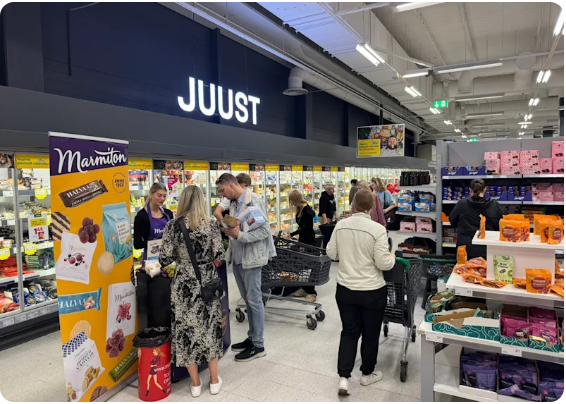
SOK has agreed to sell Prisma Peremarket (13 stores, ~700 employees) to Coop Estonia, with the deal expected to close in 2026 subject to regulatory approval, marking the exit of S Group from direct retail operations in Estonia.
The planned acquisition of Prisma Peremarket by Coop Estonia should be read less as a competitive move and more as a structural rebalancing of Coop’s retail network, which has historically been disproportionately weighted toward regional Estonia rather than the capital.
The transaction is subject to approval by the Estonian Competition Authority, whose assessment will be critical given the already high level of concentration in the country’s grocery retail sector.
Estonia’s grocery retail market is relatively concentrated, with around six nationwide chains accounting for the dominant share of sales, each operating at a distinct scale and with a defined positioning:
| Chain | Estimated turnover | Notes |
|---|---|---|
| Coop Estonia | ~€1.3–1.5bn | Nationwide cooperative network, market leader |
| Maxima Eesti | ~€800–850m | Large-format and price-driven mass retail |
| Selver | ~€600m+ | Local premium positioning |
| Rimi Eesti Food | ~€450–500m | Urban supermarkets and convenience formats |
| Lidl Eesti | ~€300m+ (estimated) | Fastest-growing player, price-driven expansion |
| Prisma Peremarket | ~€180–200m | Hypermarket format |
Secondary but regionally relevant: OG Elektra.
At the same time, Estonia stands out in Europe for its high retail space per capita, creating an environment where consumers face abundant choice and can switch between chains with minimal friction.
Against this backdrop, Coop’s nationwide footprint has not translated into an equally strong position in Tallinn, where store density and accessibility have remained below those of its competitors.
The transaction combines two clearly measurable layers of the market: Coop’s existing national network and Prisma’s urban store base.
| Indicator | Value |
|---|---|
| Coop Estonia stores | ~320 |
| Market share | ~23% |
| Net turnover (2024, central structure) | €856.1m |
| Prisma Peremarket stores | 13 |
| Employees transferred | 700+ |
| Estimated Prisma turnover | €180–200m |
| Added scale to Coop | ~12–15% of revenue base |
This effectively introduces a ready-made urban layer into Coop’s structure, allowing it to expand in Tallinn through established high-traffic locations rather than through a gradual rollout constrained by real estate availability and permitting.
The timing of the deal also reflects broader market pressure. In 2025, real consumption in the grocery segment weakened under the impact of inflation, prompting retailers to intensify competition for limited spending through aggressive pricing strategies and loyalty campaigns.
From an operational perspective, the impact is immediate, as the company acquires not only physical assets but also a fully functioning store network with an established workforce, avoiding the ramp-up period typically associated with new openings.
At the same time, the transaction creates a structural integration challenge, as Prisma’s large-format hypermarkets differ from Coop’s core focus on mid-sized supermarkets and proximity retail, suggesting that parts of the acquired network may be adapted over time to better align with Coop’s operating model.
An additional, less visible dimension of the deal concerns financial services. For Coop Pank, the expansion into Prisma’s urban locations may provide access to customer segments in Tallinn that have been harder to reach through Coop’s traditionally regional footprint, opening the way for further integration of banking services into retail spaces.
Taken together, the deal does not alter the hierarchy of Estonia’s grocery retail market but resolves a specific internal imbalance within the leading player, allowing Coop to complete its national coverage by strengthening its presence in the capital without engaging in multi-year organic expansion.