Analysis · Transport & Logistics
Liepāja SEZ keeps green aviation track alive as focus shifts from aircraft to fuel
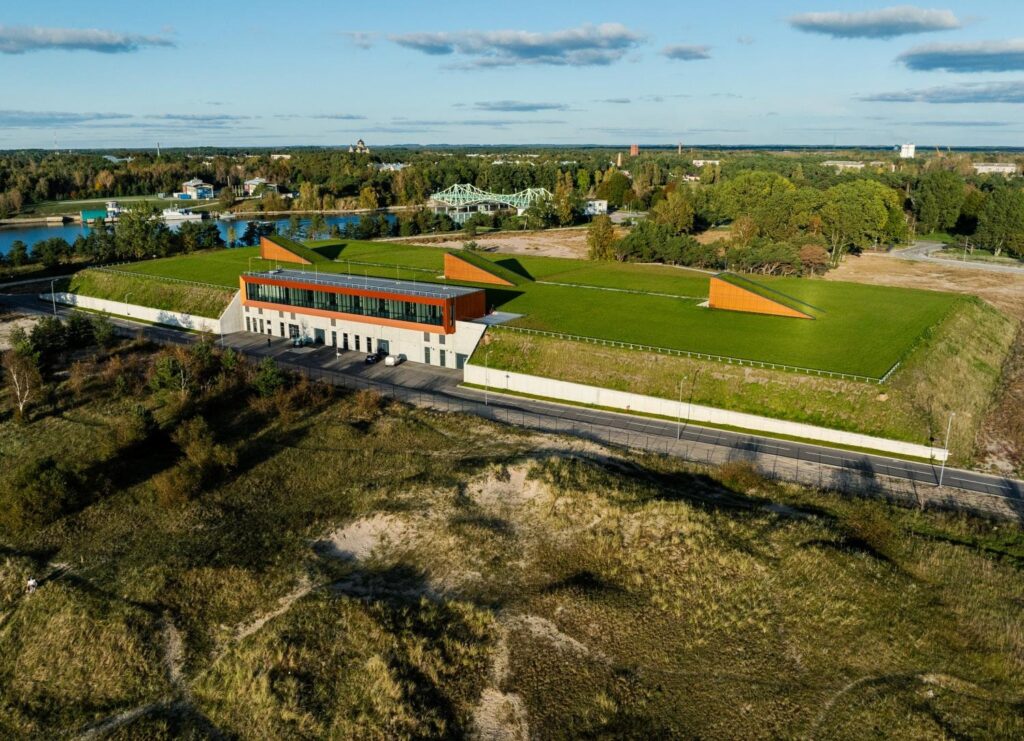
Liepāja Special Economic Zone is continuing to work with green aviation projects, but the centre of gravity has shifted. The earlier public story around Fokker Next Gen Latvia was linked to hydrogen-powered aircraft. The current one is linked to sustainable aviation fuel, synthetic SAF and port-side industrial infrastructure.
Fokker Next Gen Latvia entered liquidation in December 2025 after being presented as part of Liepāja’s hydrogen-aviation ambitions. The current aviation-fuel project follows a different route. In February 2025, Liepāja SEZ announced that GI Termināls had attracted Avia Solutions Group as a strategic investor, changed its name to NorSAF, and would develop a SAF production plant and CO₂ terminal in Liepāja.
Avia Solutions Group is not a minor local participant. It is an Irish-registered aviation group with Baltic origins and a large international ACMI business. Its role in Liepāja should be read as aviation-sector capital and market positioning, not as proof that a complete SAF supply chain already exists in Latvia.
The group also has a regional fuel-handling layer through Baltic Ground Services, part of ASG. BGS acts as one of the aviation-fuel suppliers and into-plane fuelling providers for airlines at selected Baltic and Central European airports, and lists aircraft fuelling, jet-fuel supply and SAF logistics among its services. BGS says 150,000 metric tonnes of its annual fuel volumes are dedicated to into-plane aviation fuel supply. This is relevant for the logistics side of the NorSAF story, but it is separate from SAF/eSAF production.
The latest public step is the licence agreement between NorSAF and KBR for PureSAF technology. The planned facility is presented with a target capacity of 100,000 tonnes of SAF and eSAF per year. Avia Solutions Group’s own figures split this into 61,600 tonnes of SAF and 38,400 tonnes of eSAF annually. Latest public communications describe the investment value as above €1 billion. A final investment decision has not yet been made.
Public timelines differ. KBR says production is planned to start in 2030, while other recent project communications point to 2031. The project is promoted around 100% drop-in SAF, but the certification layer remains important: current coverage describes the fuel as certified for blending up to 50% with fossil kerosene, while approval for full drop-in use in Europe is expected in 2026, depending on ASTM certification.
That places Liepāja inside a wider European aviation-fuel transition. ReFuelEU Aviation requires fuel suppliers to gradually increase the share of sustainable aviation fuels at EU airports, including a separate synthetic aviation fuel sub-mandate from 2030. For a port and special economic zone, this creates a new industrial-policy field: not only fuel storage or logistics, but possible production chains around aviation fuel, hydrogen, CO₂ and feedstock.
The visible structure of the Liepāja project now includes several documented elements: an aviation-sector investor, a licensed fuel technology, EU regulatory demand, port land, an environmental-assessment process and a planned CO₂ terminal.
Other elements remain part of the next project stages: renewable hydrogen, biogenic CO₂ supply, feedstock, financing, offtake, full drop-in approval and construction.
One existing element is unusual for a Baltic port: Liepāja already has a specialised potable-water export terminal at Oskara Kalpaka Street 117. It was not built for SAF. The terminal was developed by SIA EIPU as a drinking-water export facility and was commissioned in 2024. LIFEBLNC presents the Liepāja facility as a water terminal with 94,000 m³ of storage capacity, a 4,000 m³/h pumping station, treatment infrastructure, a dedicated pipeline and loading arms.
This does not make the water terminal a SAF facility. It does show, however, that one rare utility and logistics asset already exists in the port area. The original business case was bulk drinking-water export by sea. The SAF/eSAF project now places that infrastructure inside a different industrial context, without changing the fact that hydrogen, CO₂, feedstock, financing, offtake and construction remain separate project elements.
For Liepāja SEZ, the current SAF project therefore connects several layers: aviation capital, fuel technology, EU regulation, port-side location, a planned CO₂ terminal, a regional fuel-handling operator within the ASG group, and an existing water-logistics asset built before the SAF project for another commercial use. The next stages of the project will show how these elements are joined with hydrogen, CO₂, feedstock, financing, offtake and construction.
Data card
- Location: Liepāja Special Economic Zone, Latvia
- Previous green-aviation track: Fokker Next Gen Latvia, hydrogen-powered aircraft project, liquidation started in December 2025
- Current project company: NorSAF, formerly GI Termināls
- Strategic aviation investor: Avia Solutions Group
- Related ASG fuel layer: Baltic Ground Services — one of the regional aviation-fuel suppliers and into-plane fuelling providers; aircraft fuelling and SAF logistics, not SAF/eSAF production
- Technology partner: KBR, PureSAF technology
- Planned capacity: 100,000 tonnes SAF/eSAF per year
- ASG split: 61,600 tonnes SAF and 38,400 tonnes eSAF per year
- Investment value: latest public communications describe the project as above €1 billion
- Timeline: KBR references 2030; other recent project communications point to 2031
- Final investment decision: not yet made
- Certification layer: currently up to 50% blend; full drop-in approval expected subject to ASTM process
- Existing related asset: potable-water export terminal at Oskara Kalpaka Street 117
- Water terminal capacity: 94,000 m³ storage; 4,000 m³/h pumping station
- Elements still to be joined: hydrogen, biogenic CO₂, feedstock, financing, offtake, full drop-in approval and construction