Lithuania’s Q1 taxpayer rankings: ORLEN leads overall, banks lead without VAT and excise
Lithuania’s State Tax Inspectorate, VMI, has published its taxpayer rankings for the first quarter of 2026.
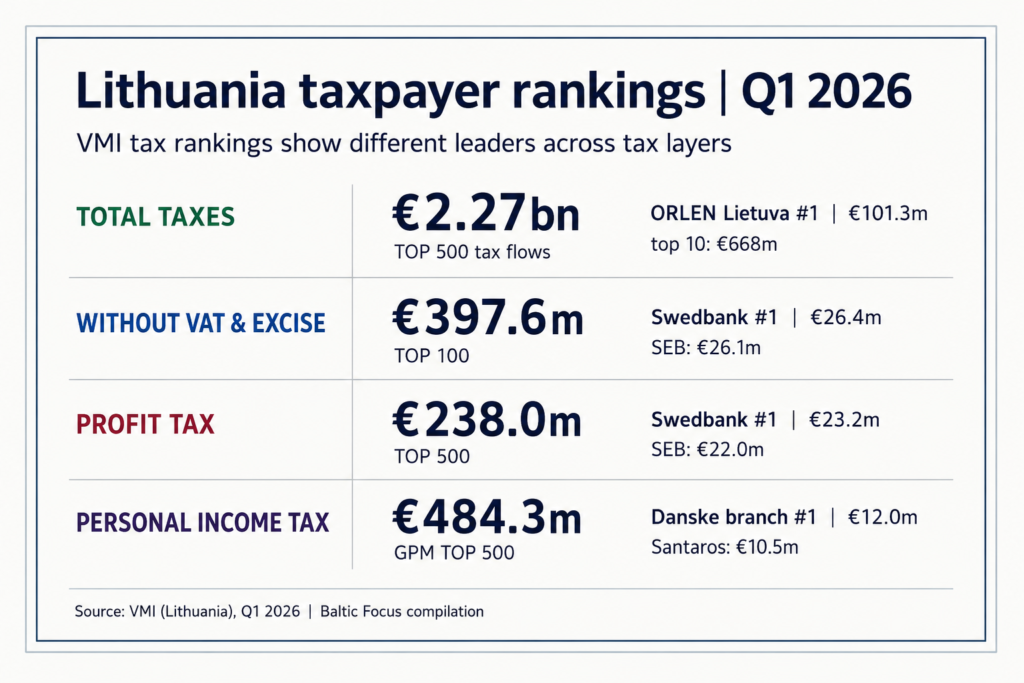
Lithuania’s State Tax Inspectorate (VMI) has published its taxpayer rankings for the first quarter of 2026. The headline list is led by ORLEN Lietuva, but the picture changes sharply once VAT and excise duties are excluded.
The headline ranking: €2.27bn through the top 500
The overall TOP 500 companies accounted for €2.27bn in tax flows received by VMI in Q1 2026. The ten largest names alone represented €668m, or almost 30% of the TOP 500 total.
In the overall ranking, ORLEN Lietuva led with €101.3m. It was followed by Circle K Lietuva with €90.8m, Okseta with €87.5m, KN Energies with €73.5m, Philip Morris Baltic with €72.4m, Sanitex with €58.2m, Ignitis with €56.7m, Maxima LT with €49.6m, MV Group Distribution LT with €40.5m and Lidl Lietuva with €37.7m.
Why the total list is not a profit ranking
This ranking should not be read as a simple list of Lithuania’s most profitable companies. VMI says the TOP lists cover taxes received from legal entities and include indirect taxes such as VAT and excise duties, as well as personal income tax withheld from Class A income.
VAT and excise duties are largely taxes collected through companies from consumers or from specific products. They are not a direct measure of a company’s own profit. That is why fuel, tobacco, alcohol, retail and distribution companies move to the top of the total ranking.
The clearest example is ORLEN Lietuva. It ranks first in the total list with €101.3m, but falls to eighth place in the ranking excluding VAT and excise duties, with €9.0m. ORLEN remains a major industrial and tax player, but the gap shows how strongly the headline ranking is shaped by fuel-related VAT and excise flows.
Banks move to the front once VAT and excise are excluded
Once VAT and excise duties are excluded, the ranking changes. VMI publishes this layer as a TOP 100, not as a TOP 500, so it should not be compared mechanically with the full overall ranking.
In this list, the TOP 100 companies accounted for €397.6m. The first two positions were taken by banks: Swedbank with €26.4m and SEB bankas with €26.1m. They were followed by Valstybinių miškų urėdija with €12.6m, Danske Bank’s Lithuanian branch with €12.0m, Revolut Bank with €11.3m, Maxima LT with €11.1m, Top Sport with €10.1m, ORLEN Lietuva with €9.0m, Luminor Bank with €8.8m and Thermo Fisher Scientific Baltics with €7.8m.
This ranking is cleaner than the headline list, but it is still not a pure profit ranking. It includes other tax payments received by VMI, including personal income tax withheld by employers. That matters for names such as Valstybinių miškų urėdija, the state forestry company, and Top Sport, a Lithuanian betting operator. Their positions may reflect a mix of profit-related payments, payroll-related taxes, sector-specific tax mechanics and payment timing, not one simple measure of operating profit or economic size.
The banking caveat
The banking result needs a separate note. Lithuania’s banks are not taxed under exactly the same conditions as ordinary companies. The country introduced a temporary solidarity contribution on excess net interest income after the rise in ECB rates. It was applied for 2023–2024 and was later extended for the 2025 payment period to support defence financing.
Lithuania also applies a higher corporate income tax rate to credit institutions. From 2026, the standard corporate income tax rate is 17%, while taxable profits of credit institutions above the statutory threshold are taxed at 22%.
This means the strong position of Swedbank, SEB, Luminor and Revolut should not be read only as a neutral profitability comparison with other sectors. It reflects genuine banking profitability, but also Lithuania’s sector-specific tax treatment of financial institutions and the possible tail of the bank solidarity contribution cycle.
Corporate income tax: the bank-led layer
The corporate income tax ranking points in the same direction. The TOP 500 profit-tax payers accounted for €238.0m, with the ten largest companies representing about €87.5m.
Swedbank ranked first with €23.2m, followed by SEB bankas with €22.0m, Luminor Bank with €8.8m, Revolut Bank with €7.6m, Ignitis gamyba with €6.1m, Thermo Fisher Scientific Baltics with €5.3m, Tele2 with €4.7m, Artea bankas with €3.5m, Telia Lietuva with €3.4m and NT Service with €2.9m.
Energy names should be read differently from banks. ORLEN’s position in the total ranking is mainly a VAT-and-excise story. Ignitis gamyba appears in the corporate income tax ranking, but electricity-market regulation works through a different mechanism than the bank solidarity contribution. The banking levy added a sector-specific tax burden on excess net interest income. Energy crisis measures, by contrast, included revenue caps or fossil-fuel-related mechanisms, which do not translate into the same kind of corporate income tax signal.
Personal income tax: a map of large employers
The personal income tax ranking shows another layer of the economy: large employers and high-payroll organisations. The TOP 500 companies and institutions in this ranking accounted for €484.3m in GPM received by VMI.
The largest remitter was Danske Bank’s Lithuanian branch with €12.0m, followed by Santaros klinikos with €10.5m, Kauno klinikos with €8.9m, Maxima LT with €7.5m, Vilnius University with €5.6m, InMedica with €5.5m, SEB’s Vilnius branch with €4.7m, Energijos skirstymo operatorius with €4.7m, Thermo Fisher Scientific Baltics with €4.5m and Klaipėda University Hospital with €4.3m.
This is not a ranking of Lithuania’s richest individuals. It shows legal entities from which VMI received the largest amounts of personal income tax. In practice, it maps payroll scale and high-value employment: banks, hospitals, universities, retail, healthcare, energy networks and life sciences.
The signal: several tax maps, not one ranking
Lithuania’s tax base cannot be read through one ranking alone. ORLEN Lietuva leads the headline ranking because fuel-related VAT and excise flows are large. Swedbank and SEB bankas dominate the bank-led layers because banks combine strong profitability with sector-specific taxation. Maxima LT is visible across several lists because it combines retail scale and employment. Thermo Fisher Scientific Baltics stands out as a high-value industrial and life-science company visible in the ranking excluding VAT and excise duties, the corporate income tax ranking and the payroll-related ranking.
Depending on the tax layer, Lithuania’s largest contributors look like fuel companies, banks, retailers, public-service employers, energy networks or life-science producers.
Source: VMI, Q1 2026 taxpayer rankings; Baltic Focus compilation.