Analysis · Transport & Logistics
Six, Then Three, Then Three More: airBaltic’s Aircraft Exit Moves Into December
With six aircraft leases already rejected and six more awaiting court approval, airBaltic faces a December financing decision that could also affect its aviation businesses at Riga Airport.
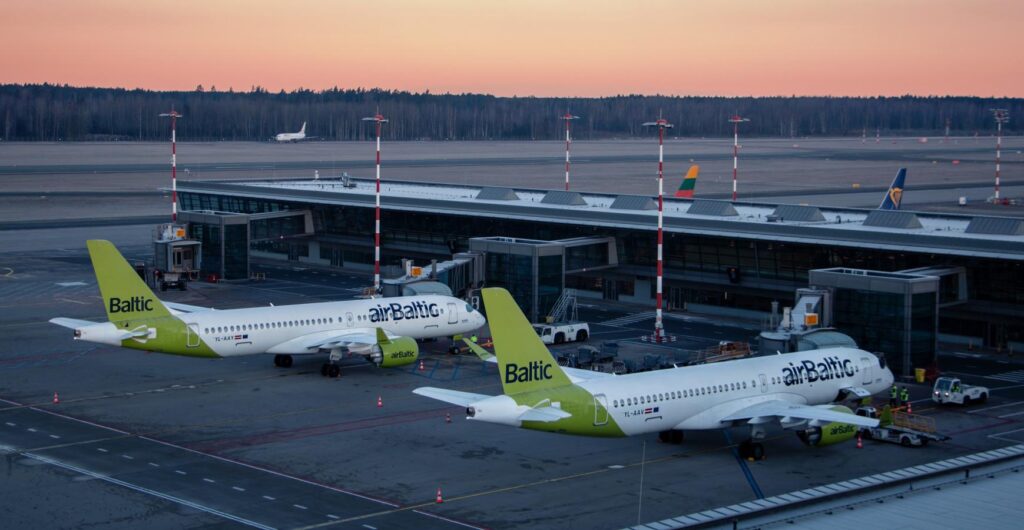
On 15 February 2026, Latvian airline airBaltic welcomed its 54th Airbus A220-300 since introducing the type in 2016. The company celebrated the arrival of YL-BTD with a press release declaring: “Over the past 30 years, airBaltic has evolved into a globally respected carrier.”
Deliveries continued throughout the first half of 2026. But by June, the airline had also begun returning aircraft ahead of schedule.
| Period | Fleet changes |
|---|---|
| February | 2 new A220-300s |
| April | 2 new A220-300s |
| June | 1 new A220-300; 2 early returns |
| 30 June | 54 aircraft in the fleet |
The 54th delivery in February was a cumulative count since 2016. The fleet of 54 reported at the end of June reflected subsequent deliveries and returns.
Nine months after the February celebration, YL-BTD and the other February arrival, YL-BTC, appeared in a US bankruptcy court order approving airBaltic’s rejection of their leases.
The order, signed on 17 November, covered six aircraft. Another six are now awaiting court decisions.
airBaltic plans to reduce its fleet from 54 to approximately 36 aircraft by the end of 2026. The court filings show how that reduction is taking shape.
| Lease rejection date | Aircraft | Status |
|---|---|---|
| 17 November | YL-CSI, YL-ABD, YL-ABE, YL-ABF, YL-BTC, YL-BTD | Approved |
| 25 November | YL-CSN, YL-CSL, YL-CSM | Requested |
| 2 December | YL-AAW, YL-AAX, YL-AAY | Requested |
The two pending applications are scheduled for hearings on 9 December at the US Bankruptcy Court for the Southern District of New York. The dates in the table refer to lease rejection, not necessarily the physical departure of the aircraft.
The hearings fall within a critical period for airBaltic. According to its financial adviser, the airline could run out of cash in the first half of December without additional financing.
A smaller airline, a different business plan
The 12 aircraft covered by the filings represent two-thirds of airBaltic’s planned 18-aircraft reduction, provided the remaining applications are approved and the aircraft are returned.
In August, management abandoned its earlier ambition to expand towards 100 aircraft. The revised plan calls for a fleet of approximately 36 by the end of 2026, followed by gradual growth to around 40 aircraft by 2031.
The lease rejections involve international aviation leasing companies associated with Azorra, Falko, Airborne Capital and Merx Aviation.
Michael B. Cox, an aviation restructuring adviser with Seabury, told the court that the aircraft were no longer needed under airBaltic’s revised business plan. He also said their lease rates exceeded prevailing market prices for comparable equipment.
A separate application filed on 20 November concerns YL-AAO, an A220-300 declared a constructive total loss after a technical incident in June 2025. On 9 December, airBaltic will seek permission to transfer the damaged aircraft and two engines to insurers represented by Allianz, while retaining parts already installed on aircraft still in service. It also wants to reject outstanding obligations to replace those parts.
YL-AAO is not included in the 12 lease rejections listed above.
The airline is concentrating its route network around Riga, focusing on commercially sustainable connections and frequencies. It also intends to retain its aircraft-and-crew leasing business.
Known as ACMI or wet leasing, this business supplies aircraft, crews, maintenance and insurance to other airlines. It generated approximately €98 million in revenue during the first half of 2026, almost a quarter of the group’s total revenue.
airBaltic has renewed its cooperation with Lufthansa Group, with plans to provide up to six aircraft in summer and four in winter. Its cooperation with Air Serbia also continues, with four aircraft planned for summer and two for winter.
The airline will have to meet these commitments and operate its own passenger routes with a smaller fleet.
Staff reductions are also under way. In October, airBaltic initially estimated that organisational changes could affect 500–700 employees across Riga, Vilnius and Tallinn, including through reduced working hours. By 28 October, it had outlined plans to make approximately 100 pilots and 200 cabin crew members redundant.
The December financing problem
The airline’s immediate financial challenge is to secure enough money to continue operating.
On 14 September, Air Baltic Corporation AS and two subsidiaries entered Chapter 11 proceedings in the United States. All three have continued operating while negotiating a restructuring of their debts.
airBaltic arranged up to €350 million in debtor-in-possession (DIP) financing to fund operations during the proceedings.
| Financing | Amount | Position |
|---|---|---|
| DIP tranche 1 | €175m | Court-authorised |
| DIP tranche 2 | €125m | Subject to further conditions |
| DIP tranche 3 | €50m | Subject to further conditions |
| Total DIP facility | €350m | |
| Estimated DIP claims at plan effective date | €432m | Including €82m contractual minimum return |
Access to the remaining financing depends partly on changes to creditor security rights.
The new lenders want priority over assets already pledged to holders of airBaltic’s 14.5% secured bonds due in 2029. An Ad Hoc Group of 2029 Bondholders and individual bondholders have challenged the proposal.
At the start of Chapter 11, the outstanding principal on the bonds was approximately €393.8 million.
On 16 November, Stephan T. Krastev, vice-chairman of Seabury Global Aviation Advisors, presented the court with his assessment of airBaltic’s liquidity.
According to the company’s cash forecasts, available funds would be exhausted during the first half of December without additional DIP financing. Krastev warned that the airline would then be unable to finance its operations and would face liquidation.
His assessment describes what could happen without new funding. airBaltic has not announced plans to suspend flights on a particular date.
Bondholders are scheduled to meet on 4 December. The court is due to consider the contested financing arrangements on 9 December.
The cost of the emergency financing is substantial. Krastev estimates that claims under the €350 million DIP facility could reach €432 million when a reorganisation plan takes effect. The figure includes an €82 million contractual minimum return.
Even airBaltic’s eight owned aircraft are tied to the new borrowing. Approximately €79 million of initial DIP funding was used to repay previous financing associated with eight A220 aircraft, seven spare engines and a flight simulator. The assets became company property and were pledged as security for the new financing.
More than passenger flights
The American proceedings cover three Latvian companies: Air Baltic Corporation AS, Air Baltic Training SIA and Baltijas Kravu Centrs SIA.
The airline is the DIP borrower. The training and cargo companies are guarantors.
Baltijas Kravu Centrs has operated at Riga Airport since 2001. According to the group’s initial Chapter 11 declaration, it was the airport’s largest cargo handler by turnover and number of flights handled.
Operations at a new cargo-handling terminal began in early 2025. That year, Baltijas Kravu Centrs handled approximately 10,379 tonnes of cargo and mail and reported revenue of €1.22 million. Cargo revenue across the wider airBaltic group was approximately €6.2 million.
Air Baltic Training provides professional aviation education and operates two Airbus A220 full-flight simulators.
Together with maintenance facilities, hangars and other equipment, these businesses form a sizeable aviation operation around Riga Airport.
Their financing is linked to the American restructuring.
Latvian Enterprise Register records reviewed by Baltic Focus on 21 November confirm five commercial pledge contracts. Three were registered by Air Baltic Corporation AS, one by Air Baltic Training SIA and one by Baltijas Kravu Centrs SIA.
All five name GLAS Americas LLC, the collateral agent for the DIP lenders, as pledgeholder.
The register review found no separate Latvian insolvency applications for the three companies.
Some physical assets have separate financing.
In August 2025, airBaltic obtained a €10 million facility from BluOr Bank to refinance construction of a cargo hangar at Riga Airport. Approximately €7.9 million remained outstanding when Chapter 11 proceedings began.
The loan is secured by the building and associated land-use rights. The building’s net book value was €15.2 million at 30 June 2026.
This loan is separate from the DIP facility. The available documents do not establish that the hangar belongs to the collateral currently disputed between the new lenders and bondholders.
For Riga Airport, the consequences of airBaltic’s restructuring go beyond passenger numbers. Fewer flights would affect aircraft movements and demand for airport services. Changes to the ownership, financing or operation of cargo facilities, maintenance infrastructure and training businesses could also reshape the airport’s commercial activity.
What the collateral is worth
The value of airBaltic’s pledged assets is another point of contention.
Krastev estimates that assets securing the existing bonds are worth approximately €251 million if the business continues operating.
They include hangars, a training centre, an A220 flight simulator, spare parts, intellectual property, receivables and other property.
Under two liquidation scenarios, Krastev puts their recoverable value at just €28.5–56.1 million.
These estimates cover the bondholders’ collateral, not the entire airline or Riga Airport. The detailed expert report supporting them was submitted under a request for confidential treatment.
Krastev argues that continued operations would preserve more value for existing creditors than liquidation, even if the new lenders receive priority over part of the collateral.
His estimates also point to a practical problem: specialised aviation assets may lose much of their value when separated from the businesses that use them.
The implications reach the cargo, training and maintenance activities at Riga Airport. Their future will depend on the restructuring agreements, creditor rights and the ability of the companies to continue operating.
December’s decisions
| Date | Scheduled event or deadline |
|---|---|
| 2 December | Deadline for objections to lease applications No. 197 and No. 240 and equipment application No. 284 |
| 4 December | Bondholders’ meeting on DIP security arrangements |
| 9 December | Court hearings on six pending aircraft leases, damaged YL-AAO and related insurance obligations; consideration of contested DIP collateral priority |
| First half of December | Forecast cash exhaustion without additional DIP financing |
| 23 December | Deadline for binding arrangements with lessors covering 75% of the fleet and with Airbus, Pratt & Whitney and Lufthansa Group |
| 12 January 2027 | Deadline for equity, exit-financing and Latvian government support commitments |
The final two dates are milestones under the emergency financing agreement. By 23 December, airBaltic must reach binding terms with lessors and major commercial partners.
By 12 January, it must secure commitments for new equity, financing to exit Chapter 11 and Latvian government support for its reorganisation plan.
Missing these milestones without an extension or waiver would constitute an event of default under the DIP agreement.
In February, airBaltic was still celebrating new Airbus deliveries. By November, it had secured permission to reject leases on some of those same aircraft and was seeking approval for further returns.
The next decisions will come in December, alongside the deadline for securing the financing needed to continue flying.
The outcome will affect the airline’s operations, creditors and employees. It could also alter the businesses and infrastructure built around airBaltic at Riga Airport.
Sources
- airBaltic, 16 February 2026 press release
- airBaltic, January–June 2026 interim financial statements
- airBaltic business plan, 11 August 2026
- US Bankruptcy Court, Case No. 26-12188, Epiq docket register — documents 14, 72, 149, 172, 197, 240, 253, 256 and 284
- airBaltic, bondholder meeting announcement
- airBaltic, workforce restructuring announcement
- LSM, workforce reductions, 28 October 2026
- Latvian Enterprise Register, commercial pledge records reviewed 21 November 2026.