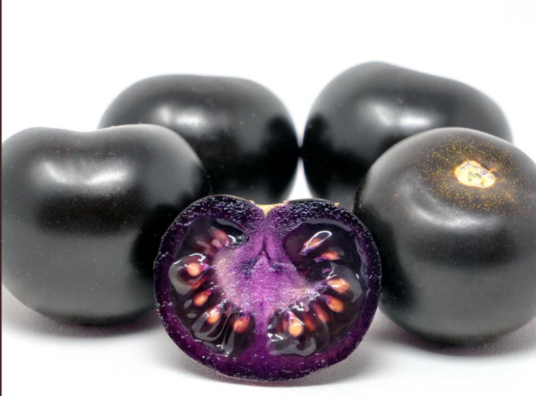
In May 2026, Latvia’s State Plant Protection Service detected the unauthorised distribution of genetically modified Norfolk Purple tomato seedlings in Latvia.
The seedlings were offered at the gardening fair Dārzs un Dzīvesstils 2026, at the stand of the gardening enthusiasts’ club TOMĀTS. Norfolk Purple is a genetically modified tomato developed by the US company Norfolk Healthy Produce. It is not authorised for cultivation or distribution in Latvia or the European Union.
After receiving information about the sale, the State Plant Protection Service inspected both the TOMĀTS club and the grower who had supplied the seedlings. Buyers were asked not to grow the plants, not to distribute them further, and to destroy the material safely.
The case matters because this was not only an online seed issue. By the time Norfolk Purple reached a public gardening fair as seedlings, the material had already moved through earlier stages: seeds had been obtained, plants had been grown, and seedlings had been supplied for sale.
That makes the case less about one prohibited tomato variety and more about the visibility of unauthorised GM plant material outside formal agricultural supply chains.
Not the first warning signal
This was not the first warning signal around Norfolk Purple in Latvia.
According to Latvian reporting, the same variety had already been found in Latvia in 2025 at a private collector, but had not reached the market.
There was also a Baltic online signal in 2025. Lithuania’s plant authority reported a cross-border online case involving Norfolk Purple tomato seeds. The website used for the sale was registered in Latvia. Public information is not enough to say where the seller was physically based.
These episodes do not prove one single chain of distribution. But they show that Norfolk Purple has appeared around Latvia more than once: first as a private or online seed issue, and now as seedlings at a public gardening fair.
Europe is not GMO-free
The Purple Tomato case does not show that Europe simply rejects GMO agriculture.
The EU is not a GMO-free zone. Authorised GM soy and maize already move through European food and feed chains, especially through livestock production. The EU also still has one GM crop authorised for cultivation: MON810 maize, grown mainly in Spain. But no GM vegetable crop is authorised for cultivation in the EU.
What the European system knows how to handle is authorised GMO material in large, traceable commodity flows: imports, food and feed use, labelling, testing and risk assessment.
What Norfolk Purple exposed is different: unauthorised GM plant material moving through smaller channels — gardening fairs, private greenhouses, online sales and local seed exchanges.
This is the old European compromise under pressure. Europe restricts GMO cultivation and unauthorised seed circulation at home, while allowing authorised GM crops into food and feed chains after EU assessment. That distinction may work for large commodity flows. It is much harder to apply when biotechnology arrives as a garden seedling.
Not a monster tomato
Norfolk Purple is not a “monster tomato”.
It is a transgenic tomato with dark-purple skin and flesh linked to higher anthocyanin content. The main visible trait is plant-based: the tomato was engineered to produce more anthocyanins, pigments found in foods such as blueberries, blackberries, blackcurrants and red cabbage.
The developer presents the tomato as a food and nutrition product, not as a herbicide-tolerant commodity crop. That does not make it a medicine or prove a specific health benefit for consumers. But it does make the case different from the classic early-2000s GMO image of Monsanto-era maize, herbicide tolerance and large-scale industrial agriculture.
This distinction matters. The public debate around GMO in Europe was shaped by a different set of products and fears. Norfolk Purple belongs to a newer consumer-facing biotechnology world: a tomato that a gardener may simply want to try in a greenhouse.
The real risk is visibility
There is no public evidence that Norfolk Purple presents a special health threat.
The environmental risk also looks limited in Latvian conditions. Tomatoes are not a crop that normally establishes itself as a wild population in Latvia. They are usually planted as seedlings each season, often in greenhouses or gardens.
But the regulatory problem is real.
The tomato can move through private gardens, seed saving, collectors, online sales and hobby groups without entering a formal agricultural supply chain. It may never reach a shop shelf. It may go directly into private greenhouses, family salads, jars of home preserves and next year’s seed exchange.
That is why the key question is not whether this is the only case.
The key question is whether it is only the visible case.
Regulators can see a public fair, a complaint, an online listing or an inspected grower. They cannot easily see what is already growing in private greenhouses.
Why organic producers were warned
Latvia’s plant protection authority specifically warned organic farmers and gardeners because GMO use is not allowed in organic production.
A farmer may not plant Norfolk Purple as a commercial GMO crop. It may enter a farm as a curiosity — a few purple tomato plants grown next to ordinary seedlings for family salads and home preserves.
But for organic certification and traceability, intention is not the main issue. The problem is the presence of an unauthorised GMO plant in the production environment.
Latvia has seen GMO-related cases before, including GMO presence in oilseed rape material. But that belongs to a more classical control problem: contamination, seed or feed chains, testing and coexistence. Norfolk Purple is different.
A system built for another problem
Latvia’s GMO-free framework is partly municipal. Municipalities can adopt additional territorial bans on the cultivation of GM crops. Many have done so, but not all.
This does not mean that unauthorised GMO crops may be grown in the remaining municipalities. EU and national authorisation rules still apply.
But the municipal GMO-free layer was designed for territorial cultivation control. Norfolk Purple exposes a different problem: not a farmer applying to grow a GM crop in a field, but a seedling moving through a gardening fair and private greenhouse networks.
Latvia’s public GMO framework still carries much of the language of the first European GMO battles: risks to health and the environment, allergens, toxicity, coexistence with conventional and organic farming, GMO-free territories and commodity crops.
Those concerns have not disappeared. But they do not fully describe the Norfolk Purple case.
What to watch
Norfolk Purple is not the final test for European plant biotechnology. It is a signal.
The harder debate will come when new plant technologies offer traits that farmers may clearly want: crops less vulnerable to wet seasons, disease, late spring frosts or unstable weather.
Then the question will become harder than whether Europe should allow a purple tomato. It will be whether Europe can update its plant-biotech rules without relying only on the political reflexes of the early GMO wars.
The Purple Tomato case is not mainly about one tomato variety.
It is about whether Europe can still see the seed market it is trying to regulate.