Analysis · Industry & Manufacturing
What Operating Environment Is Latvia Selling to Foreign Investors?
Baltic Focus analysis
Editor: Galina Molochkova
Riga has just hosted a dense run of investor-facing events built around stability, innovation, competitiveness and aftercare. But Latvia’s domestic administrative signal raises a practical question: what kind of state will foreign investors actually meet after the conference stage?
Latvia’s external investor message looked unusually strong in early June.
Riga hosted the EBRD Annual Meeting and Business Forum on 5–7 June 2026, bringing government representatives, business leaders, policymakers, academics and opinion leaders to Latvia. The event positioned Riga at the centre of discussions on competitiveness, innovation and economic resilience, and was presented as an opportunity to highlight Latvia’s potential as an investment destination.
At almost the same time, Riga hosted the 2026 Aftercare Forum, presented by LIAA as the world’s only international event dedicated entirely to investor aftercare. It brought together investment-promotion, economic-development and investment-sector professionals from 20 countries to discuss technology, data, collaboration, investor relations, business growth and national competitiveness.
This is the conference version of Latvia: open, European, digitally capable, investor-facing and serious about aftercare.

For Baltic Focus, the issue is not that these conferences took place or that Latvia promoted itself there. The issue is what kind of operating environment Latvia promised to the external world — and whether the domestic administrative state offers the same environment after the conference stage.
Foreign investors do not meet Latvia only at conferences.
They meet it at PMLP (Latvia’s Office of Citizenship and Migration Affairs, the migration and identity-document authority), at the police desk, at the border, in municipal offices, in banks, with notaries, in schools, in family paperwork, in road incidents and in ordinary situations where the state is no longer an investment-promotion partner but a service provider.
That is where the harder question begins.
What operating environment did Latvia just sell to the external world — and does the domestic administrative state offer the same environment once investors, specialists, suppliers, workers and family members actually arrive?
The other signal
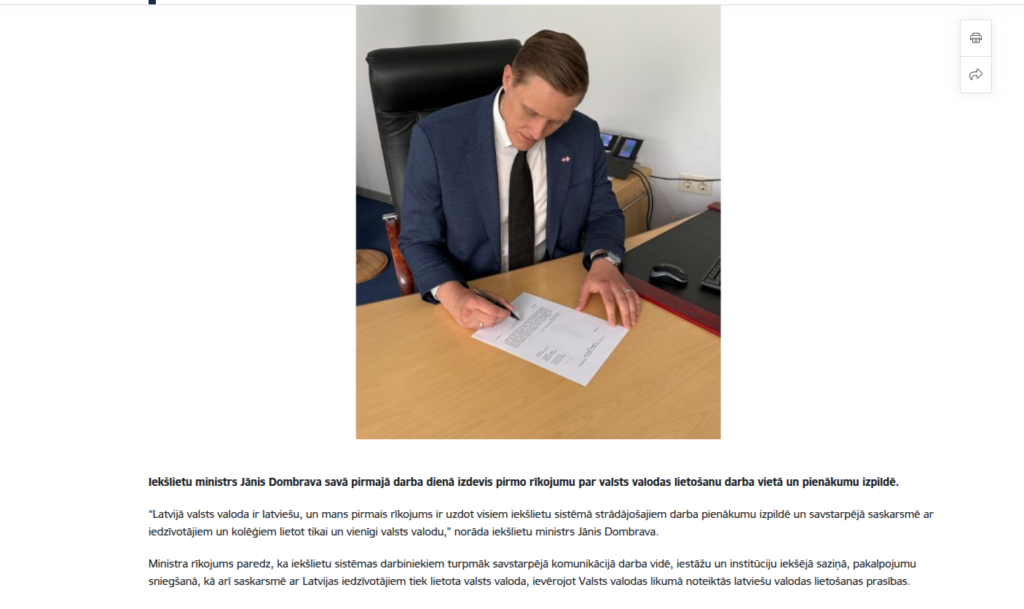
On 29 May, on his first working day as Latvia’s new interior minister, Jānis Dombrava announced his first order: employees of the Interior Ministry system must use “only and exclusively” the state language when performing duties and when communicating with residents and colleagues.
This was not framed only as a rule for formal documents. According to the ministry’s own public statement, the instruction applies to the working environment, internal communication between institutions, service provision and contacts with residents.
The official wording is also important because it refers to service provision and communication with “Latvian residents”. That may be legally meaningful, or it may simply be administrative wording. But for foreign users it leaves a practical question unanswered: how should the rule apply to non-Latvian-speaking investors, specialists, suppliers, workers or family members who are dealing with Interior Ministry institutions?
That matters because the Interior Ministry system is not peripheral to foreign investors. It includes practical state interfaces that foreigners may meet after arrival: police, border control, migration procedures, identity documents, public order and other points of contact.
The point is not that every foreign investor personally spends their first week in Latvia at an Interior Ministry counter. Many will use lawyers, relocation consultants, employers, business associations or LIAA channels.
But “foreign investor” does not only mean a fund, a corporation or a high-budget project with professional wrappers. It can also mean a small entrepreneur buying a shop, opening a café, registering a company, renting premises and dealing personally with PMLP, municipal offices, banks, notaries and other parts of the Latvian administrative system. For this part of the investor spectrum, the public-service interface is not abstract. It is the operating environment itself.
PMLP’s customer-service standard adds another layer. If a client does not know Latvian, the client is expected to come to PMLP with a person who can help communicate and provide translation from a foreign language into Latvian. PMLP also states that it provides information on public services and the conditions for receiving them in the state language.
This is a clear operating model. Public administration works in Latvian. Translation is not presented as a general public-service layer. The foreign client is expected to bring language capacity, private support or local administrative help.
That model may be legal. It may be politically intended. It may also reflect Latvia’s long-standing language policy.
But if it is the actual model, it belongs in Latvia’s investment message too.
Not a language-identity argument
This is not a question of replacing Latvian with English.
Latvia has a state language. That is not the issue. A small European state has every reason to protect the language in which its institutions, law, education and democratic life function.
The issue is different.
Latvia is not only protecting its state language. It is also actively inviting foreign investors, high-skilled specialists, defence-technology partners, allied personnel, foreign workers, founders, managers and their families into its economy and security environment.
For these groups, English is not an ideological concession. It is a working tool. It is the language of international investment platforms, EBRD-related discussions, defence-technology cooperation, fintech meetings, European partners, U.S. companies and transatlantic investors.
Latvia can keep Latvian as the state language and still recognise that the foreign users it invites need a usable public-service interface. These two things are not contradictory. They are basic operating logic for a small open economy.
The question is not whether English should become a general public-service right in Latvia.
The question is whether Latvia clearly explains what foreign investors, specialists, workers, suppliers and family members should expect when they need to deal with the state after the conference, after the investment announcement, after relocation, after a business trip, after a road incident, or after a document problem.
If the answer is: “bring your own Latvian-language capacity from day one,” that should be part of the operating environment Latvia sells before commitment.
Is this just a Baltic norm?
This is not simply “how the Baltics work”.
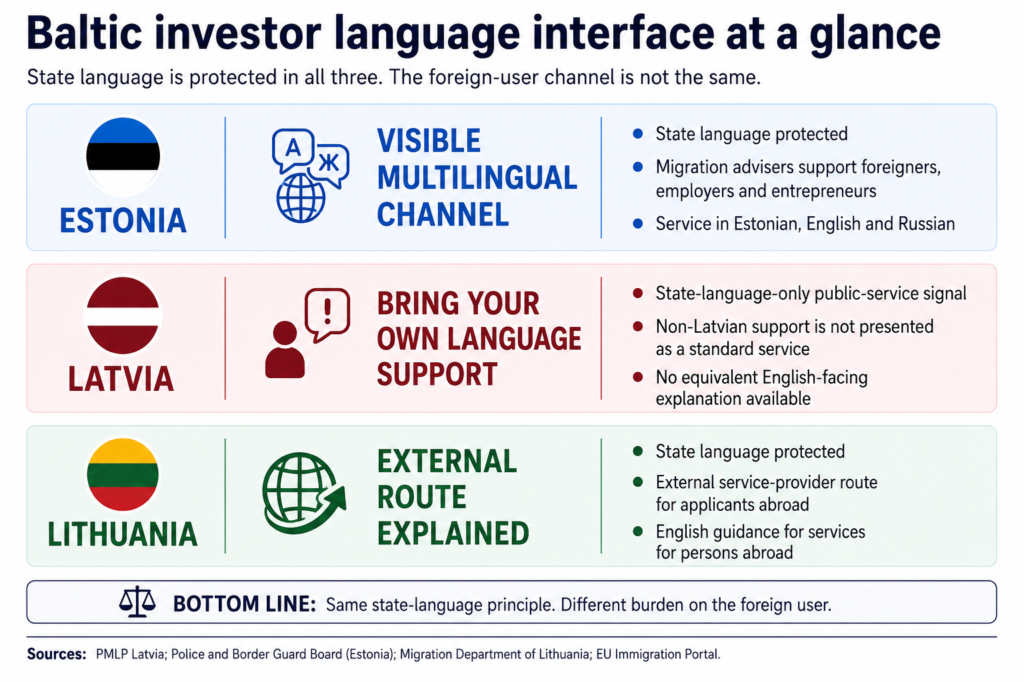
All three Baltic states protect their state languages. Estonia protects Estonian. Lithuania protects Lithuanian. Latvia protects Latvian. That is the common regional baseline.
The practical question is how each country organises the foreign-user channel around that state-language model.
Estonia’s Language Act regulates the use of both Estonian and foreign languages in oral and written administration, public information and service. Estonia also has Police and Border Guard migration advisers whose task is to support foreigners settling in Estonia and to work with employers, entrepreneurs, educational institutions and others who invite foreigners to Estonia. These advisers provide service in Estonian, English and Russian.
Lithuania also protects Lithuanian, but its migration interface includes a visible external-service-provider route for foreigners applying from abroad. The EU Immigration Portal states that when coming to Lithuania from abroad, an applicant can submit a temporary residence-permit application through the external service provider chosen by the Migration Department. Lithuania’s Migration Department also maintains English-language guidance for services for persons abroad.
This does not mean Estonia or Lithuania are “English-service countries”. They are not.
But both examples show that the relevant question is not whether a Baltic state protects its language. It is whether the state clearly builds and explains a practical channel for foreign investors, workers, specialists and family members who need to deal with migration and public-service institutions.
That is the benchmark Latvia should be measured against.
The capacity already exists
The issue is not that Latvia has no multilingual capacity inside the state.
Open materials show the opposite.
PMLP has previously treated foreign-language capacity as part of administrative and service quality. In earlier language-training projects, PMLP officials took English-language training connected to migration, return and asylum-related work.
More recently, PMLP recruitment practice pointed in the same direction. A customer-service management vacancy required English at B2 level and explained why: the duties included serving foreign clients.
The State Border Guard is especially relevant because it is part of the Interior Ministry system. In 2025, it published a procurement for English-language training with an estimated contract price of €421,487. The procurement included English-language training for border guards involved in migration.
Another State Border Guard project states that training in 2026 will improve the foreign-language skills of officials involved in migration, return and asylum work, including English, and that the project is meant to strengthen institutional capacity in migration-flow management and internal and external security.
This does not mean that every Latvian official is legally obliged to serve every foreigner in English.
But it does mean that Latvia has trained, recruited and funded foreign-language capacity for work with foreign clients, migration and border-control functions.
So the question becomes simple: what was this capacity built for?
If migration officials, border guards and PMLP customer-service managers are trained or recruited for foreign-language communication, then multilingual capacity is not alien to the Latvian state.
The question is whether that capacity is allowed to function as part of the investor-service and security-cooperation interface — or whether it becomes informal, discretionary and administratively discouraged.
The communication mismatch
There is another problem: the signal is not equally visible to different audiences.
The Interior Ministry’s official Latvian-language page published the minister’s order as a short institutional message. Baltic Focus could not identify an equivalent English-facing clarification on the ministry’s website explaining how the instruction should be understood by foreign users of Interior Ministry services.
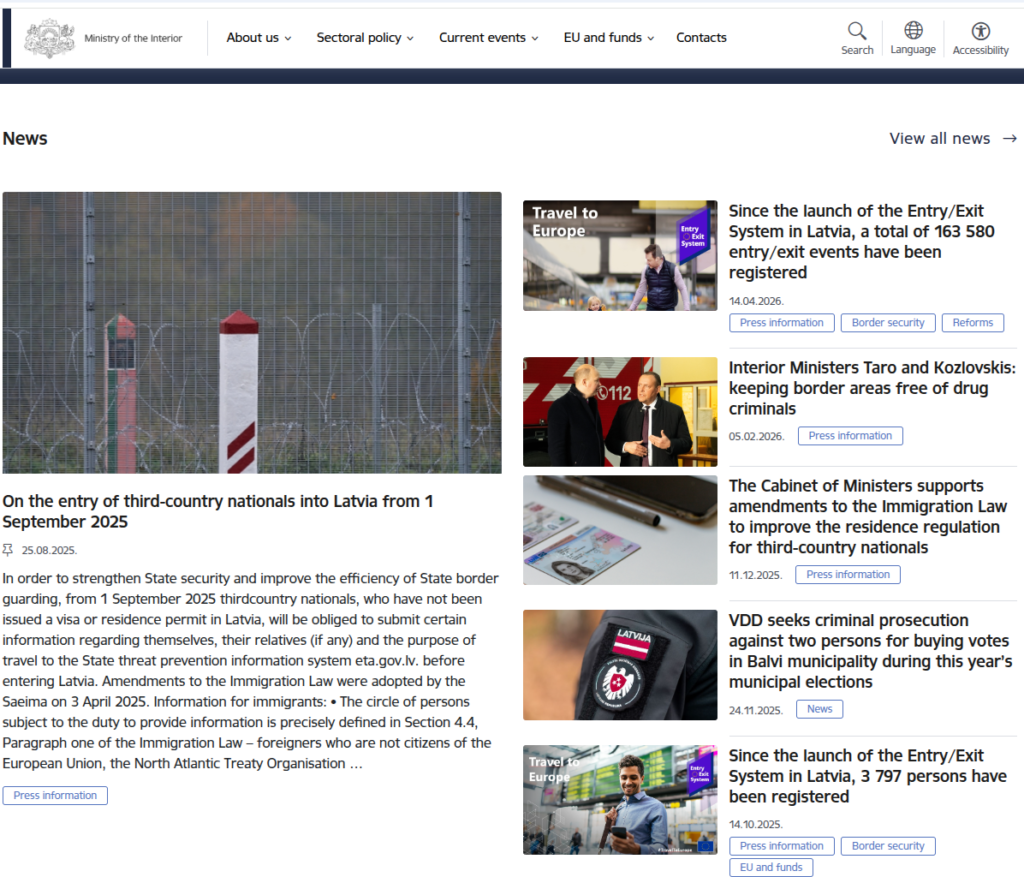
This matters because the clarification layer appears to remain mainly inside Latvia’s Latvian-language domestic information space. Some Latvian-language media later referred to exceptions under the State Language Law for urgent police, medical, rescue-service and similar situations. But that is precisely the point: such clarifications were not presented as a clear English-facing public-service explanation for foreign investors, specialists, suppliers, workers or family members.
Latvia’s English-facing institutional layer presents an international, European and accessible state: border security, EU systems, Ukraine support, migration, public safety, cooperation and capacity-building.
The Latvian-language domestic layer may contain practical conditions under which that state actually works.
Foreign investors and partners do not need Latvia’s domestic political debates translated for them. But they do need clear public rules. If a rule affects the foreign-user interface, it should be visible in the same layer through which Latvia presents itself internationally.
That is the problem here. The English-language layer shows an accessible, European and investor-facing country. The Latvian-language domestic layer may carry the political context, media follow-ups and practical explanations. When those conditions are not explained clearly to foreign users, investors are left to discover the real administrative environment after arrival.
This is no longer only about one minister’s political signal. The Interior Ministry is part of the government. More than a week after the order was published, Baltic Focus could not identify an official English-language explanation of what the new instruction means for foreign users of Interior Ministry services.
If this is now Latvia’s policy, it should be explained clearly in English, through an official channel, with links to the relevant legal acts or service guidelines.
That is the post-conference issue.
If the two layers are consistent, the government can explain that clearly. If they are not, the gap itself becomes part of the investment environment.
Not only investors
The same issue affects the foreign-resident layer Latvia has already attracted.
Many expats are not separate from the investment story. They are investors, managers, specialists, consultants, founders, spouses, partners and families who have already acted on Latvia’s promise as a workable place to live and do business.
Part of that promise has been practical, even if not always formal: in Latvia, many public-facing professionals can understand or use English, and everyday life for foreign residents can often be managed without high-level Latvian.
But knowing English is not the same as being institutionally allowed or encouraged to use it in public service.
If multilingual capacity becomes informal while Latvian-only communication becomes the safest institutional rule, the operating environment changes for people who are already here — not only for those still considering investment.
The issue also extends to European partners, U.S. companies, transatlantic investors, allied personnel, defence suppliers, foreign workers and high-skilled specialists. These groups do not all have the same legal status, income level or reason to learn Latvian at a high level before dealing with the state.
Latvia’s economy uses foreign labour, courts foreign capital and hosts foreign partners. Its public-service language model should be assessed against that real user base — not against an imagined foreigner who has already become a Latvian-speaking administrative user.
Security and capability
The contradiction is not limited to investor service.
The new government’s agenda places border security and anti-drone measures near the top of the political priority list. Dombrava’s publicly reported priorities also include strengthening interior services, civil protection, automated solutions, drones, artificial intelligence and closer cooperation between interior and defence services.
This is a highly international field.
Drone detection, counter-drone systems, radio-electronic warfare, border protection and lessons from Ukraine do not develop inside a purely domestic language bubble. In this field, foreign technical expertise may arrive faster than it can be translated into Latvian. Suppliers, allied specialists and Ukrainian practitioners may need to explain systems, risks, software, procedures and field lessons directly to Latvian institutions.
This is not only about visiting experts who arrive for one meeting and leave.
Foreign technical specialists may need to spend time in Latvia: training local teams, installing systems, testing equipment, adjusting software, working with border-security institutions, supporting suppliers or helping transfer lessons from Ukraine and allied partners.
If such specialists are expected to solve the Latvian-language interface themselves whenever they deal with Interior Ministry institutions, this becomes more than an administrative detail. It becomes an operating cost and a coordination risk inside the very security cooperation Latvia says it wants to strengthen.
A counter-drone or border-security project cannot rely only on informal goodwill and ad hoc translation. If Latvia needs foreign expertise, it also needs to explain what working-language layer will support that expertise while those people are actually in the country.
That makes the language question operational, not symbolic.
If the Interior Ministry system needs international knowledge transfer, allied cooperation, foreign suppliers and technical communication in areas such as drones and border security, then foreign-language capacity is not a courtesy. It is part of institutional capability.
The EU comparison inside the same story
There is no contradiction in Latvia’s interior minister speaking Latvian at an EU Council meeting.
That is how the European Union is designed to work: national languages are supported by institutional translation, interpretation, protocol and administrative infrastructure. Latvian becomes usable internationally because the system provides the language layer around it.
The question is whether Latvia provides any comparable practical layer for the foreign people it invites into its own operating environment.
An investor, specialist, allied partner or family member who meets PMLP, police, border services or another Interior Ministry institution does not enter the same protected multilingual infrastructure. If the operating rule is Latvian-only, the language gap may become the foreign user’s private responsibility.
That is the mismatch.
The real investor question
This is a policy-coherence question, not a language-identity argument.
The issue is the gap between how Latvia presents itself on international and authoritative investor-facing stages — and what foreign investors, specialists, partners and families may meet inside the country after they commit.
If the practical operating model requires Latvian-language capacity, private interpreters or local administrative wrappers from day one, this should be visible before money is invested, teams are relocated or families move to Latvia.
Not after landing.
Not at the PMLP counter.
Not when a family member needs a document.
Not when a road incident or police contact happens outside the prepared service package.
Before commitment.
Otherwise Latvia risks presenting one operating environment at investor events and delivering another inside the administrative system.
The investor does not meet “LIAA Latvia” and “Interior Ministry Latvia” as separate countries. They meet one Latvia.
Once Latvia invites foreign investors into its economy, the usability of the Latvian state becomes part of the investment offer.
The question is therefore not only whether Latvia welcomes investors on stage, but what operating environment it is actually selling them before they commit capital, staff or family relocation.
Editorial note
As of publication, Baltic Focus could not identify an official English-language clarification on the Interior Ministry website explaining how non-Latvian-speaking foreign investors, allied personnel, defence suppliers, foreign workers and their families are expected to interact with Interior Ministry institutions under the new language instruction.
If the Ministry of the Interior considers this reading incomplete or incorrect, Baltic Focus would welcome clarification in English, with links to the relevant legal acts, internal instructions or public-service guidelines.
Baltic Focus would be ready to publish such clarification in English.