Analysis · Transport & Logistics
Active Restructuring Is Beginning in the Baltic Postal Market — Who Could Be the First to Exit?
DHL eCommerce has agreed to acquire Venipak’s companies in Lithuania, Latvia and Estonia.
DHL eCommerce has agreed to acquire Venipak’s companies in Lithuania, Latvia and Estonia. The transaction gives DHL an established Baltic last-mile platform rather than requiring it to build separate operations in the three countries.
Subject to regulatory approval, Venipak will become part of DHL eCommerce. The company will continue operating under the Venipak brand during the integration period, with its current management and employees remaining in place. DHL plans further investment in sorting capacity, technology and the out-of-home delivery network.
DHL already carries international shipments to and from the Baltic states. The acquisition adds direct control over local sorting, couriers, parcel lockers and customer contracts.
What DHL Is Acquiring
Venipak operates around 800 parcel lockers across Lithuania, Latvia and Estonia. Its partnership with the open-access uDrop network increased the number of lockers available to Venipak customers to more than 1,000 by the end of 2025.
The distinction is important. DHL is acquiring Venipak’s proprietary infrastructure, but not uDrop. The additional locations remain part of a shared network also available to other delivery companies.
The latest local accounts show the financial scale of the Baltic business.
| Venipak company | 2025 revenue | 2025 net result |
|---|---|---|
| Venipak Lietuva | €62.02m | −€0.84m |
| Venipak Latvija | €25.71m | €0.86m |
| Venipak Eesti | €11.05m | −€1.18m |
| Combined local accounts | €98.77m | −€1.15m |
The combined figures are an arithmetic sum of the three local accounts, not an official consolidated Venipak result. They may include transactions between group companies.
Venipak’s Lithuanian operation accounted for almost two-thirds of the total revenue. Latvia was the only profitable Baltic company in 2025, while the Lithuanian and Estonian businesses reported losses.
DHL eCommerce generated €6.884 billion in revenue and €379 million in EBIT in 2025. Its European network included more than 167,000 service points, including over 53,000 parcel lockers.
Venipak withdrew from Poland’s domestic parcel market in 2025, leaving the company more concentrated on the three Baltic states. Poland remains part of the transaction’s logistics logic: Venipak’s Lithuanian infrastructure supports cross-border flows towards Poland and can now be connected to DHL’s existing Polish and European network.
DHL is therefore buying a regional operating platform with close to €100 million in annual local revenue, not only a parcel-locker network.
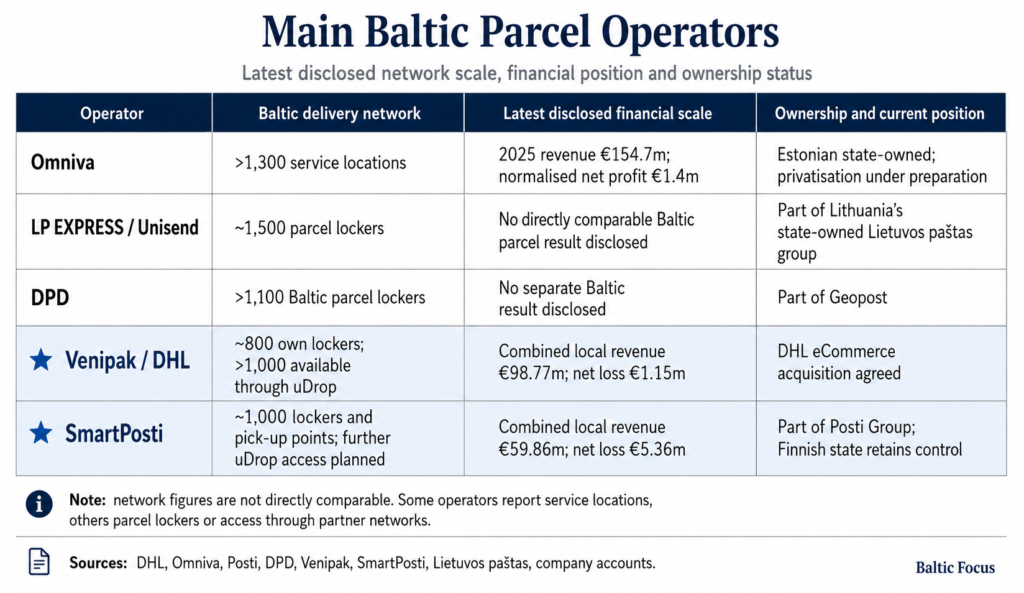
Main Baltic Parcel Operators
| Operator | Baltic delivery network | Latest disclosed financial scale | Ownership and current position |
| Omniva | More than 1,300 service locations | 2025 revenue: €154.7m; normalised net profit: €1.4m | Owned by the Estonian state; privatisation under preparation |
| LP EXPRESS / Unisend | Around 1,500 parcel lockers | No directly comparable Baltic parcel result disclosed | Part of the Lithuanian state-owned Lietuvos paštas group |
| DPD | More than 1,100 Baltic parcel lockers | No separate Baltic result disclosed | Part of Geopost |
| Venipak / DHL | Around 800 own lockers; more than 1,000 available through uDrop | Combined local revenue: €98.77m; net loss: €1.15m | Acquisition by DHL eCommerce agreed |
| SmartPosti | Roughly 1,000 lockers and pick-up points; further uDrop access planned | Combined local revenue: €59.86m; net loss: €5.36m | Part of Posti Group; Finnish state retains control |
The network figures measure different categories. Omniva reports service locations, DPD reports parcel lockers, and Venipak and SmartPosti include access to shared infrastructure. They indicate regional reach, not directly comparable market shares.
The table nevertheless shows that DHL is acquiring one of several established Baltic-scale networks. The market is already occupied by operators with regional infrastructure, sorting capacity and cross-border operations.
Ownership Restructuring Begins
The DHL–Venipak acquisition may be the first major transaction in a broader restructuring of ownership in the Baltic postal and parcel-delivery market.
The next large change is already being prepared. On April 2, the Estonian government decided to sell 100% of Eesti Post, operating under the Omniva brand, through a public auction. Preparations are scheduled for 2026, with a share purchase agreement planned for 2027.
Estonian media have mentioned FedEx and Chinese companies among possible buyers. No bidder has been officially confirmed.
Omniva is not being prepared for sale as a distressed operator. The group generated €154.7 million in revenue in 2025 and reported a net profit of €5.9 million. Of that amount, €4.6 million came from a one-off property transaction; normalised net profit was €1.4 million.
Its Baltic parcel-business revenue increased by 11% to €84.1 million, while international transit revenue rose to €25.2 million. The group handled more than 50 million parcels during the year.
A buyer would acquire an operating platform across all three Baltic states, not simply the Estonian universal postal-service provider. Only around 5% of Omniva’s 2025 revenue came from the universal postal service.
The DHL–Venipak deal gives the Omniva privatisation a wider market context. Two large Baltic delivery platforms could change ownership within a relatively short period.
Pressure on the Other Operators
DPD already belongs to a large international parcel group. Its Baltic network is integrated into Geopost’s wider European system, reducing the immediate ownership pressure.
The DHL transaction will still increase direct competition. DHL will gain its own Baltic sorting and last-mile capacity instead of depending as heavily on external delivery operators.
Lietuvos paštas has followed a regional expansion strategy. Its LP EXPRESS and Unisend network now includes around 1,500 parcel lockers across the Baltic states. Unisend reported more than seven million parcels during its first two years in Latvia and Estonia.
Its next task is to convert geographical expansion into stable parcel volumes and profitability. It will compete against a DHL-owned Venipak and, potentially, an Omniva with a new strategic owner.
uDrop has a different role. Its open-access model allows several operators to expand coverage without financing a complete proprietary network. Venipak, SmartPosti and Unisend all use or have announced access to shared infrastructure.
This reduces the importance of locker numbers alone. An operator can increase available locations without controlling the underlying assets.
SmartPosti Is the First Candidate to Lose Its Independent Position
SmartPosti has the weakest financial position among the regional operators for which comparable local results are available.
| SmartPosti company | 2025 revenue | 2025 net result |
| SmartPosti Estonia | €32.19m | −€0.89m |
| SmartPosti Lithuania | €18.76m | −€2.53m |
| SmartPosti Latvia | €8.91m | −€1.94m |
| Combined local accounts | €59.86m | −€5.36m |
These figures are also an arithmetic sum of local accounts rather than an official consolidated Baltic result.
All three SmartPosti companies reported losses in 2025. Estonia moved from a €1.04 million profit in 2024 to a loss of €0.89 million. Lithuania remained loss-making despite higher revenue. Latvian revenue fell to €8.91 million and the loss widened to €1.94 million.
SmartPosti’s combined local revenue was approximately 39% below Venipak’s. Its combined loss was more than four times larger.
This does not show that Posti Group has already decided to sell or close the Baltic business. It does make SmartPosti the first candidate to lose its position as a separately maintained Baltic platform.
The most likely form of exit would be a sale, merger or integration with another operator. A complete withdrawal from the three markets is a more radical scenario.
Posti Group was listed on Nasdaq Helsinki in 2025. The Finnish state retains approximately 65.8% of the shares and remains the controlling owner. The group must therefore balance the strategic value of its Baltic presence against continued losses and the interests of minority shareholders.
Posti may still choose to invest. SmartPosti’s partnership with uDrop is expected to increase the number of collection locations available to its Baltic customers by approximately 30% by the end of 2026.
A larger accessible network, however, does not resolve the financial problem by itself. The relevant test is whether SmartPosti can attract enough additional parcel volume to reverse losses in all three countries.
If Venipak is integrated into DHL and Omniva receives a new well-capitalised owner, Posti will have to decide whether to finance SmartPosti as an independent Baltic platform or change the structure of the business.
The Next Phase
The Baltic parcel market is moving beyond the initial phase of parallel locker-network construction.
DHL is acquiring an operating platform and connecting it to international parcel flows. Omniva is being prepared for a full change of ownership, while shared networks allow operators to expand coverage without owning every delivery point.
The next phase will be determined by the integration of Venipak into DHL, the outcome of the Omniva privatisation and Posti Group’s response to SmartPosti’s Baltic losses.