Lithuania’s Top-Paying Employers in June 2026: A Map of the Country’s High-Value Economy
Employer-level Sodra data reveal where Lithuania hosts expensive technology, pharmaceutical, financial, laboratory and regional corporate functions — and which June payments were structural or exceptional.
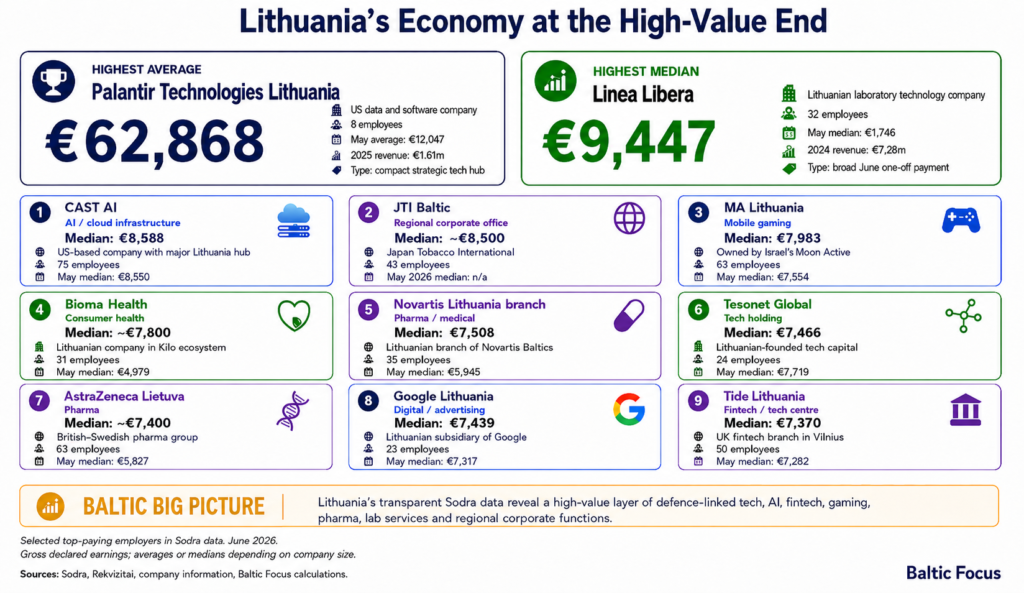
Employer-level Sodra data reveal where Lithuania hosts expensive technology, pharmaceutical, financial, laboratory and regional corporate functions — and which June payments were structural or exceptional.
Baltic labour markets are usually assessed through national averages, medians and wage differences between sectors. Lithuania, however, offers an additional level of transparency. Open data from the national social insurance fund, Sodra, make it possible to see the average earnings reported by individual employers and, for larger companies, the median and quartile distribution of those earnings.
Baltic Focus found no comparable official monthly database ranking named private employers in Latvia or Estonia. Both countries publish detailed wage statistics by sector, occupation and region, but Lithuania’s employer-level data connect officially declared insurable income to specific companies.
The figures for June 2026, reported on 27 July, drew attention after Palantir Technologies Lithuania topped the list with average gross earnings of almost €62,900 for eight people who had worked all or part of the month. Lithuania’s average gross monthly wage was €2,542.8 in the first quarter of 2026.
The more useful question, however, is not simply who transferred the largest amount to employees in one month. It is what kinds of companies appear at the top, which functions they have placed in Lithuania, whether they are Lithuanian or foreign-owned, and whether the June figures reflect persistent pay levels or exceptional payments.
Who Sits Alongside Palantir at the Top of Lithuania’s Pay Scale — and How Lithuanian Are These Companies?
Palantir: A Strategic Entry Followed by First Place
Palantir Technologies Lithuania is the Lithuanian subsidiary of the US data and software company, not an unrelated local namesake. The legal entity was registered in Vilnius in March 2022.
Its purpose became clearer in April 2023, when Palantir announced a strategic partnership with Lithuania’s Ministry of National Defence. The agreement covered cooperation on new digital solutions, while the company presented Vilnius as the planned location of a regional competence and technical hub for big-data capabilities. Palantir also said it intended to recruit software engineers in Lithuania.
In June 2026, its eight employees received average gross earnings of €62,868, compared with €12,047 in May. The June result therefore appears to include substantial bonuses, share-related compensation or other additional payments. Yet the May figure was already nearly five times the Lithuanian national average, indicating a structurally expensive operation even before the June surge.
The local company generated approximately €1.61 million in revenue and €139,000 in net profit in 2025. It remains a compact team rather than a large employment centre.
Linea Libera: A Lithuanian Laboratory Company and a Large One-Off Payment
The highest median earnings in June were reported by Linea Libera, a Lithuanian laboratory-technology company operating since the 1990s.
Linea Libera supplies equipment, instruments, reagents and consumables and provides installation, servicing, training and technological integration for research, life-sciences, healthcare and industrial laboratories. It is a locally owned distributor and integrator working with several international manufacturers.
The company had 32 employees. Their median gross earnings reached €9,447 in June, while average earnings rose to €12,617. In May, however, the median had been €1,746 and the average €1,784.
Because both indicators increased sharply, the additional payment reached a substantial part of the workforce rather than one director or specialist. The data suggest a broad bonus or another collective payment, although the company has not confirmed its nature.
The latest available financial results are for 2024, when Linea Libera generated €7.28 million in revenue and around €6,000 in net profit. Without its 2025 accounts or a company explanation, the June payment cannot be described as profit-sharing.
CAST AI: A Persistently Expensive Development Hub
CAST AI reported a June median of €8,588 across approximately 75 employees, almost unchanged from €8,550 in May.
The company develops technology for automating and optimising cloud infrastructure and AI workloads. Although headquartered in the United States, it has placed a central part of its product development in Lithuania. Invest Lithuania describes Vilnius as CAST AI’s only hub outside the US and says that as much as 95% of its software has been developed there.
The Lithuanian operation covers software engineering, research and development, product and project management, customer work and marketing. CAST AI Baltic generated €11.42 million in revenue and €720,000 in net profit in 2025.
Unlike several companies lifted by additional June payments, CAST AI remained above €8,500 in both months.
JTI Baltic: High-Paid Regional Corporate Functions
JTI Baltic reported median earnings of approximately €8,500 for 43 employees. The company belongs to Japan Tobacco International and performs Baltic commercial and corporate functions from Vilnius.
The Lithuanian company generated €20.79 million in revenue and approximately €241,000 in net profit in 2025.
A directly comparable median for May 2026 was not available. Historical averages nevertheless indicate that high earnings are not unprecedented. Average gross earnings stood at €8,724 in May 2025, fell to €7,347 in June and ranged from approximately €8,680 to €9,974 over the following three months.
These averages cannot be compared directly with the June 2026 median, but they indicate that JTI Baltic has occupied Lithuania’s upper pay range before. Its position also broadens the picture beyond technology: regional management, legal, financial and commercial functions can command similar earnings.
MA Lithuania: A High-Paid Gaming Studio Under Foreign Ownership
MA Lithuania is a Vilnius mobile-game development company owned by Israel’s Moon Active. It previously operated as Melsoft LT and adopted its current name in 2024.
The Lithuanian team performs product, engineering, design and operational work rather than merely representing the parent company. MA Lithuania employed 63 people in June and reported median earnings of €7,983, compared with €7,554 in May.
The company generated €21.78 million in revenue and €1.31 million in net profit in 2025. Revenue was around 20% lower than in 2024, and the company has reduced its workforce.
MA Lithuania therefore combines persistently high earnings with a contracting local operation. Salary levels alone do not indicate business expansion.
Bioma Health: A Lithuanian Consumer-Health Export Business
Bioma Health is a Lithuanian company within the wider Kilo business ecosystem. It sells consumer-health products focused on probiotics and the gut microbiome.
Its model is closer to an internationally oriented health brand supported by e-commerce, product management, marketing and data functions than to a pharmaceutical research laboratory.
The company had 31 employees in June, with median earnings of approximately €7,800, up from €4,979 in May. The previous month was already well above the national average, but June brought a sizeable additional increase.
In 2024, Bioma Health generated €34.56 million in revenue and €4.25 million in net profit. Results for 2025 were not yet available in the public company database.
Novartis: A Lithuanian Branch Inside a Baltic Legal Structure
Novartis had 35 employees in Lithuania, with median earnings of approximately €7,500 in June.
The operation is not an independent Lithuanian limited company. It is the Lithuanian branch of SIA Novartis Baltics, a Latvia-registered company belonging to the Swiss pharmaceutical group.
Its median rose from €5,945 in May to €7,508 in June, while average earnings increased from €6,616 to €7,587. This points to an additional June payment on top of an already high base.
Because the Lithuanian operation is a branch, it does not publish a separate turnover figure comparable with those of Lithuanian limited companies. Its functions are likely to include specialised medical, regulatory, market-access and commercial work within the Baltic structure.
Tesonet Global: Lithuanian Capital and Holding-Company Economics
Tesonet Global is part of a Lithuanian-founded technology and investment ecosystem associated with cybersecurity, web intelligence, hosting, artificial intelligence and other digital sectors.
Its 24 employees had median earnings of €7,466 in June, compared with €7,719 in May. Average earnings also changed only slightly, from €8,306 to €8,012.
The company reported €5.79 million in sales revenue and €553.49 million in net profit in 2025. The extreme gap makes the result incomparable with the operating profits of CAST AI, AstraZeneca or JTI. Without the underlying accounts, it should be treated as a holding-company result rather than attributed to a specific transaction or ordinary margin.
Tesonet’s presence confirms that Lithuania’s upper earnings layer also includes locally accumulated technology capital and investment-management functions.
AstraZeneca: A High-Paid Pharmaceutical Subsidiary
AstraZeneca Lietuva is the Lithuanian subsidiary of the global British-Swedish biopharmaceutical group. It employed 63 people in June, with median earnings of approximately €7,400.
The May median was €5,827, meaning June brought a significant increase on top of an already high base.
The company generated €10.28 million in revenue and approximately €469,000 in net profit in 2025. The Lithuanian operation is a commercial and professional pharmaceutical presence rather than a manufacturing site, with medical, regulatory, market-access and sales functions.
Google Lithuania: A Stable but Compact Commercial Operation
Google Lithuania is a local subsidiary of the US technology group. Its registered activity is associated with advertising services, and it employed 23 people in the June ranking.
Median earnings were €7,439 in June, compared with €7,317 in May. Average earnings rose from €8,010 to €8,502, indicating a consistently high pay level rather than a one-month anomaly.
The Lithuanian entity generated €5.55 million in revenue and €363,000 in net profit in 2025. These accounts describe only the local legal company, not Google’s total revenue or economic footprint in Lithuania.
Tide: A British Fintech Building a Lithuanian Technology Centre
Tide is a British financial platform serving small and medium-sized businesses. Its Lithuanian operation is a branch of the UK company.
Tide opened its Vilnius technology centre in 2024. The team develops products and supports operations across several markets, making it an engineering and product centre rather than a representative office.
The branch employed 50 people in June. Median earnings were €7,370, almost unchanged from €7,282 in May, while average earnings remained just above €7,100.
As a branch, Tide does not provide a directly comparable Lithuanian turnover figure. Its employment scale and stable median nevertheless indicate a substantive local technology operation.
What the Ranking Reveals
The May comparison separates persistent high earners from companies lifted by additional June payments.
CAST AI, MA Lithuania, Tesonet Global, Google and Tide recorded broadly stable medians in both months. Palantir had an exceptionally high May base but added a very large June payment. Novartis, AstraZeneca and Bioma Health combined high underlying earnings with clear June increases.
Linea Libera is the most distinct one-off case: its May earnings were close to or below the Lithuanian national average before a broad additional payment lifted it to the top of the June median ranking. JTI lacks a directly comparable May 2026 median, although historical averages indicate a consistently expensive operation.
The companies also represent different types of activity. Palantir, CAST AI and Tide have placed specialised technology functions in Lithuania. MA Lithuania is a foreign-owned development studio. Google, AstraZeneca, Novartis and JTI maintain commercial, medical, regulatory or regional corporate teams. Linea Libera is a locally owned laboratory-technology business, while Bioma Health and Tesonet represent Lithuanian product and investment ecosystems.
The ranking is therefore not evidence of one homogeneous high-salary sector. It is a partial map of the engineering, product, specialist and regional functions for which both foreign and Lithuanian companies are prepared to pay well above the national average.
Methodology
Sodra reports officially declared gross insurable income, not contractual base salaries. The figures can include bonuses, additional remuneration, compensation and other payments subject to social insurance.
Average earnings are published for employers with more than three insured workers. Median and quartile data require more than 20 employees and may include people who worked only part of the month.
Where possible, the article compares May and June 2026 medians. Palantir is assessed through averages because it has only eight employees. Both average and median are used for Linea Libera to show that its June payment reached a broad part of the workforce.
Financial figures refer to the Lithuanian legal entity, not the entire international group. Branches such as Tide and Novartis do not publish directly comparable standalone Lithuanian results, while holding-company profits such as those of Tesonet Global may reflect investment or corporate activity rather than ordinary sales.