Analysis · Finance & Investment
Baltic pensions: 20 years of changing rules

Lithuania’s mass withdrawal from the second pension pillar has revived familiar concerns about financial literacy, short-term consumption and inadequate retirement savings.
SEB’s latest pension study describes the first half of 2026 as a financial-literacy “exam” and reports that the share of Lithuanians making no additional pension savings has doubled to 56%. The survey concerns additional retirement saving more broadly, not only participation in the second pillar. (seb.lt)
The demographic argument behind such warnings is real. Baltic societies are ageing, increasing pressure on pay-as-you-go first pillars and strengthening the case for additional retirement savings.
But financial literacy and expected investment returns are not the only context in which households make long-term pension decisions. The institutional history matters as well.
Over the past two decades, all three Baltic states have repeatedly changed the rules governing funded pension accumulation.
| Lithuania | Latvia | Estonia | |
|---|---|---|---|
| Crisis intervention | Contribution cut to 2% in H2 2009 | Second-pillar rate cut from 8% to 2% in 2009 | Contributions suspended in 2009; phased restoration followed |
| Later structural change | Financing model redesigned in 2019 | Contribution balance between first and second pillars changed again in 2025 | Second pillar became voluntary from 2021 |
| Current / recent rule | 2026–2027 withdrawal window | 15% first pillar / 5% second pillar through 2028 | Participant can choose a 2%, 4% or 6% personal contribution |
| Useful measure of change | 13 contribution changes in first 20 years | Rate path: 2 → 4 → 8 → 2 → 4 → 5 → 6 → 5% | No directly comparable official count |
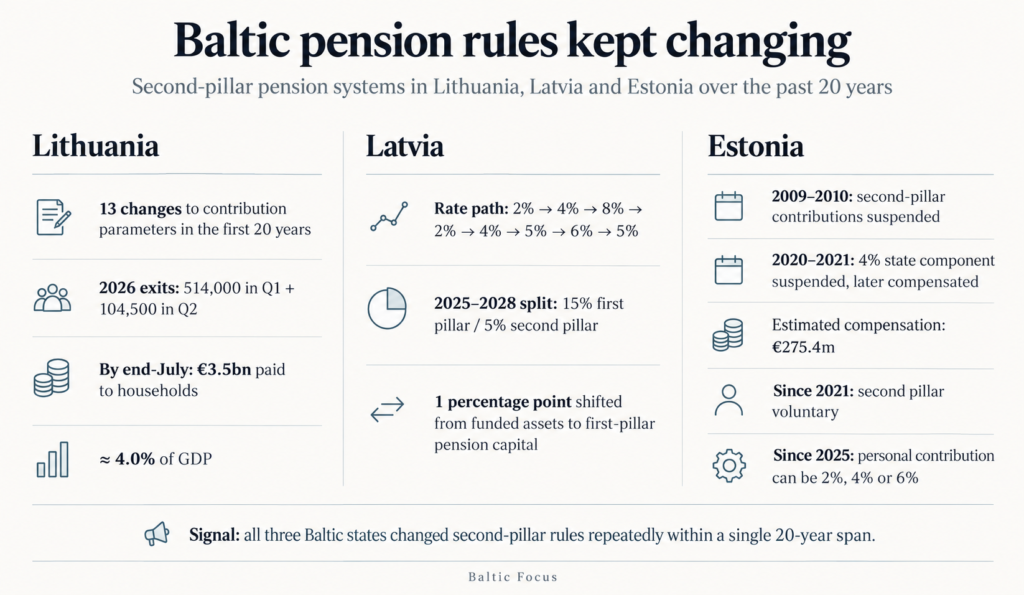
Lithuania now provides an unusually large real-world test. In the first quarter of 2026, 514,000 people — 37% of second-pillar participants — decided to withdraw. Another 104,500 left through the second quarterly window. By the end of July, households had received around €3.5 billion, equivalent to 4.0% of Lithuania’s GDP, measured against nominal GDP over the four quarters from Q3 2025 to Q2 2026. (lb.lt)
The question here is not whether withdrawing was financially wise, or whether changes to the second pillar explain attitudes towards voluntary pension saving. It is narrower: whether discussion of long-term pension confidence can treat the institutional rules themselves as a fixed background.
2009: one crisis, three pension systems
The global financial crisis provides the clearest regional example.
| Country | Before / entering the crisis | Crisis change | Subsequent path |
|---|---|---|---|
| Lithuania | Larger funded contribution envisaged | Cut to 2% in H2 2009 | Original accumulation target was not restored in its original form |
| Latvia | 8% in 2008 | Cut to 2% in 2009 | 2% through 2012, then 4%, 5% and 6% |
| Estonia | Standard 2% employee + 4% state model | Contributions suspended from June 2009 | Partial restoration in 2011; standard 2% + 4% restored in 2012 |
Lithuania cut the share transferred to the second pillar to 2% in the second half of 2009. The original plan had envisaged a larger funded component, but the Bank of Lithuania notes that the initially intended accumulation level was never restored in its original form. (lb.lt)
Latvia went further. Its second-pillar rate had risen from 2% in 2001–2006 to 4% in 2007 and 8% in 2008. In 2009 it was cut back to 2%, where it remained through 2012 before gradually climbing again: 4% in 2013–2014, 5% in 2015 and 6% from 2016. (vsaa.gov.lv)
Estonia also changed course. Mandatory second-pillar contributions were suspended from 1 June 2009 through the end of that year. In 2010, participants who had submitted an application could continue paying their own 2% contribution, while the regular state component remained suspended for most participants. In 2011 contributions resumed at reduced rates: generally 1% from the employee and 2% from the state, while those who had opted to continue payments in 2010 paid 2% and received 2% from the state. The normal 2% + 4% arrangement was restored in 2012. (pensionikeskus.ee)
The governments had strong reasons. The financial crisis produced severe pressure on public finances and current social expenditure. But from the participant’s perspective, 2009 demonstrated something else as well: when fiscal conditions deteriorate sufficiently, the parameters of a pension arrangement designed for decades can change within months.
Lithuania: 13 changes to contribution parameters
Lithuania has the clearest official measure of how frequently the parameters moved.
The Bank of Lithuania calculated that the contribution amount to the second pillar changed 13 times during the system’s first 20 years. (lb.lt)
That figure should not be read as 13 unexpected policy reversals. Some changes were scheduled steps, including gradual adjustments following later reforms. But the same period also included crisis-driven cuts and major structural redesigns.
The 2019 reform changed the financing model itself. Transfers from Sodra were replaced by a system based primarily on participants’ own contributions combined with a state incentive.
From 2026, the architecture changed again. Participants can suspend contributions more flexibly, and a two-year withdrawal window runs from 1 January 2026 to 31 December 2027. Those leaving receive their own contributions and the full investment result generated by the accumulated assets. Previous Sodra and state contributions are transferred back into Sodra and converted into additional first-pillar pension accounting units. (lb.lt)
The significance of the “13 changes” figure is therefore not that every alteration made the system worse. It is that a Lithuanian entering a pension arrangement for several decades has already experienced repeated changes in both contribution parameters and the architecture surrounding them.
The Bank of Lithuania publishes an explicit count of these contribution changes. No directly comparable official count appears to be available for Latvia or Estonia, so their records are better treated as timelines rather than converted into artificial numerical scores.
Latvia: from funded assets to a different kind of pension right
Latvia’s history is equally useful because it shows that changing a contribution does not necessarily mean taking pension rights away. It can change what kind of pension right the participant receives.
The contribution split has moved repeatedly: 2% to the second pillar in 2001–2006, 4% in 2007, 8% in 2008, back to 2% in 2009–2012, then 4%, 5% and finally 6% from 2016 through 2024. (vsaa.gov.lv)
A further change took effect in January 2025 and is currently scheduled to last through 31 December 2028. One percentage point was shifted from the funded second pillar to the first pillar. The split changed from 14% + 6% to 15% + 5%. (lm.gov.lv)
The overall 20% pension contribution did not shrink, and the redirected percentage point still generates future pension rights. But the economic form of those rights changed.
Money entering the second pillar becomes funded capital invested for the individual participant. The additional percentage point now entering Latvia’s first pillar is credited to pension capital within the state system and evolves according to the rules governing first-pillar pension capital rather than market investment returns. The Ministry of Welfare itself noted when proposing the change that the two pillars have different return mechanisms. (lm.gov.lv)
In other words, individually funded assets are being replaced, for that percentage point, by a notional claim within the state pension system. Both create retirement rights, but they have different financing mechanisms, indexation rules and exposure to future policy decisions.
Saying that the percentage point was simply “taken away” would therefore be wrong. Saying that nothing economically important changed because the total pension contribution remained 20% would also be wrong.
Estonia: rules changed, were restored — and the contract itself changed
Estonia demonstrates another pattern.
After the 2009–2011 suspension and phased restoration, the system was altered again during the COVID-19 crisis. The 4% component financed from social tax was suspended for most participants from 1 July 2020 through 31 August 2021.
This time the story did not end with the suspension. Eligible participants who continued paying their own 2% contribution were subsequently compensated for the missing state component. The Ministry of Finance initially estimated the compensation at around €275.4 million, with the final amount also reflecting the average pension-fund return over the relevant period. Compensation was paid in January 2023. (fin.ee)
At the same time, a much deeper structural reform was taking effect. From 2021, participants gained the right to stop contributing, leave accumulated assets invested, move them to a pension investment account or withdraw from the second pillar altogether.
Since 2025, participants remaining in the system can also choose to contribute 2%, 4% or 6% of gross salary, while the 4% component redirected from social tax remains unchanged. (pensionikeskus.ee)
Some of these changes increased individual control rather than reducing it. The COVID-era suspension was compensated. Estonia’s 2021 reform gave participants options they had not previously had. What the chronology demonstrates is not continuous deterioration, but substantial evolution of the terms of participation within one working lifetime.
Pension confidence has an institutional history
Over the past two decades, Baltic pension systems have not moved in one direction. Some reforms reduced funded contributions, some restored them, some compensated earlier decisions and some gave participants substantially more freedom.
What they have not demonstrated is long-term stability of the rules themselves.
Contribution rates have changed. Money has moved between funded and pay-as-you-go pillars. Payments have been suspended and resumed. State incentives have been redesigned. Conditions for participation, withdrawal and access to accumulated capital have changed.
This history does not establish that regulatory uncertainty caused Lithuanian households to withdraw from the second pillar, or that it explains weaker voluntary pension saving. Liquidity needs, consumption, debt, housing, alternative investments and preferences over control of savings may all matter.
But institutional history belongs in the same discussion as financial literacy and expected returns.
In Lithuania alone, contribution parameters changed 13 times during the first 20 years of the second pillar. Latvia and Estonia followed different paths, but both repeatedly altered contribution rates, financing arrangements or participation rules over the same broad period.
Households are being asked to make pension commitments lasting several decades on the basis of institutional arrangements that have already changed repeatedly within a single 20-year span.
That does not make pension saving irrational.
It does make surprise at limited confidence in the stability of pension arrangements harder to sustain.