Baltic economies are growing. Why are their 2027 budgets still under pressure?
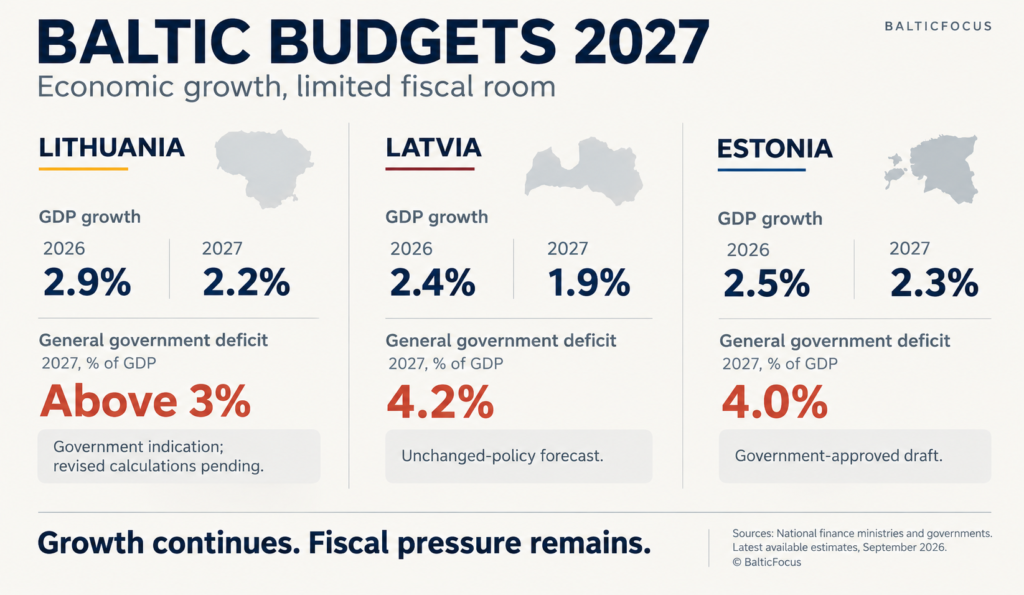
All three Baltic economies are expected to grow next year, yet their governments face increasingly difficult budget calculations. Lithuania is preparing for a larger deficit despite rising tax revenue, Latvia faces substantial financing constraints, and Estonia has already revised its spending plans. Behind the figures lies a broader problem: higher defence expenditure is arriving alongside existing social commitments, changing revenue expectations and the growing cost of public debt.
Economic recovery should make government finances easier to manage. Across the Baltic states, however, the latest budget preparations reveal a more complicated picture.
Lithuania expects its economy to expand by 2.2% in 2027, Latvia forecasts growth of 1.9%, and Estonia projects 2.3%. Yet all three are preparing for general government deficits exceeding the Maastricht reference value of 3% of GDP.
Their fiscal positions are not identical. Lithuania has announced a probable deterioration in its deficit forecast without publishing the revised calculations. Latvia has quantified the financing challenge under unchanged policies but has yet to agree on its budget measures. Estonia, meanwhile, has approved a draft budget incorporating additional expenditure adjustments.
| 2027 | Lithuania | Latvia | Estonia |
|---|---|---|---|
| GDP growth | 2.2% | 1.9% | 2.3% |
| General government deficit | Likely above 3% | 4.2% | 4.0% |
| Defence spending | At least 5% | 5% | 5% |
| Budget status | Revised calculations pending | Unchanged-policy forecast | Government-approved draft |
GDP figures come from the latest national government forecasts available on 30 September 2026. Defence figures follow national government statements and NATO-based spending commitments; they should not be confused with expenditure recorded under European national accounts. The deficit figures represent different stages of budget preparation.
Lithuania Finance Ministry
All three countries have activated the EU’s national escape clause for additional defence expenditure. It provides temporary flexibility within the European fiscal framework but does not remove financing requirements or automatically exempt other expenditure from fiscal rules. A deficit above 3% therefore needs to be assessed in the context of the applicable flexibility rather than treated as an automatic breach.
Council of the European Union
The more immediate economic issue is how the Baltic governments will accommodate higher expenditure while their tax bases, inflation forecasts and borrowing requirements develop differently.
Lithuania: rising revenue, but the budget equation has changed
Lithuania approaches 2027 with comparatively strong economic performance in the current year. Its Finance Ministry expects GDP to grow by 2.9% in 2026 before slowing to 2.2% next year, partly as the temporary consumption stimulus from second-pillar pension withdrawals fades.
Domestic demand remains an important source of growth, but the inflation outlook has deteriorated. Higher energy prices have prompted the ministry to raise its 2026 inflation forecast to 5%, while inflation in 2027 is expected to ease to 3.3%. Average gross wages are projected to increase by another 7.2%, although labour shortages continue to constrain economic expansion.
Lithuania Finance Ministry
The revenue figures suggest that economic activity is generating substantial additional tax receipts.
During January–August 2026, Lithuania’s state and municipal budgets collected €14.38 billion, excluding European and other financial assistance, an increase of 8.7% year-on-year. Tax revenue flowing into the state budget grew by 10% to €10.68 billion.
VAT receipts rose by 10.7%, reflecting stronger domestic consumption, while personal income tax revenue increased by 12.9% alongside the expanding wage bill. Corporate income tax receipts were 5.8% higher, partly reflecting the increase in the standard rate from 16% to 17% introduced at the beginning of 2026.
Lithuania Finance Ministry
These figures demonstrate growth in nominal tax revenue. They do not, however, establish whether collections are meeting the government’s original expectations, since the published annual revenue plan does not provide a directly comparable January–August target.
Nevertheless, the fiscal outlook has deteriorated. On 29 September, Prime Minister Mindaugas Sinkevičius indicated that Lithuania’s general government deficit would probably exceed 3% of GDP in 2027. He linked the budget challenge to the need to maintain high defence expenditure alongside planned increases in other spending. The Finance Ministry said the final figures would be published with the forthcoming budget proposal.
BNS
The announcement raises an important question because Lithuania’s April fiscal report had projected a deficit of just 2.8% of GDP for 2027.
That report, however, contained another figure. Had expenditure on military equipment and inventories been recorded according to cash payments rather than the applicable statistical accounting treatment, the projected deficit would have reached 4.3% of GDP.
The difference of 1.5 percentage points illustrates how military procurement can create a substantial divergence between expenditure recognised in a particular year and the timing of government payments. It does not establish Lithuania’s total borrowing requirement, but it demonstrates that considerable military payments were already incorporated into the spring fiscal calculations.
Lithuania Finance Ministry
This distinction matters when examining the latest deterioration. Defence expenditure was already a major commitment, and the available information does not establish whether the higher expected deficit reflects changes in procurement schedules, additional spending commitments, revised revenue assumptions or a combination of these factors.
Lithuania’s debt position adds another consideration. The April projections anticipated general government debt reaching 48.9% of GDP in 2027, compared with 44.9% in 2026. Interest expenditure was projected to increase from 1.2% to 1.3% of GDP over the same period. The immediate increase in interest costs is relatively modest, although the larger debt stock will remain relevant to future financing requirements.
Lithuania Finance Ministry
Lithuania therefore enters the budget negotiations with an unusual combination: economic growth, substantially higher tax receipts and a government announcement that the deficit will nevertheless exceed its earlier forecast.
The forthcoming budget must establish what has changed. Until then, the deterioration cannot be reliably attributed to either defence expenditure or other spending commitments.
Latvia: economic recovery has not resolved the financing problem
Latvia’s budget preparations reveal a different problem. Unlike Lithuania, the country has already published a detailed unchanged-policy fiscal trajectory, allowing its financing constraints to be examined more closely.
The economic background initially appears encouraging. Latvia’s GDP increased by 2.8% year-on-year during the first half of 2026, prompting the Finance Ministry to raise its annual growth forecast from 2% to 2.4%.
Trade, manufacturing and commercial services made the largest contributions to output growth. Investment increased, private consumption recovered and exports accelerated, particularly during the second quarter.
The ministry nevertheless expects growth to slow to 1.9% in 2027. At the same time, it has raised next year’s inflation forecast to 3.7%, citing delayed increases in heating costs and renewed pressure from oil and natural gas prices.
Ministry of Finance
The implications for public finances are visible in the latest budget execution figures.
During January–August, Latvia’s consolidated budget collected almost €10 billion in taxes, including social insurance contributions. Revenue increased by 6.1% year-on-year but remained €81.5 million below the period’s collection plan.
VAT receipts performed relatively strongly, increasing by 8.2%. However, personal income tax, natural resource tax and excise receipts fell short of expectations. Collections were also affected by the temporary reduction in diesel excise duties and lower-than-planned banking solidarity contributions, partly reflecting tax relief available to banks under existing legislation.
Ministry of Finance
The overall budget balance initially presents a more favourable picture. Latvia’s consolidated budget recorded a surplus of €127.6 million during the first eight months, compared with a deficit a year earlier.
Much of that improvement, however, resulted from a €489.1 million increase in European funding and other foreign financial assistance. The central government’s basic budget still recorded a deficit of €438.4 million, while the Finance Ministry expects the consolidated budget to return to a deficit as expenditure increases towards the end of the year.
Spending pressures are already apparent. Social payments increased by 8.2%, adding almost €299 million to expenditure, while capital spending rose by another €211 million, or 20.4%. Defence procurement contributed to the latter increase alongside other public investment.
Ministry of Finance
Against this background, the Finance Ministry’s July unchanged-policy forecast projected a general government deficit of 4.2% of GDP in 2027. The estimate already includes defence expenditure of 5% of GDP according to NATO definitions.
The ministry attributes the deterioration from its earlier forecast primarily to weaker projected tax revenue, reflecting slower expected growth in consumption and the wage bill, and higher expenditure on social benefits, particularly pensions. The automatic pension recalculation carried out in April 2026 and stronger inflation-related indexation have both increased spending.
Ministry of Finance
The September budget preparation update provided a further indication of the scale of the problem.
According to the ministry, previously adopted decisions without specified financing sources will have an estimated impact of €421 million in 2027. Meanwhile, government debt-servicing expenditure could reach approximately €681 million next year.
The €421 million does not represent Latvia’s entire financing gap, nor can it simply be added to the projected deficit or debt-service costs. It identifies a particular group of expenditure commitments within a considerably larger fiscal problem.
Ministry of Finance
The broader trajectory is especially revealing.
Under unchanged policies, the ministry projects the deficit rising from 4.2% of GDP in 2027 to 5.4%, or €2.73 billion, in 2028, before declining to 4.3% in 2029 and 3.5% in 2030.
This is not a continuously widening deficit. Rather, it is a forecast of a substantial peak followed by a partial improvement. Even after that improvement, however, the projected balance remains negative.
One reason the financing problem extends beyond the immediate budget is the changing structure of government revenue. The existing framework includes temporary measures, notably the banking solidarity contribution, scheduled to end in 2028. Contributions to the second pension pillar are also due to return to 6% in 2029.
The Finance Ministry consequently expects general government revenue to decline from 43.6% of GDP in 2025 to 37.9% by 2030. Expenditure is also projected to fall as a share of GDP, but more slowly, from 46.1% to 41.4%. These are medium-term projections rather than outcomes already determined by policy.
Ministry of Finance
The immediate challenge is therefore clear. Latvia must accommodate higher defence expenditure, inflation-linked social commitments and increasing debt-service costs while its current tax receipts remain below plan and some existing revenue measures are temporary.
How the government addresses that challenge has yet to be decided. With parliamentary elections scheduled for 3 October, the Finance Ministry has prepared alternative fiscal scenarios for the next government rather than a final package of budget measures.
Estonia: a budget adjustment during economic recovery
Estonia has moved further into the 2027 budget process. On 28 September, the government approved a draft targeting a general government deficit of 4% of GDP, incorporating additional measures intended to improve its fiscal position by approximately €250 million.
The government describes this as a 0.5-percentage-point improvement relative to the forecast used for its latest budget decisions. Earlier projections had produced different deficit estimates, so the €250 million adjustment should be understood against the government’s specified budget baseline rather than calculated from separate historical forecasts.
Eesti Vabariigi Valitsus
The decision comes as Estonia’s economy continues to recover. The government’s latest forecast projects GDP growth of 2.5% in 2026 and 2.3% next year, supported by domestic demand and improving export markets.
Eesti Pank’s September forecast is slightly more optimistic, anticipating growth of approximately 2.5% in both years. However, the central bank also identifies an important feature of Estonia’s recovery: part of the expansion is being supported by additional government expenditure financed through borrowing.
Meanwhile, wages and private consumption have grown more slowly than previously expected, limiting tax revenue growth and contributing to the deterioration in the fiscal outlook that preceded the government’s latest adjustments.
Eesti Pank
Estonia is therefore attempting to contain its deficit while maintaining expenditure that it considers necessary for defence, public services and social commitments.
The approved draft provides for state-budget revenue of approximately €19.4 billion and expenditure of €20.2 billion, with investment reaching around €1.2 billion. These figures describe the state budget, whereas the 4% deficit target covers the broader general government sector.
Defence expenditure is maintained at 5% of GDP. At the same time, average pensions are expected to increase by 5.1% in 2027, bringing the pension budget to €3.57 billion. The teachers’ wage fund is scheduled to rise by 3.9%, while healthcare expenditure also remains substantial.
Eesti Vabariigi Valitsus
Unlike Lithuania and Latvia, Estonia has already incorporated a combination of expenditure restraint and previously announced tax changes into its draft budget. The government is proceeding with measures intended to increase household disposable income while reducing spending elsewhere.
The country’s comparatively low public debt provides a different starting position, although it does not eliminate the consequences of persistent deficits.
Government debt is projected to reach 28.3% of GDP in 2027. Eesti Pank nevertheless warns that the speed of debt accumulation is becoming increasingly important, with annual interest expenditure projected to reach €472 million in 2028.
That projection was published before the government’s latest budget adjustments, but it illustrates the longer-term financing implications of sustained borrowing.
Eesti Vabariigi Valitsus
Estonia has thus taken a more concrete step towards adjusting its fiscal position, although the draft budget still requires parliamentary consideration. Its immediate challenge is to implement the proposed expenditure measures without undermining the economic recovery on which future revenue growth partly depends.
The Baltic picture: three budgets at different stages
The three countries are entering 2027 with positive economic growth forecasts, substantial defence commitments and different degrees of certainty about their fiscal plans.
Lithuania is still preparing the calculations behind its revised deficit outlook. Latvia has published a detailed assessment of its financing constraints, including the consequences of existing commitments and temporary revenue measures, but its final budget decisions remain open. Estonia has already incorporated additional expenditure adjustments into a government-approved draft.
The debt figures also require careful interpretation. Lithuania’s April forecast puts general government debt at 48.9% of GDP in 2027, Estonia’s current draft projects 28.3%, while Latvia’s July assessment anticipates debt close to 48% at the end of 2026 and further increases thereafter. These estimates have different reference dates and should not be presented as a fully harmonised ranking of the countries’ debt positions.
Lithuania Finance Ministry
What the available evidence does establish is that all three countries face additional demands on their budgets while attempting to sustain economic growth. The scale and timing differ, and the contribution of individual expenditure categories cannot yet be quantified consistently across the region.
Energy prices add another element to the immediate outlook. They are already reflected in revised inflation forecasts and, in Latvia’s case, have contributed to decisions that reduce fuel-tax receipts. Lithuania’s forthcoming budget will also have to accommodate higher energy-price assumptions and any final decisions concerning its planned fuel-tax increases.
These developments connect budget expenditure, household purchasing power and government revenue without producing an identical fiscal effect in each country.
The next stage of the 2027 budget cycle will therefore be particularly informative. Lithuania must publish its revised calculations, Latvia’s next government must choose its financing measures, and Estonia must complete parliamentary consideration of the draft already presented.
The central question is no longer whether the Baltic economies will grow in 2027. It is how much room that growth will leave in national budgets once existing commitments, defence expenditure and financing costs have been accounted for.