Analysis · Industry & Manufacturing
Latvia’s iconic balsam producer faces bankruptcy as rescue plan collapses
Amber Latvijas balzams, the historic producer of Riga Black Balsam, is facing possible bankruptcy after creditors rejected its restructuring plan and Latvia’s tax authority froze its bank accounts again. The future of one of the country’s largest spirits manufacturers, employing hundreds of people, is now in question.
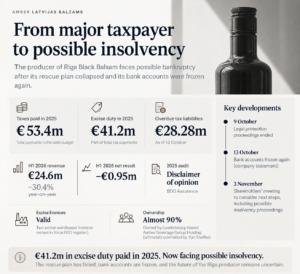
The company confirmed the renewed account freeze on 13 October, following the termination of court-supervised legal protection proceedings four days earlier. Shareholders will meet on 3 November to consider the next steps, including possible insolvency proceedings.
The producer owed €28.28 million in overdue taxes as of 12 October, exceeding its entire revenue of €24.6 million for the first half of 2026. The arrears are largely linked to delayed excise-duty payments, according to the company. In November 2025, the State Revenue Service (VID) had already initiated recovery of €17.71 million in unpaid taxes.
The scale of the problem is particularly striking for a major taxpayer. In 2025, Amber Latvijas balzams paid €53.4 million into the state budget, including €41.2 million in excise duty.
Sales have deteriorated sharply. First-half revenue fell 30.4%, with a net loss of €951,000. Sales volumes of Stoli and elit fell by 35%, partly reflecting reduced export orders from Stoli Group companies, particularly in the United States.
The company’s finances also carry risks extending beyond its own production. In September, auditor BDO Assurance declined to express an opinion on the 2025 accounts after being unable to verify major accounting corrections involving loans and receivables from related companies. These included a €91.61 million reduction in opening retained earnings. The auditor also raised concerns about guarantees of up to €79.7 million provided for obligations of the parent company.
A factory and its famous brands
Amber Latvijas balzams is almost 90% owned by Luxembourg-based Amber Beverage Group Holding, ultimately controlled by Yuri Shefler, the businessman behind the international Stolichnaya vodka business.
Shefler has fought a longstanding dispute with Russian authorities over the Stolichnaya brand, internationally renamed Stoli in 2022. But the group has also suffered serious commercial difficulties. Its American subsidiaries sought liquidation earlier this year, while the Luxembourg holding company entered judicial reorganisation.
The consequences are already visible in Latvia. Production of Rīgas šampanietis, a sparkling wine associated with Riga for generations, moved to Lithuania this summer. The successor product, Rīgas Dzirkstošais, is now manufactured by Lithuanian MV GROUP Production, whose Alita factory in Alytus specialises in sparkling wines.
Riga Black Balsam presents another question. The Latvian manufacturer pledged rights to use trademarks in the Baltic states as security for a €10 million loan obtained by its parent company from Rietumu Banka.
Bankruptcy of the manufacturer would not necessarily mean the disappearance of the famous herbal liqueur. But the future of the factory and the rights associated with its brands could be decided separately.
Former owners, new creditors
Meanwhile, the restructuring has developed into a dispute over creditor influence.
In August and September, a newly established Latvian company, MBO Beverages, acquired claims previously held by Luminor and UBS with a combined nominal value of €35.38 million. Its owners are three former Amber Beverage Group employees: Jekaterina Stuģe, Intars Geidāns and Rolands Gulbis.
The purchase price has not been disclosed. Acquiring the claims gave MBO substantial influence in creditor negotiations, where voting power depends on the value and classification of claims.
Amber Latvijas balzams says the tax authority supported its proposed four-year repayment plan, but other creditors withheld the necessary approval. Management also opposed conditions that it said would transfer substantial control over the business to a creditor. The exact voting breakdown has not been disclosed.
MBO Beverages disputes the management’s explanation of the financial difficulties. In a statement issued on 13 October, the company argued that the principal problems stemmed not from external market conditions but from long-standing debts owed by related group companies, whose repayment had repeatedly been deferred. MBO cited the auditor’s findings on substantial losses associated with intra-group loans and receivables.
MBO maintains that Amber Latvijas balzams remains a viable business generating cash flow and has called for production, brands and jobs to remain in Latvia. Its board member Jekaterina Stuģe proposed a supervisory board including representatives nominated by secured creditors, unsecured creditors and the majority shareholder. She said MBO was prepared to negotiate a solution to stabilise the company.
The dispute has also brought another prominent businessman back into the picture.
On 1 September, Shefler met former Latvian prime minister Andris Šķēle in Riga. Both men confirm that the meeting took place.
Šķēle, who headed Latvia’s government in the 1990s and was a major figure in its privatisation-era business, has a direct historical connection to the factory. His Ave Lat group previously held a substantial stake in Latvijas balzams.
In an interview with The Telegraph, Shefler alleged that Šķēle had proposed taking control of his business in exchange for resolving its financial difficulties. He described the proposal as a hostile takeover and claimed it was connected to Russian interests.
Šķēle rejected the allegations, saying the meeting was a discussion about preserving the group’s solvency.
“There was no threat,” he told the newspaper.
Latvia’s State Security Service confirmed receiving Shefler’s complaint and said it was evaluating the information. His allegations have not been substantiated publicly.
For the Riga factory, the immediate question is whether production can continue. On 14 October, VID’s public register still listed two valid excise warehouse licences for Amber Latvijas balzams, despite the renewed bank-account restrictions. The company has not confirmed whether manufacturing continues without interruption.
The next turning point is the shareholders’ meeting on 3 November. By then, the fate of the factory behind Latvia’s best-known souvenir may depend less on demand for its famous products than on whether its creditors can agree on a way forward.