Baltic retail sales rose in September, led by non-food goods
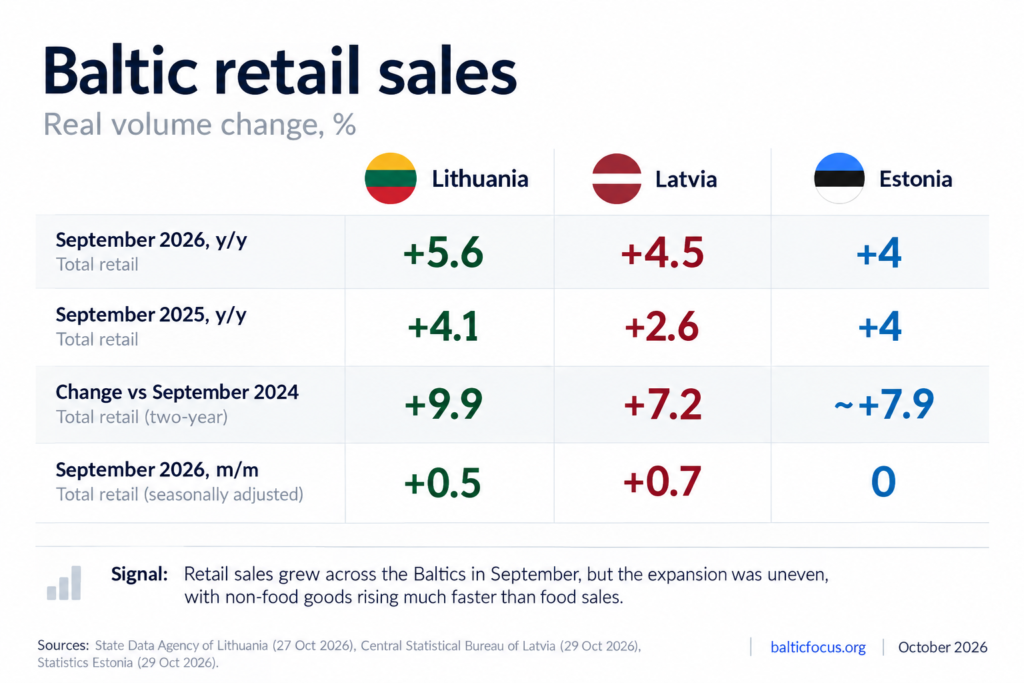
Retail sales were higher than a year earlier in all three Baltic states in September, just before the heating season began in October. Lithuania recorded annual growth of 5.6%, Latvia 4.5%, and Estonia around 4%. Consumer demand held up, but unevenly: non-food sales grew considerably faster than food sales.
Baltic retail sales — September 2026
Change in real retail sales volume, %
| Indicator | Estonia | Latvia | Lithuania |
|---|---|---|---|
| Total retail, September y/y | +4% | +4.5% | +5.6% |
| August, m/m | +1% | −1.4% | +0.1% |
| September, m/m | 0% | +0.7% | +0.5% |
| Food retail, y/y | +1% | +0.3% | +1.4% |
| Non-food retail, y/y | +5% | +9.3% | +11.9% |
| Automotive fuel retail, y/y | −2% | −0.8% | −1.7% |
Sources: Statistics Estonia (29 October), Central Statistical Bureau of Latvia (29 October), State Data Agency of Lithuania (27 October). August monthly figures are from the corresponding August releases.
Monthly changes are seasonally adjusted; annual changes are measured at constant prices. Estonia’s published rates are rounded to whole percentages. Its non-food figure refers to stores selling manufactured goods, while Latvian and Lithuanian figures follow their respective national classifications, excluding fuel retail. Category definitions and adjustment methods differ slightly.
Monthly momentum shifts
Estonia’s seasonally adjusted retail sales volume was unchanged in September after rising 1% in August. Annual growth also slowed from 6% to around 4%, indicating that the recovery had lost some momentum.
Latvia gained 0.7% on the month, regaining roughly half of August’s 1.4% decline. Lithuania continued to expand, with monthly growth picking up from 0.1% to 0.5%.
Non-food retail remained the strongest segment. In Lithuania, annual growth accelerated from 9.2% in August to 11.9% in September, while food sales rose only modestly across all three countries. The gap between the two categories highlights the uneven nature of consumer demand.
Fuel retail volumes fell year on year throughout the region. Estonia recorded its first decline after 20 consecutive months of growth, with Statistics Estonia attributing the fall to higher fuel prices.
A positive signal as winter approaches
September’s results largely confirm the picture outlined in Baltic Focus’s August review. Lithuania continues to show strong retail growth, Latvia has recovered part of its August losses, and Estonia’s monthly advance has paused.
Even so, the positive annual figures and sustained demand for non-food goods suggest that Baltic consumers entered the heating season in relatively good shape.
The months ahead may prove more difficult. The Bank of Latvia has warned that higher energy and heating costs could constrain household spending. In Lithuania, the central bank expects the temporary boost to consumption from second-pillar pension withdrawals to fade.
For now, Baltic retail enters winter with growth intact, though its strength varies considerably across markets and product categories.