Analysis · Industry & Manufacturing
Lithuania Calls It a Dairy Crisis as Processors Expand — While E-Piim Collapses in Estonia
he same downturn is producing different outcomes across Baltic dairy:
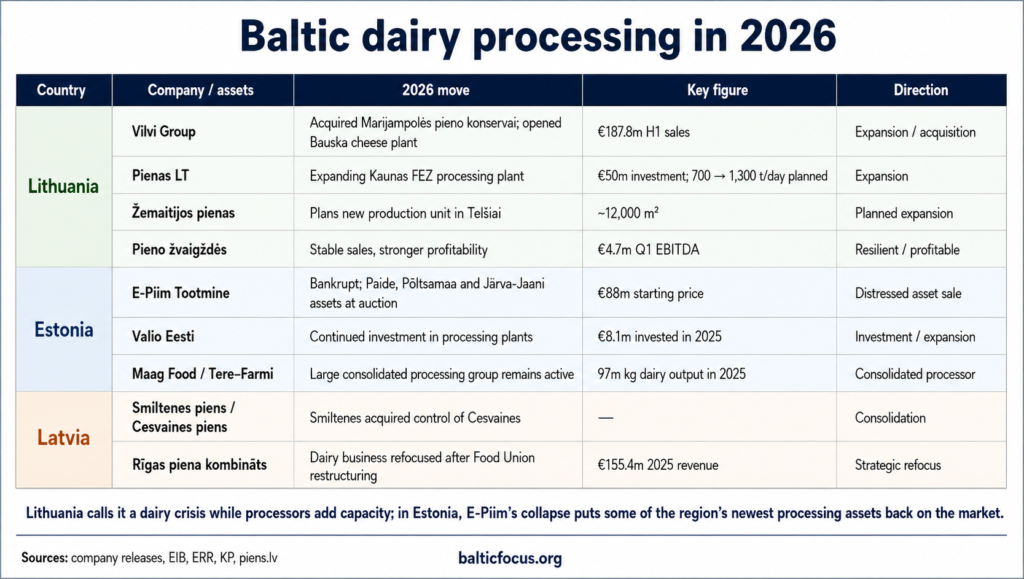
Lithuania described its dairy sector as being in a prolonged crisis this year. At the same time, some of its largest processors and cooperatives are buying companies, building plants and adding capacity.
Across the border, Estonia’s E-Piim Tootmine was declared bankrupt in March and its recently built production assets are now at auction.
The same downturn is producing different outcomes across Baltic dairy: stronger companies continue to invest and consolidate, while weaker structures face restructuring, merger or asset sales.
| Country | Company / assets | 2026 development | Key figure |
|---|---|---|---|
| Lithuania | Vilvi Group | Marijampolė acquired; Bauska cheese plant opened | €187.8m H1 sales |
| Lithuania | Pienas LT | Kaunas FEZ expansion | €50m investment |
| Lithuania | Žemaitijos pienas | New Telšiai unit planned | ~12,000 m² |
| Lithuania | Pieno žvaigždės | Stable sales, stronger profitability | €4.7m Q1 EBITDA |
| Estonia | E-Piim Tootmine | Bankruptcy; assets at auction | €88m starting price |
| Estonia | Valio Eesti | Continued plant investment | €8.1m in 2025 |
| Estonia | Maag Food / Tere-Farmi | Major consolidated processor | 97m kg output |
| Latvia | Smiltenes / Cesvaines | Control acquired by Smiltenes | Consolidation |
| Latvia | Rīgas piena kombināts | Dairy business refocused | €155.4m revenue |
Lithuania: crisis and expansion
In May, Lithuania told the EU Agriculture and Fisheries Council that its dairy sector had been in a prolonged crisis. The average raw milk price had fallen 30% year on year by March, while processors faced weak cheese demand, high inventories and slower export contracting.
Corporate investment nevertheless continued.
Vilvi Group generated €187.78 million in H1 sales, up 31.5%. It completed the acquisition of Marijampolės pieno konservai in January and started production at its new Bauska cheese plant in Latvia, where more than €60 million was invested.
Farmer-owned Pienas LT is implementing a €50 million expansion at its Kaunas FEZ plant and plans to increase milk-processing capacity from around 700 to 1,300 tonnes per day by 2028.
Žemaitijos pienas is planning another production unit of around 12,000 square metres in Telšiai. Pieno žvaigždės reported broadly flat Q1 sales but EBITDA more than doubled to €4.7 million.
Lithuania therefore presents the clearest regional paradox: the government describes a dairy sector in crisis while several of its largest processors and cooperatives are expanding.
E-Piim puts new Estonian capacity on the market
E-Piim Tootmine was declared bankrupt on 11 March.
Its Paide and Põltsamaa assets are being offered for a combined starting price of €80 million, with Järva-Jaani offered for another €8 million.
The Paide plant was one of Estonia’s largest recent dairy investments. The project was estimated at around €154 million, including a €29 million EIB loan, and designed to process up to 1,150 tonnes of milk per day.
Milk producers were owed almost €30 million, while preliminary creditor claims exceeded €200 million.
The assets have attracted interest from several countries. Vilvi Group confirmed in June that it was evaluating a possible acquisition of the Paide plant.
The Lithuanian group expanding across the region could therefore become a buyer of capacity released by the collapse of E-Piim.
Estonia still has a large processing base
E-Piim is only one part of Estonia’s dairy industry.
As Baltic Focus showed in Baltic agriculture 2025, Estonia produced 707 kg of fresh milk per resident in 2025, compared with 532 kg in Lithuania and 526 kg in Latvia. Its apparent annual milk yield, 11,353 kg per cow, was the highest in the EU.
The Estonian Chamber of Agriculture and Commerce reported 969 million kg of milk collected in 2025, with dairy-processing sales of €659 million and exports of €425 million.
Around 40% of Estonian milk still leaves the country as raw milk, mainly for processing in Latvia and Lithuania.
Other processors remain active. Valio Eesti increased revenue and profit in 2025 and invested €8.1 million. Maag Food, through Tere and Farmi, produced around 97 million kg of dairy products. Estonia also retains Estover and farmer-owned Saaremaa Piimatööstus.
E-Piim’s collapse therefore sits inside a strong milk-production base and a wider processing sector that continues to operate.
Latvia sits between the systems
Latvia appears in both the Lithuanian and Estonian stories.
Vilvi’s Bauska plant adds Lithuanian-owned processing capacity in Latvia. E-Piim’s cooperative structure included Latvian producers and links to Jaunpils Pienotava.
Latvia’s own processors are also changing. In March, the Competition Council approved Smiltenes piens acquiring control of Cesvaines piens.
Rīgas piena kombināts also emerged as a more focused dairy business after Food Union’s European ice-cream operations were sold to Froneri. The company reported €155.4 million in 2025 revenue.
Latvia is therefore receiving new Lithuanian-owned capacity, processing part of Estonia’s milk and consolidating its own dairy businesses.
The downturn is redistributing Baltic dairy capacity
Lithuania is adding capacity. Latvia is consolidating it. Estonia is putting some of its newest processing assets back on the market.
The common factor is a weaker dairy market, but the outcome depends on financial strength. Companies with capital and access to financing can expand, acquire businesses or take over assets released by weaker competitors.
E-Piim is the clearest example. The Paide plant has not disappeared with the company that built it. It is now available to another processor — potentially one already expanding elsewhere in the Baltics.
The downturn is therefore changing not how much processing capacity the region has, but who is strong enough to control the next round of it.