Lithuania’s GDP grows 3% in nine months despite third-quarter contraction
Lithuania’s economy expanded by 3% in the first nine months of 2026, although strong growth in the first half was followed by a contraction in the third quarter, according to the State Data Agency’s first GDP estimate released on October 30.
GDP reached €67.9 billion at current prices in January–September. In the third quarter, real output declined by 1% compared with the previous quarter, while annual growth slowed from 3.9% in Q2 to 2.3%, on a seasonally and working-day adjusted basis. Without adjustment, annual growth was 1.8%.
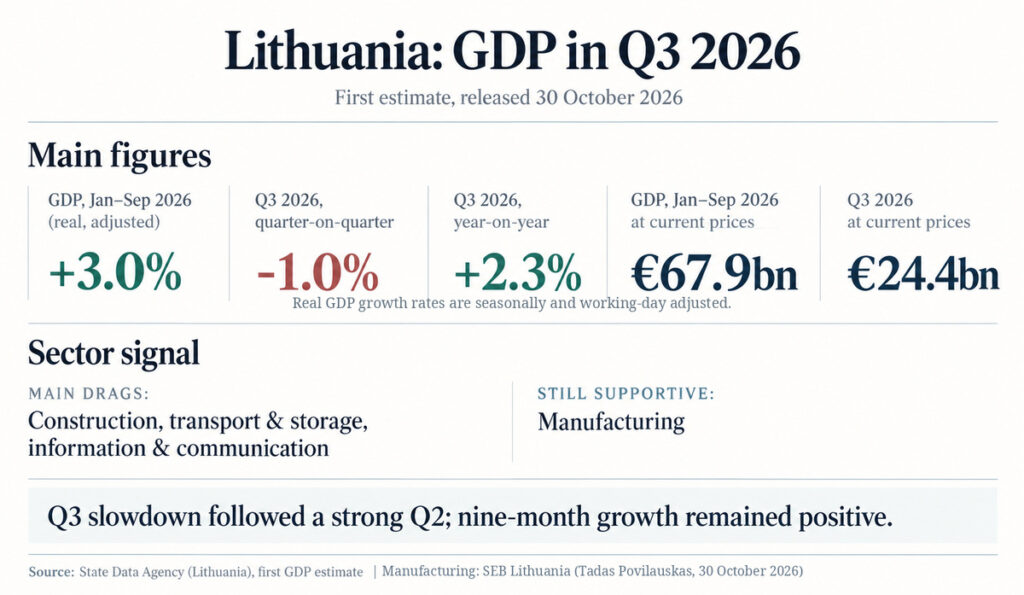
The slowdown was uneven across sectors. Construction, information and communication, and transport and storage made the largest negative contributions to GDP change, while manufacturing remained an important source of growth.
According to SEB Lithuania economist Tadas Povilauskas, manufacturing output excluding refined petroleum products increased by 6.4% year on year in the third quarter. Electronics, plastics, wood products, furniture and food manufacturing were among the strongest performers. However, rising energy costs are putting increasing pressure on industrial profitability.
Household consumption continued to benefit from withdrawals from second-pillar pension funds, although the effect was weakening. Retail sales excluding fuel rose by 7.1% year on year, compared with 10.9% in the second quarter. Household incomes growing faster than inflation also continued to support spending.
Construction was one of the main sources of the slowdown after its strong performance earlier in the year. Povilauskas expects its contribution to improve in the final quarter, although rising construction costs remain a challenge.
The negative contribution from transport and storage raises a separate question. European road freight operators have been facing subdued demand and higher fuel and operating costs. These pressures may have affected Lithuania’s transport sector, although the initial GDP estimate does not establish the causes of its weaker performance.
At the same time, several indicators suggest that Lithuanian road hauliers have continued expanding their operating capacity. According to Povilauskas, the number of truck drivers at the end of September was 8.8% higher than a year earlier, while third-quarter registrations of truck tractors increased by 32% and semi-trailers by 37%. The divergence between these indicators and the sector’s GDP contribution requires further examination.
The performance of information and communication services is another unresolved issue. Povilauskas noted that the sector’s contribution to GDP had turned negative despite apparently growing export revenues. More detailed sectoral statistics will be needed to explain the change.
Despite the third-quarter contraction, Lithuania’s economy maintained positive growth over the first nine months. SEB expects to lower its current forecast of 3% GDP growth for 2026 when it publishes updated projections on November 10. Its forecast for 2027 remains at 2.1%.
The State Data Agency will release its second estimate of third-quarter GDP on December 1.