BURGA opens €20m Kaunas hub: Chinese inputs, Lithuanian production, global sales
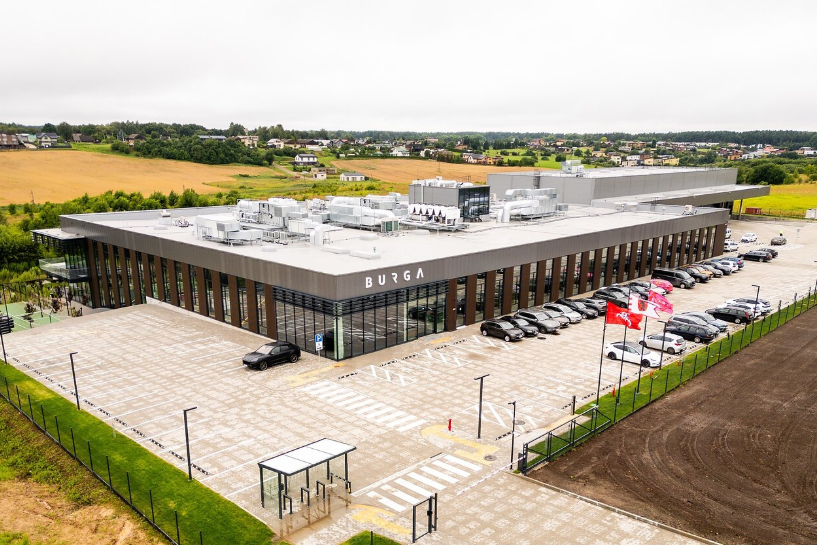
The Lithuanian-owned accessories brand is combining Asian manufacturing inputs with design, printing, assembly and global fulfilment in Kaunas. Its new facility shows how a digital-first exporter is turning international demand into physical industrial capacity at home.
Lithuanian accessories brand BURGA has opened a new manufacturing facility and headquarters in the Kaunas Free Economic Zone.
According to Kaunas FEZ, the company invested approximately €20 million in the complex and technological equipment. The facility covers more than 7,200 square metres and combines product development, manufacturing, warehousing, administration and logistics.
The slightly lower €19 million figure previously reported by Luminor refers to the factory, warehouse and office construction project. The bank provided €10 million in financing. The difference between the two figures appears to reflect the inclusion of technological equipment in the broader Kaunas FEZ estimate.
Kaunas FEZ says the administrative and product-development areas can accommodate up to 140 professionals, while the manufacturing space has capacity for almost 600 employees. These figures describe the facility’s potential capacity, not the number of positions already filled.
Growth came before the factory
BURGA operates through the Lithuanian company UAB Hautica, established in 2015 by Gytis Gelžinis and Linas Motiejauskas. LRT reported that the two founders continue to own 50% each, with Motiejauskas also serving as the company’s chief executive. Gelžinis is primarily responsible for marketing and the brand, while Motiejauskas oversees production.
Financial statements reproduced by Lithuanian company-information platform Rekvizitai.lt show that Hautica generated €110.49 million in revenue and €15.69 million in net profit in 2025. That gives the company a net margin of approximately 14.2%. Rekvizitai identifies the figures as the company’s 2025 financial results.
The expansion has continued in 2026. Lithuanian business newspaper Verslo žinios reported that BURGA increased its first-half revenue by 70% year on year. The publication did not disclose the absolute first-half revenue figure in its publicly visible headline and summary.
The new Kaunas facility therefore follows established sales growth. It is not merely a factory built in anticipation of demand that has yet to appear.
BURGA began with printed phone cases but has since expanded into a wider portfolio of technology and lifestyle accessories. The core commercial model remains direct-to-consumer: the company develops designs, markets the products internationally and sells them primarily through its own digital channels.
What is actually produced in Lithuania?
BURGA’s supply chain does not fit neatly into either a “Made in Lithuania” or “Made in China” label.
In a September 2025 interview reported by LRT, Gelžinis said that BURGA also manufactures in Asia, while products are printed, assembled and dispatched from Lithuania. He added that Lithuania accounts for only a few percentage points of the company’s turnover, confirming that the business is overwhelmingly export-oriented.
BURGA’s own customer-support pages provide a more specific but internally inconsistent description.
The Spanish-language version says that its phone cases are manufactured at a factory in China under BURGA quality-control supervision, while products are designed, assembled or completed in Lithuania.
The English-language version, however, says the cases are designed, assembled and crafted in Lithuania, without mentioning China.
These statements cannot be treated as fully compatible. They may reflect different production stages, changes in the supply chain or inconsistent translations across the company’s support pages.
The most defensible interpretation, supported by Gelžinis’s public description, is:
Asian-produced cases, components or other inputs → design, printing, assembly and fulfilment in Lithuania → sales under a Lithuanian-owned brand to customers worldwide.
Phone cases remain BURGA’s core product, but the company has expanded into laptop and tablet cases, watch straps, drinkware, eyewear, charging products and other lifestyle accessories. The available evidence supports the supply-chain description above specifically for phone cases; BURGA does not provide equally detailed production information for the rest of its portfolio.
The China element therefore rests on BURGA’s own multilingual support pages and the founder’s public description of Asian production, rather than an independent customs-data reconstruction.
The product is cheap. Customer acquisition is not
BURGA is competing in a category where an unbranded phone case can be bought through a Chinese marketplace for a few euros. The company’s advantage is therefore not based on manufacturing the lowest-cost plastic shell.
It lies in design, visual differentiation, collection management, digital advertising, direct sales, personalisation and control of customer data.
The scale of the marketing operation illustrates this. In the September 2025 LRT report, Gelžinis said that BURGA had generated €12 million in turnover during the preceding month and spent approximately €4 million on advertising across Facebook, Google, TikTok, Snapchat, X and YouTube. The figures were presented by Gelžinis at the Lūžio taškas conference and should therefore be read as a company disclosure rather than independently audited monthly data.
This spending helps explain why BURGA can sell a commoditised physical product at branded-consumer-goods prices. Its commercial asset is the system that identifies demand, converts advertising into purchases and retains a direct relationship with customers across multiple markets.
The Kaunas facility adds a physical layer to that system. By bringing product development, printing, assembly, storage and dispatch closer together, BURGA should be able to shorten product-launch cycles, improve quality control and handle larger order volumes.
At the same time, the investment changes the company’s risk profile. A digital-first business with flexible advertising expenditure is adding a large fixed-cost manufacturing and logistics platform. The next test is not whether BURGA can generate attention, but whether it can preserve marketing efficiency while operating substantially greater physical capacity.
A different kind of Kaunas FEZ investor
Kaunas FEZ has traditionally attracted foreign industrial companies looking for a production base inside the European Union.
BURGA represents a different route. It is a Lithuanian-owned company that first built global demand through e-commerce and is now placing more of its production and logistics infrastructure inside the zone.
That distinction matters more than the product category.
This is not conventional import substitution: BURGA is not replacing the Chinese supplier base or attempting to reproduce the full Asian manufacturing ecosystem in Lithuania. Nor is it simply importing finished goods for resale.
It is using globally sourced inputs while retaining several higher-value functions in Lithuania: ownership, design, customisation, production management, branding, fulfilment and access to the final customer.
The industrial signal is therefore not that Lithuania can make phone-case shells more cheaply than China.
It is that a Lithuanian company can use Chinese manufacturing capacity, add value in Kaunas and export the finished consumer proposition under its own brand — while converting part of that global demand into investment, employment and fixed industrial assets at home.