Who is the main tourist in the Baltics? A Baltic resident.
In the second quarter of 2026, tourist accommodation establishments across Latvia, Lithuania and Estonia recorded about 5.48 million overnight stays.
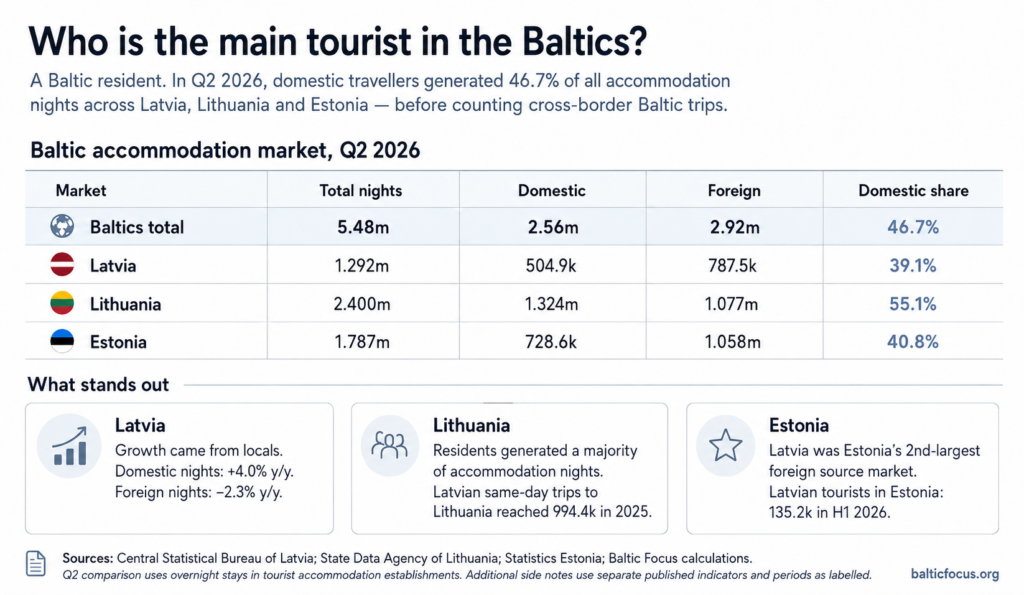
Almost half of accommodation nights come from domestic travellers — and neighbouring Baltic countries provide another substantial layer of demand.
In the second quarter of 2026, tourist accommodation establishments across Latvia, Lithuania and Estonia recorded about 5.48 million overnight stays. Almost half came from residents travelling in their own countries. The next layer of demand is strikingly regional: Lithuanians are important for Latvia, Latvians for Estonia, while almost one million Latvian day trips to Lithuania never enter hotel statistics at all.
A Baltic market built largely at home
The three Baltic states recorded about 5.48 million overnight stays in tourist accommodation establishments in Q2 2026.
The split between domestic and foreign guests was surprisingly close: residents generated about 2.56 million nights, or 47%, while foreign visitors accounted for 2.92 million, or 53%.
Data card — Baltic accommodation, Q2 2026
- Total overnight stays: 5.48 million
- Domestic: 2.56 million
- Foreign: 2.92 million
- Domestic share: 46.7%
- Foreign share: 53.3%
Sources: Central Statistical Bureau of Latvia, State Data Agency of Lithuania, Statistics Estonia; Baltic Focus calculations.
The Baltic total hides some important differences. Lithuania relies more heavily on its domestic market, while Latvia and Estonia have remarkably similar domestic/foreign structures.
Latvia: locals kept the quarter growing
Latvia recorded 1.29 million overnight stays in Q2. Foreign visitors still generated around 61% of them, but they were not the source of growth.
Domestic guest numbers increased by 3.5% year on year and their overnight stays by 4%. The number of foreign guests fell by 0.4%, while foreign overnight stays declined by 2.3%.
Data card — Latvia, Q2 2026
- Overnight stays: 1.29 million
- Domestic share: 39.1%
- Foreign share: 60.9%
- Domestic nights: +4.0% y/y
- Foreign nights: −2.3% y/y
Source: Central Statistical Bureau of Latvia.
So Latvia’s modest tourism growth in Q2 came from people travelling inside Latvia.
Among foreign guests, however, Lithuania stood out. Latvian accommodation establishments hosted 70,100 Lithuanian guests during the quarter, compared with 43,700 from Estonia.
Lithuania was Latvia’s largest foreign source market overall, accounting for almost 16% of foreign accommodated guests.
Lithuania: domestic tourists provide the majority
Lithuania recorded 2.40 million overnight stays in Q2 2026. Unlike Latvia and Estonia, most were generated by the country’s own residents.
Data card — Lithuania, Q2 2026
- Overnight stays: 2.40 million
- Domestic nights: 1.324 million
- Foreign nights: 1.077 million
- Domestic share: 55.1%
- Foreign share: 44.9%
Source: State Data Agency of Lithuania; quarterly totals calculated from April–June monthly data.
Lithuania is therefore the only Baltic state where domestic residents generated a majority of accommodation nights during the quarter.
But hotel data tell only part of Lithuania’s relationship with its northern neighbour.
In 2025, Lithuania recorded 994,400 same-day trips from Latvia. That represented about 59% of all foreign same-day trips recorded by Lithuania.
Almost one million Latvian visits therefore crossed the border without producing a single hotel night.
A traveller can drive or take a coach into Lithuania, shop, eat, visit an attraction or attend an event and return home the same evening. The economic activity is there; the accommodation statistic is not.
Estonia: similar structure to Latvia, with Latvians among the main customers
Estonia recorded about 1.79 million overnight stays in Q2 2026.
Its domestic/foreign split was close to Latvia’s: Estonian residents generated around 41% of accommodation nights, while foreign visitors accounted for about 59%.
Data card — Estonia, Q2 2026
- Overnight stays: 1.79 million
- Domestic nights: 729,000
- Foreign nights: 1.06 million
- Domestic share: 40.8%
- Foreign share: 59.2%
Source: Statistics Estonia; Baltic Focus calculations from published accommodation data.
Latvians are also a substantial part of Estonia’s foreign market.
During the first half of 2026, Estonian accommodation establishments hosted 135,200 Latvian tourists, compared with 38,300 from Lithuania. Latvia was Estonia’s second-largest foreign source market overall during the period.
The period is different from the Q2 accommodation comparison above and is used here only to show the importance of Baltic neighbours within Estonia’s foreign demand.
The Baltic travel chain
Put together, the figures show two overlapping layers of Baltic tourism.
The first is domestic. Nearly half of all accommodation nights across the three states in Q2 were generated by people travelling inside their own countries. In Lithuania, domestic travellers actually produced the majority.
The second is cross-border but still close to home. Lithuanians are Latvia’s largest foreign accommodated group. Latvians are one of Estonia’s largest foreign customer groups. And the flow from Latvia into Lithuania is much larger than hotel data alone suggest once almost one million annual same-day trips are included.
That does not make the three national markets identical. It shows something simpler: a substantial part of Baltic tourism demand is created by the roughly seven million people already living inside the region and moving around it.
For hotels, the border matters because it determines whether a guest is recorded as domestic or foreign.
For the traveller, a trip across that border may be little more than a weekend — or an afternoon — away.
Methodological note
The Q2 comparison uses the same basic indicator — overnight stays in tourist accommodation establishments — for April–June 2026 in all three countries. National coverage and reporting rules are not completely identical, so the figures should not be treated as a perfectly harmonised ranking of the three tourism industries.
The Estonia H1 source-market figures and Lithuania’s 2025 same-day travel statistics are separate indicators and are used only as additional evidence on travel between the Baltic states. Accommodation guests, overnight stays, tourist trips and same-day visits are not interchangeable measures.