Analysis · Transport & Logistics
What Selective Default Means — and Whether airBaltic Can Make It Through the Crisis
S&P Global Ratings downgraded airBaltic to SD, or Selective Default, and lowered the rating on its €380 million senior secured bonds due in 2029 to D.
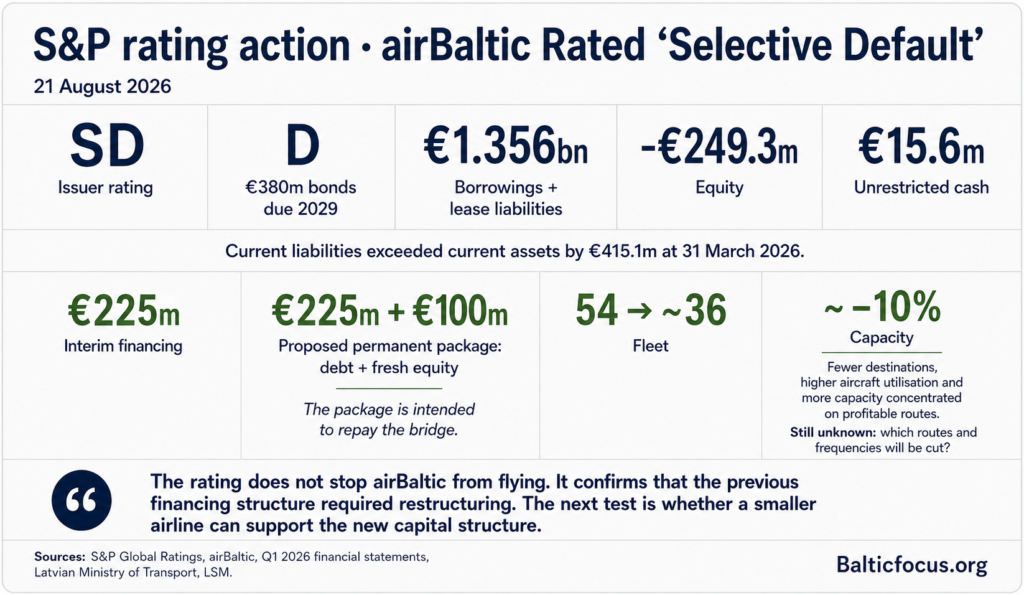
On Friday, 21 August, S&P Global Ratings downgraded airBaltic to SD, or Selective Default, and lowered the rating on its €380 million senior secured bonds due in 2029 to D. The move followed bondholders’ decision to amend the notes under financial stress, including capitalising interest due in August and November rather than paying it in cash.
For S&P, this means a default event has already occurred; it is not a warning about a possible future default. The SD rating applies when an issuer defaults on specific obligations while continuing to meet others. It is not the same as insolvency or a suspension of operations.
1. Passengers: little changes for now
For passengers, the rating has little immediate effect. airBaltic continues to operate and sell tickets; the SD and D ratings concern financial obligations, not the airline’s operating licence or the validity of its tickets.
The relevant change is the network restructuring. airBaltic currently has 54 Airbus A220-300 aircraft, while the revised plan envisages around 36 by the end of 2026. Management nevertheless expects overall capacity to decline by only about 10%, implying materially higher utilisation of the remaining fleet.
Board member Vitolds Jakovļevs has said airBaltic will concentrate more capacity on profitable destinations and cut weaker services, in some cases almost completely. The number of destinations will fall. For passengers, the practical question is therefore not the rating itself but the eventual schedule: which routes remain, which lose frequencies and which disappear.
2. Bondholders: from coupon to recovery
The 2029 bonds were issued with a 14.5% annual coupon. After airBaltic decided in June not to replenish its bond service reserve account, Fitch reported that the rate applicable to the August interest payment had stepped up to 16.5%.
The August payment was not made in cash under the original schedule. Bondholders subsequently agreed to capitalise that interest, together with the interest due in November. The claim remains, but the original terms — high cash coupons followed by repayment of principal in 2029 — no longer describe the likely outcome.
The proposed recapitalisation envisages up to €125 million of take-back debt for existing bondholders, with part of the remaining claims expected to be converted into equity. The final equity allocation, valuation and recovery waterfall have not been disclosed.
If the full €125 million were allocated pro rata across the original €380 million principal, it would amount to about €32.90 of new debt for every €100 of original principal. This is not a recovery estimate. Any additional recovery will depend on the value of the equity and the final transaction structure.
The recovery picture is further complicated by the proposed €225 million of interim financing, which may receive first-out priority against collateral already securing the existing bonds. Management estimates the going-concern value of that collateral at about €506 million, but this is not an independent liquidation appraisal, and the company has said liquidation proceeds could be materially lower.
The notes remain senior secured, but that description alone no longer indicates what bondholders are likely to recover.
3. A €225 million bridge against €1.36 billion of borrowings and leases
The SD rating may be temporary. Once the distressed exchange is completed, S&P can reassess airBaltic under the revised capital structure. The balance sheet matters more than how long the SD label remains in place.
At 31 March 2026, airBaltic Group reported €472.3 million of borrowings and €883.8 million of lease liabilities, or €1.356 billion combined. Total liabilities stood at €1.802 billion. Group equity was negative €249.3 million, while unrestricted cash was €15.6 million.
These liabilities are not all immediately payable, but they put the proposed financing in perspective. airBaltic is seeking €225 million of interim financing. Supervisory board chairman Andrejs Martinovs has said an active group of private creditors is prepared to provide the full amount, although final terms are still being negotiated. Jakovļevs has also indicated that, given the risk, a rate materially above the old 14.5% bond coupon would be a reasonable assumption.
Under the revised business plan, the €225 million interim financing is temporary. It is expected to be replaced by a permanent package of up to €225 million of new debt and €100 million of fresh equity, alongside the restructuring of existing claims. Proceeds from the permanent package would repay the bridge rather than add another €325 million on top of it.
Several critical terms remain unresolved: who provides the €100 million of fresh equity, the valuation attached to that investment, the cost of permanent debt and the cash generation of the smaller airline after leases, financing costs and operating expenses.
The bridge provides liquidity and time to complete the recapitalisation. It does not establish that the resulting capital structure will be sustainable.
4. Airbus and the 100-aircraft bet
airBaltic has had an unusually prominent role in the A220 programme. It became the launch operator of the A220-300 in 2016, later moved to an all-A220 fleet and became one of the aircraft’s most visible European reference customers.
When airBaltic ordered another 30 aircraft in 2023, taking its firm orderbook to 80, Airbus explicitly referred to the airline as an “ambassador for the A220”. airBaltic was then targeting a fleet of 100 aircraft by 2030. A further order in 2024 took its firm commitment to 90 A220-300s.
The commercial context has since changed sharply. The revised airBaltic plan is built around approximately 36 aircraft at the end of 2026, followed by only gradual expansion.
This is not evidence of a problem with the A220 programme. By the end of July 2026, Airbus reported 1,106 cumulative A220 orders and 532 deliveries. In May, AirAsia placed a firm order for 150 A220-300s, the largest single firm order in the programme’s history. BermudAir added another 10-aircraft order in July.
airBaltic helped establish the A220 as a credible platform for a European network airline. The aircraft no longer depends on airBaltic for market validation. The question now is what happens to airBaltic’s remaining delivery commitments.
A fleet trajectory approaching 100 aircraft cannot simply coexist with a business plan centred on roughly 36. That does not mean the difference translates directly into cancelled orders: delivered aircraft, direct purchase commitments, leasing arrangements and future deliveries are separate issues. But delivery schedules, financing arrangements or contractual commitments will have to reflect the airline’s new scale, and the treatment of those commitments has not yet been disclosed in sufficient detail.
Airbus has successfully built a broad market for the A220. airBaltic still has to show that its own fleet ambitions can be supported by demand and cash flow.
5. Can airBaltic Make It to the Other Side?
The storm that caused extensive damage across the Baltic states overnight into Sunday pushed developments at airBaltic into the background. S&P Global Ratings’ decision on Friday to downgrade the company to Selective Default and its bonds to D passed almost unnoticed.
Yet this is no longer just another stage of restructuring. It is formal confirmation that airBaltic’s financial crisis has entered a new phase — with direct consequences for the company, its creditors and, eventually, its passengers.
The main question now is whether airBaltic can make it to the other side of that crisis — and emerge as a smaller but financially sustainable airline.