Why are Estonian banks gloomy?
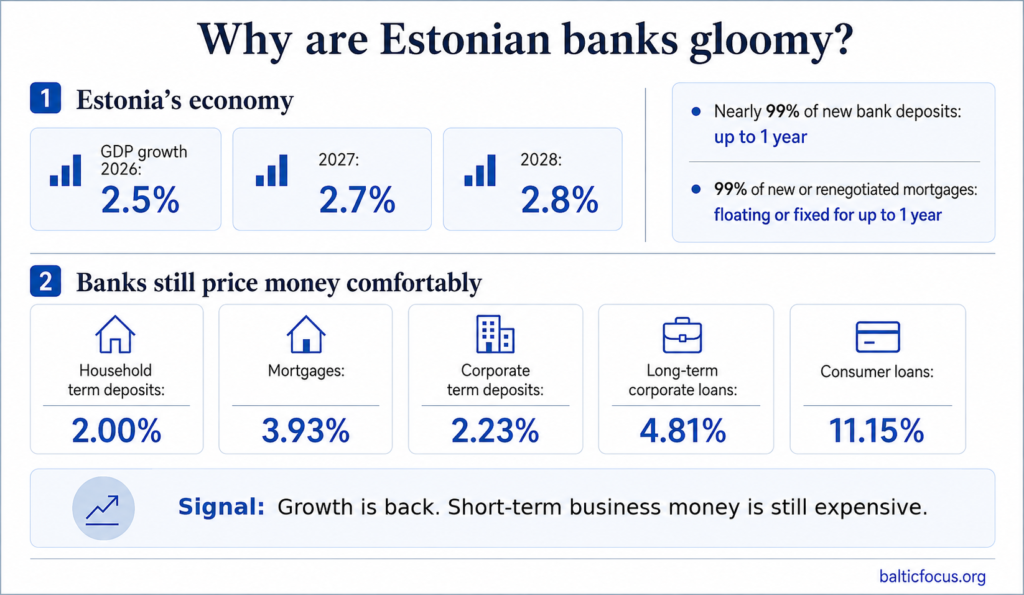
Estonia is growing again. SEB expects GDP to expand by 2.5% in 2026, 2.7% in 2027 and 2.8% in 2028 — respectable rates for an economy operating in much less favourable conditions than during the rapid convergence years.
The financial data, however, show that the recovery has not removed short-term caution.
Nearly 99% of new bank deposits in Q2 were placed for up to one year, while 99% of new or renegotiated mortgages carried floating rates or were fixed for no longer than a year. In Estonia this is not necessarily a warning signal: short-rate mortgages are a longstanding feature of the market. What it does show is a system built around frequent repricing rather than long-term rate certainty.
The corporate loan market is harder to dismiss as habit. Loans with maturities below one year carried an average rate of 6.28%, compared with around 4.8–4.9% for loans above one year. Short-term corporate money is therefore markedly more expensive than longer-term financing.
That does not mean Estonian banks expect a recession. But it does suggest that they are pricing immediate liquidity and working-capital risk more aggressively than duration risk. In other words, the concern appears to be less about where the economy will be in ten years than about the resilience of companies through the next few quarters.
This helps explain the cautious tone of bank economists better than nostalgia for the 4% growth rates of the 2010s. Estonia is increasingly testing whether it can sustain growth without the unusually supportive combination of rapid EU-backed convergence, eastern trade and transit, and much lower security costs.
Growth of 2.5–3% under those conditions is not a weak result. The stronger question is whether the present recovery is robust enough to ease the price of short-term business liquidity.
Signal: Estonia’s economy is growing again, but banks are still charging a noticeable premium for companies that need money now.