Analysis · Transport & Logistics
Baltic Airports Are Growing as Airlines Pull Back
Riga remains the largest individual airport in the Baltic states. But by the end of summer, the more important question is no longer who is first by passenger numbers.
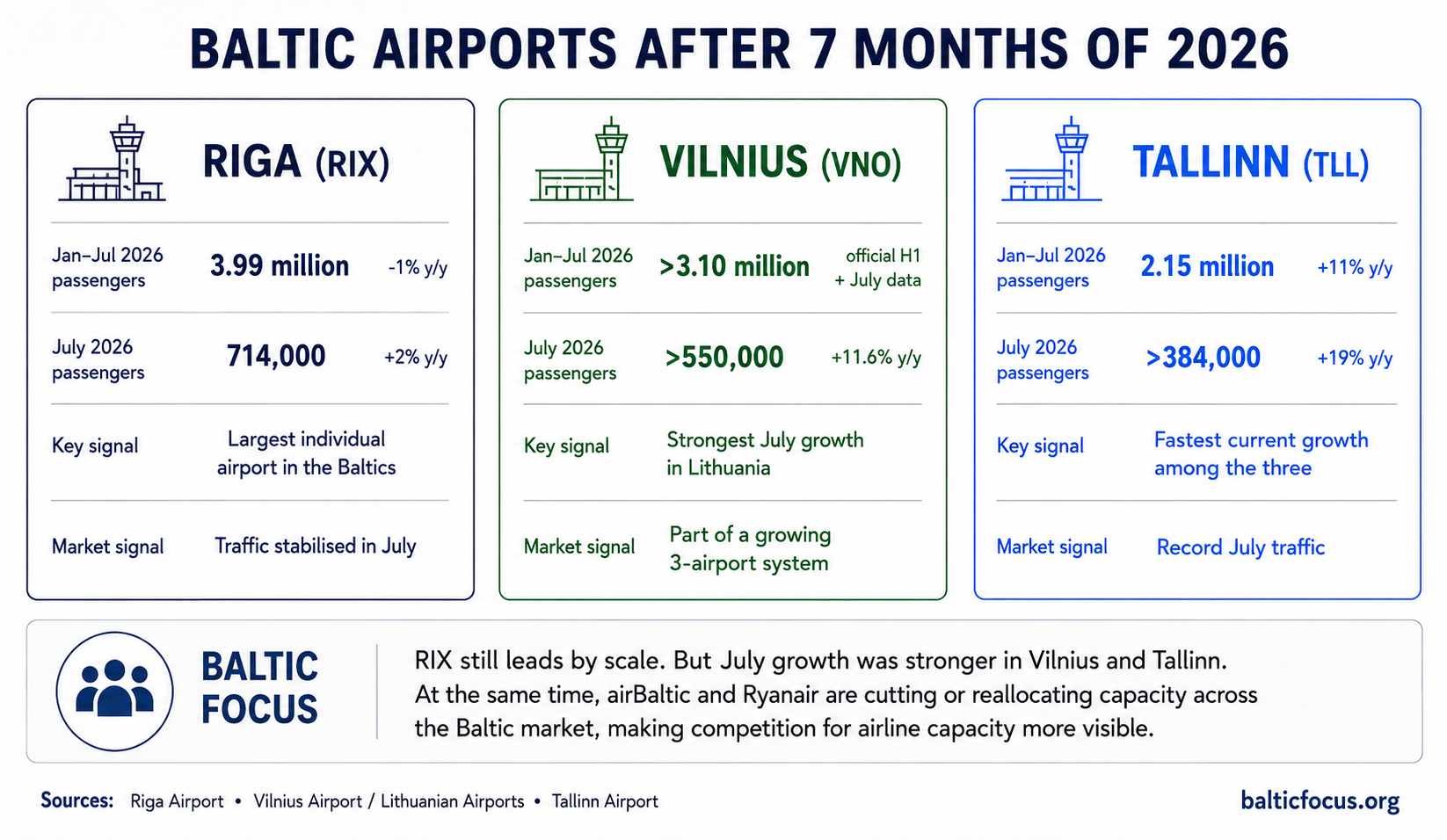
Riga remains the largest individual airport in the Baltic states. But by the end of summer, the more important question is no longer who is first by passenger numbers.
It is where the growth is going.
RIX handled 3.99 million passengers in January–July 2026, 1% fewer than a year earlier. Tallinn reached 2.15 million, up 11%. Lithuania’s three-airport system continued to post record traffic, with passenger numbers up 9%.
July made the divergence clearer.
Riga handled 714,000 passengers, 2% more than a year earlier. Tallinn passed 384,000, up 19% and setting another monthly record. Lithuania’s airports together handled almost 756,000 passengers, 10% more than in July 2025.
The gap in scale remains large. The gap in momentum does too.
Riga is still much bigger than Tallinn
Tallinn’s growth rate is impressive, but the base matters.
Its 2.15 million passengers in January–July amounted to only around 54% of Riga’s 3.99 million. The same ratio appeared in July: Riga handled almost twice as many passengers as Tallinn.
Tallinn is therefore not close to overtaking Riga in passenger numbers.
What is changing is the trajectory. The smaller airport is growing at a double-digit rate while Riga, despite returning to year-on-year growth in July, remains slightly below last year on a cumulative basis.
That makes the comparison more interesting than a simple ranking.
Riga still has the scale. Tallinn has the momentum.
Lithuania is building scale differently
Lithuania should not be treated as a single airport.
Vilnius, Kaunas and Palanga form one airport system but serve different segments and geographies. Vilnius remains the main capital gateway, Kaunas carries a substantial low-cost segment, and Palanga provides direct access to western Lithuania.
That system handled almost 756,000 passengers in July.
Vilnius alone remained smaller than Riga, but the combined Lithuanian network again handled more passengers than RIX.
This was already visible in June and now looks less like a one-month anomaly.
The distinction matters. Riga is one large hub centred heavily on one dominant airline. Lithuania is spreading traffic, carriers and infrastructure across three airports.
The two models can therefore produce similar headline passenger numbers for very different reasons.
Tallinn is diversifying while it grows
Tallinn’s expansion is also becoming less dependent on a single carrier.
airBaltic remained its largest airline in July, but its share was 29%. Wizz Air had already reached 19% after expanding its Tallinn network, while the airport continued to add direct destinations through several carriers.
That is structurally different from Riga.
At RIX, airBaltic still accounts for the majority of passenger traffic and remains central not only to direct connectivity but also to the transfer model.
Tallinn is smaller, but each additional direct route reduces the need for Estonian passengers to connect through another Baltic airport.
That does not threaten Riga’s scale in the short term. It does, however, gradually reduce Riga’s historical advantage as the default regional connecting point.
Riga’s passenger traffic is stabilising — cargo is growing much faster
Riga’s July result is not a story of continued decline.
Passenger traffic returned to growth, up 2% year-on-year. Flight numbers increased even faster, while transfer passengers still accounted for around a quarter of July traffic.
The stronger growth line is cargo.
RIX handled 16,600 tonnes in January–July, up 52% from a year earlier.
That reinforces one of the more interesting signals from the first half of the year: while passenger volumes remain broadly flat, Riga is building another source of aviation activity through freight and e-commerce logistics.
For an airport heavily exposed to one passenger airline, that diversification matters.
Airlines are recalculating the Baltic market
This is where the picture has changed most since the H1 comparison.
The pressure is no longer confined to Riga or to airBaltic.
airBaltic is cutting routes and frequencies across all three Baltic markets as it moves towards a smaller fleet and a more concentrated network. Its winter changes include the suspension of Riga–Ljubljana and Riga–Malta, Tallinn–London Gatwick, Vilnius–Berlin and Vilnius–Dubai, as well as Palanga–Tenerife. Frequencies are also being reduced on a number of other services.
The airline’s revised business plan points in the same direction. airBaltic plans to reduce its Airbus A220 fleet to around 36 aircraft by the end of 2026, abandoning the previous expansion path towards 100 aircraft and concentrating its network more heavily around Riga.
Ryanair is also becoming more selective across the region. It cut Riga’s Summer 2026 capacity by 20% and removed six routes. In Lithuania, its overall summer capacity is flat and Vilnius has lost one route. Tallinn is also getting no Ryanair growth this summer, with the carrier operating only six routes.
The significance is regional. Passenger traffic can continue to grow while airlines become more cautious about where they deploy aircraft, frequencies and routes.
That makes the assumption that any capacity withdrawn by airBaltic will simply be picked up by low-cost carriers much less certain.
The Baltic airport hierarchy has not changed. But competition for airline capacity is becoming much more visible.
Baltic Focus comparison based on official airport traffic data and carrier disclosures; airport systems and reporting bases are not identical.
Primary source
Traffic Statistics 2026 — January–July 2026
Tallinn Airport — official July 2026 traffic data
Lithuanian Airports — official July 2026 traffic data
airBaltic — 2026 network and fleet disclosures
Ryanair — Baltic Summer 2026 schedule statements