Analysis · Transport & Logistics
Baltic Airports in H1 2026: Is the Baltic Region Attracting More Passengers?
Riga remains the largest individual airport in the Baltic states, serving 3.28 million passengers in the first half of 2026, yet its traffic declined by 1%.
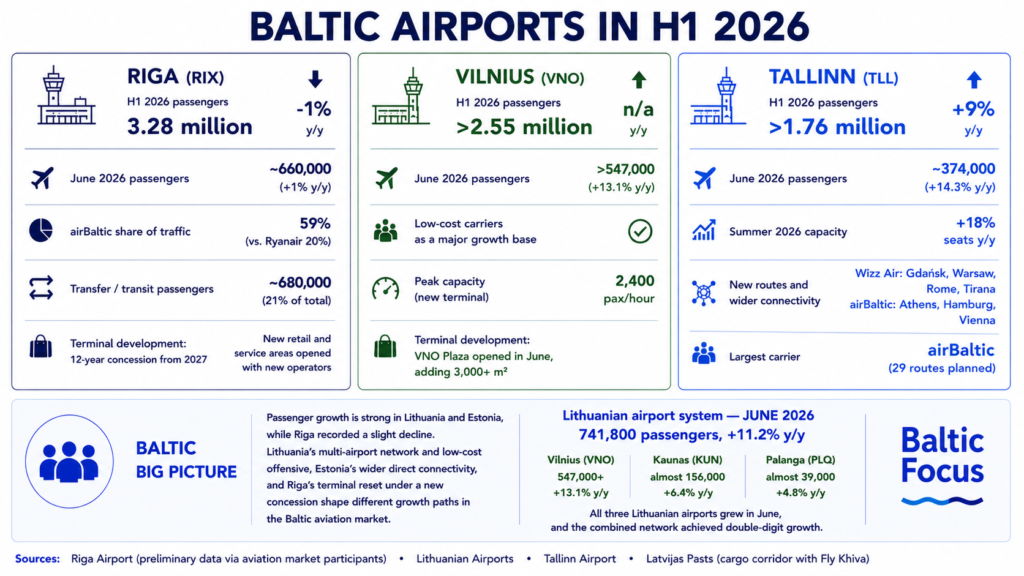
Double-digit passenger growth in Lithuania and Estonia suggests that the Baltic region is attracting more air traffic. Rising passenger numbers may reflect stronger tourism, business activity and regional mobility.
But the growth is not being distributed evenly. Riga remains the largest individual airport in the Baltic states, serving 3.28 million passengers in the first half of 2026, yet its traffic declined by 1%. Vilnius and Tallinn expanded much faster, while Lithuania’s combined three-airport network moved ahead of RIX in June.
The figures therefore show both a growing regional aviation market and a redistribution of passenger flows within it. They also reveal why airBaltic’s financing crisis has made Riga Airport’s concentration risk strategically important
Baltic airport traffic in H1 2026
| Airport | H1 2026 passengers | Year-on-year change |
|---|---|---|
| Riga | 3.28 million | −1% |
| Vilnius | More than 2.55 million* | Not disclosed |
| Tallinn | More than 1.76 million | +9% |
*Lithuanian Airports reported more than 2 million passengers at Vilnius in January–May and more than 547,000 in June; the exact H1 total has not yet been disclosed.
June sharpened the contrast. Riga handled approximately 660,000 passengers, up around 1%, according to preliminary estimates from aviation market participants. Vilnius reached more than 547,000, up 13.1%, while Tallinn served approximately 374,000, up 14.3%. The combined Vilnius–Kaunas–Palanga network handled 741,800 passengers, 11.2% more than a year earlier.
Riga therefore retained first place among individual airports. The strongest growth was recorded elsewhere.
One airport versus an airport system
Lithuania operates three complementary gateways. Vilnius provides the main capital-city network, Kaunas absorbs a large share of low-cost traffic, and Palanga extends the system into the western Baltic market.
This structure has been backed by investment. The new departure terminal at Vilnius added 14,400 square metres and doubled peak processing capacity from 1,200 to 2,400 passengers per hour.
Lithuania has also expanded the commercial base of its two largest airports. Vilnius opened the more than 3,000-square-metre VNO Plaza in June, adding a 1,300-square-metre duty-free store alongside new retail, catering and business-lounge facilities.
The expanded Kaunas terminal brought reconfigured retail and food-service areas, two duty-free shops, five car-rental offices and additional service operators.
The investment strategy was designed not merely to handle more passengers, but to build a broader commercial return around growing traffic. Infrastructure, route incentives and capacity from both low-cost and network airlines now reinforce one another.
The system also competes beyond Lithuania. For parts of western and southern Latvia, Vilnius, Kaunas and Palanga are practical alternatives to Riga. Around Liepāja, for example, the choice between Riga and a Lithuanian airport may be decided by the route, timetable and fare rather than the national border.
The scale of this cross-border flow is not publicly measured. It would be wrong to assign Riga’s weaker figures directly to Lithuania. But RIX no longer controls the full Latvian catchment area by default.
Riga’s concentration risk
Riga recorded 30,700 flights in H1, 1% more than a year earlier, but passenger traffic fell by 1%. Of the 3.28 million passengers, 2.60 million were direct and around 680,000 were transfer or transit passengers.
airBaltic accounted for 59% of RIX traffic, compared with 20% for Ryanair. Other airlines give Riga a substantial direct network, but none currently reproduces airBaltic’s combination of scale, frequencies and transfer connectivity.
The relationship is not fully reciprocal. airBaltic also operates substantial networks from Tallinn and Vilnius. At Tallinn, it remains the largest carrier and planned 29 routes for the 2026 summer season. RIX, however, has no alternative carrier capable of replacing airBaltic’s role in its hub structure.
The airline’s financial crisis has not caused Riga Airport’s first-half result. airBaltic itself carried 2.45 million passengers across its network in H1, 3.9% more than a year earlier, and operated 5% more flights. The financing problem has not yet translated into a collapse in operations.
The airport figures instead show why the crisis matters.
Reuters reported on July 17 that the Latvian government was negotiating with a strategic investor as airBaltic prepared to seek short-term financing from bondholders on August 3. The report attributed to the Latvian prime minister the position that preserving the Riga hub would be Latvia’s main condition for an investor.
The airline has yet to repay a €30 million state loan due in August and failed to replenish a reserve account required under its €380 million 2029 bonds. Fitch has placed its CCC− issuer rating on Rating Watch Negative and described the existing capital structure as unsustainable.
Riga’s weak passenger dynamics are not an effect of this financing crisis. They reveal the exposure that makes the crisis strategically important.
Tallinn expands direct connectivity
Tallinn followed a different path. Passenger traffic exceeded 1.76 million in H1, up 9%, and June produced another monthly record.
Airlines planned 18% more seats from Tallinn for the summer season. Wizz Air supplied the strongest new growth impulse, adding Gdańsk, Warsaw, Rome and Tirana, while airBaltic added Athens, Hamburg and Vienna and retained the airport’s largest route portfolio.
Tallinn is not replacing one dominant airline with one discounter. It is broadening direct connectivity across a wider carrier mix. Every new viable direct route weakens the automatic case for transferring through Riga.
Cargo moves in the opposite direction
Riga’s cargo volume rose by 57% to 14,400 tonnes in H1.
In the first half of 2026, the Latvijas Pasts–Fly Khiva corridor handled 100 cargo flights and nearly five million kilograms of e-commerce shipments, accounting for more than half of all imported cargo processed at RIX during the period.
Cargo has become a separate growth line for Riga even as passenger traffic stagnates.
The lead is narrower than the ranking suggests
Riga remains the largest individual airport in the Baltic states. Lithuania has built a broader three-airport system, while Tallinn is rapidly expanding direct connectivity.
The difference is structural. Lithuania distributes traffic across three airports and multiple airline models. Tallinn is widening its carrier base. Riga’s regional role remains tied to an airBaltic-centred hub at the moment when the airline requires new financing, restructuring and a strategic investor.
The airBaltic crisis has not reduced RIX operations yet. It has made Riga Airport’s concentration risk impossible to treat as merely an airline problem.