Analysis · Transport & Logistics
Rail Baltica on 21 July 2026: What Has Actually Been Built in Each Baltic State?
Rail Baltica is visibly under construction across Estonia, Latvia and Lithuania. But the three countries have reached materially different stages.
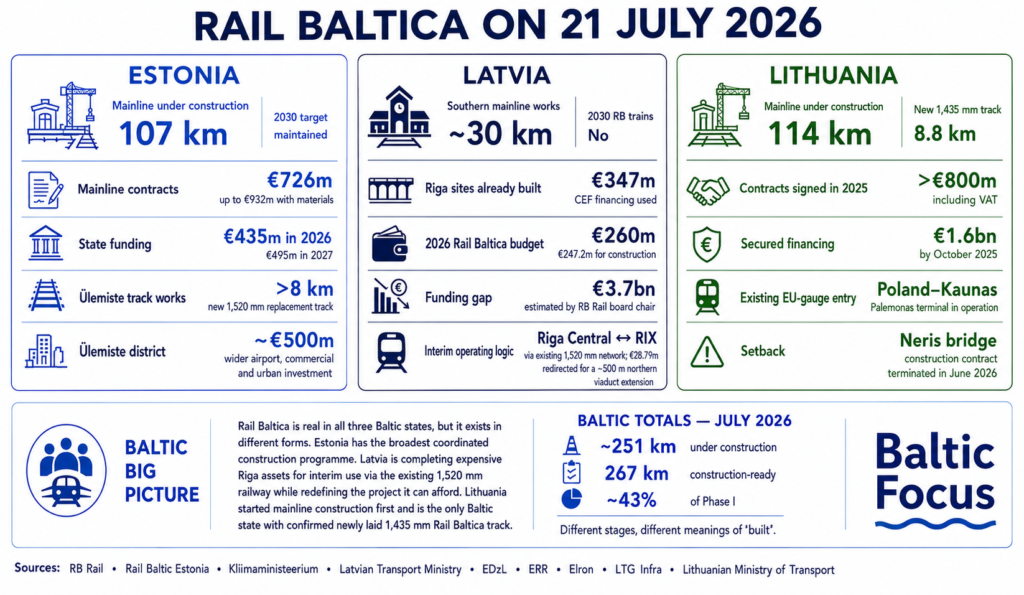
Rail Baltica is visibly under construction across Estonia, Latvia and Lithuania. But the three countries have reached materially different stages. Estonia has placed almost its entire national corridor within a coordinated construction framework. Latvia is trying to make expensive but disconnected assets usable. Lithuania has laid the first confirmed kilometres of the new European-gauge railway.
At Rail Baltica Industry Day on 27 April 2026, RB Rail reported 107 kilometres of mainline under construction in Estonia, work on Latvia’s approximately 30-kilometre priority southern section, and 114 kilometres under construction in Lithuania. In a separate project update, RB Rail described more than 267 kilometres, or over 40% of the Phase I mainline, as construction-ready.
The figures are not directly interchangeable. The three national construction totals amount to approximately 251 kilometres, while the 267-kilometre figure also includes sections classified as ready for construction rather than already undergoing active physical work.
More importantly, the word “construction” covers very different stages:
- land clearance and access roads;
- railway embankments and drainage;
- bridges, viaducts and tunnels;
- station structures;
- reconstruction of existing 1,520 mm railway infrastructure;
- installation of sleepers, ballast and 1,435 mm rails.
A country can therefore report more than 100 kilometres under construction without possessing 100 kilometres of completed railway.
As of 21 July 2026, Estonia, Latvia and Lithuania represent three different forms of Rail Baltica progress.
Estonia: the broadest construction programme
Estonia currently has the widest national construction front. RB Rail reported 107 kilometres of mainline under construction in April 2026, alongside major works at the Ülemiste international terminal and on sections extending south towards Pärnu. Estonia signed its first mainline construction contract on 5 January 2024, for a 4.8-kilometre section east of Ülemiste.
The programme expanded rapidly in 2025. In May, Rail Baltic Estonia signed two alliance contracts covering the corridor between Ülemiste and the Latvian border. Their combined estimated value is €726 million. With options to procure strategic materials such as rails, sleepers, switches and ballast, the value may rise to €932 million.
Ülemiste is developing into a much larger project than a station building alone. The construction contract for the Linda international passenger terminal is worth approximately €85 million excluding VAT. Rail Baltic Estonia, Tallinn Airport and private developer Mainor have also announced planned investment of nearly €500 million in the wider Ülemiste district. That figure includes airport, commercial and urban development and is not the cost of Rail Baltica alone.
Track installation is already taking place within the wider Ülemiste construction area, but the gauge distinction is essential. A €27.2 million infrastructure contract provides for the removal of approximately 16.3 kilometres of existing track and the construction of more than eight kilometres of replacement 1,520 mm track. The purpose is to keep the conventional railway functioning while creating space for the future 1,435 mm Rail Baltica infrastructure.
Estonia therefore already has rail installation taking place within the Rail Baltica construction programme. However, the publicly documented track at Ülemiste belongs to the rearranged conventional network. Official project updates still identify Lithuania, rather than Estonia, as the country where the first new 1,435 mm Rail Baltica track has been laid.
The financial commitment is substantial. Estonia’s 2026 state budget allocated €435.7 million to Rail Baltica. In a parliamentary response reported in July 2026, the Ministry of Climate referred to €435 million for projects in 2026 and €495 million in 2027, maintaining that the funding was sufficient to keep the national section on its 2030 schedule.
Estonia’s position can therefore be summarised as follows:
the country has mobilised a large national construction and financing programme, with structures, embankments and track-related work under way, but it does not yet have an operational Rail Baltica railway.
Latvia: completing the assets before deciding the railway
Latvia began constructing its two major Riga sites before it launched large-scale work on the cross-border mainline. Construction at Riga Central Station started in November 2020, while work at the airport site began at the end of June 2021.
The physical programme now consists of three separate construction areas:
- the southern mainline between the Lithuanian border and Misa;
- the reconstructed southern section of Riga Central Station;
- the station structures and viaduct at Riga Airport.
More than 30 kilometres of the southern mainline have been activated for construction. Work on the initial 11 kilometres focused on land clearance, unexploded-ordnance surveys, access infrastructure and staged embankment construction. A further 19.62 kilometres were handed over in January 2026 for similar preparatory, earthwork and substructure works. These areas do not yet amount to 30 kilometres of completed railway, and Latvia has not announced a completed section of newly laid 1,435 mm track.
The revised Phase I route has also changed the status of the two Riga passenger projects.
The cross-border mainline is planned to run from the Lithuanian border through Misa, Upeslejas and Vangaži to the Estonian border. It does not pass directly through either Riga Central Station or Riga Airport.
In December 2024, the Cabinet instructed the responsible ministries to assess two possible 1,435 mm connections for integrating one of the Riga international stations into Phase I:
- Upeslejas–Riga Central Station;
- Misa–Riga Airport.
This was an instruction to prepare a technical and economic assessment and explore private financing, not a decision to construct either branch. Neither connection has been built or fully financed. A subsequent government review explicitly noted that a 1,435 mm station connection might not proceed if its viability could not be demonstrated or private investment could not be secured.
Latvia has nevertheless already invested substantial capital in the two Riga sites. In May 2025, the Transport Ministry reported that approximately €347 million in Connecting Europe Facility funding had been used for their construction, with EU co-financing covering up to 85% of eligible expenditure.
Separately, a financing agreement worth €138.7 million was signed in November 2025 for the currently approved southern section of Riga Central Station. It includes €114.6 million from the Recovery and Resilience Facility and €24.1 million from the Latvian state budget.
The building envelope, façade and much of the platform infrastructure are now largely complete. The financing agreement requires substantial completion of the current works by 31 August 2026. Latvijas dzelzceļš is then expected to install tracks, signalling and overhead equipment, with full use of the southern section by passenger trains planned from summer 2028.
Those first trains will use the existing 1,520 mm railway rather than an operational Rail Baltica mainline.
The airport site follows a similar logic.
Latvia’s December 2024 implementation scenario provides for a new 1,520 mm connection from Imanta to RIX. This would link the airport station with the reconstructed Central Station through the existing railway network before the European-gauge line reaches either site.
The proposed CEF9G amendments do not finance the complete Imanta–RIX railway. They redirect exactly €28,793,386 from the southern part of the airport viaduct towards an approximately 500-metre northern extension in the direction of Imanta and Riga Central Station. CINEA has conceptually accepted the additional northern viaduct substructure, while EDzL’s schedule indicates that the relevant construction programme could be completed around the middle of 2029.
The Latvian Transport Ministry report describes the purpose of the amendments unusually directly: they are intended to reduce the discrepancy between the original plan and the actual implementation situation.
This creates a practical but striking possibility.
Elron already operates a direct Tallinn–Tartu–Riga passenger service on the existing 1,520 mm network. If Latvia completes the Central Station works and the Imanta–RIX connection, a passenger could travel from Tallinn to the reconstructed Riga station and continue by train to the airport complex without using the new Rail Baltica gauge at any point.
Latvia could therefore open its two flagship Rail Baltica passenger facilities before it opens Rail Baltica itself.
The Latvian government has also stopped presenting full delivery by 2030 as a realistic outcome. On 3 June 2026, ERR reported that ministers in the newly formed government did not expect Rail Baltica high-speed trains to be running through Latvia in 2030. The government said it would use the four months before the parliamentary election to determine what version of the project Latvia could afford and what railway it intended to build.
The financial gap is correspondingly large. At an Estonian parliamentary committee hearing on 8 June, RB Rail supervisory board chairman Matīss Paegle estimated that Latvia still lacked €3.7 billion to deliver the project by the earlier deadline. He said approximately €300 million would need to be invested in construction in 2026 and €720 million in 2027 to accelerate the programme. These were estimates of required expenditure, not amounts already allocated.
Latvia’s 2026 budget provides €260 million for Rail Baltica: €247.2 million for construction and €12.8 million for design adaptation and project management. The construction allocation includes €75 million for the southern mainline, €120 million for Riga Central Station and €52 million for the airport site.
These figures measure different things: €3.7 billion is an estimated remaining funding gap for the wider programme, while €260 million is the amount planned for use in 2026.
Latvia’s position is therefore not simply that it is “behind”:
it is completing expensive passenger facilities that no longer lie directly on the Phase I cross-border mainline, adapting them for initial use by the existing railway and reconsidering how much of the European-gauge system it can afford to construct.
Lithuania: the earliest mainline programme and the first new track
Lithuania was the first Baltic state to begin physical construction on the new Rail Baltica mainline. Initial works on access roads in the Šveicarija–Žeimiai section began in April 2022, followed by the ceremonial launch of construction on the Neris railway bridge on 21 July 2022.
By March 2024, railway embankments and engineering structures were under construction across almost 30 kilometres in the Jonava district.
Lithuania also starts from a different inherited position. It already has an operational European-standard-gauge railway from the Polish border to Kaunas and the Palemonas intermodal terminal. This is the earlier Rail Baltica I line rather than the new high-speed Phase I mainline, but it provides the Baltic states’ existing physical connection to the 1,435 mm European network.
On 30 June 2026, LTG Infra announced a €111.1 million contract, including VAT, to install modern signalling on approximately 130 kilometres of this existing line, covering ten stations and 40 level crossings.
North of Kaunas, construction now covers 114 kilometres towards Panevėžys. Two contracts signed in October 2025 added 36.7 kilometres of embankments and engineering structures at a combined value of €375.8 million including VAT. LTG Group said the total value of Rail Baltica contracts signed in Lithuania during 2025 exceeded €800 million, also including VAT.
By October 2025, Lithuania had secured approximately €1.6 billion in Rail Baltica funding, with up to 85% provided through the EU’s Connecting Europe Facility and the remainder covered by the Lithuanian state. This is secured project financing, not a measure of money already paid for completed infrastructure.
The programme has also encountered a significant setback. On 15 June 2026, LTG Infra terminated its contract with the contractor building the bridge over the Neris, citing construction progress, the contractor’s financial position and the fulfilment of contractual obligations. The bridge remains a critical but unfinished element of the Lithuanian corridor.
Despite that interruption, Lithuania has moved beyond embankment construction.
On the Šveicarija–Žeimiai section, approximately 8.8 kilometres of new 1,435 mm European-standard track have already been laid. In June 2026, production also began on the high-speed turnout systems intended for this section.
The 8.8 kilometres do not yet form an operational high-speed railway. They are not connected into a completed line from Kaunas to Panevėžys, the Latvian border or the rest of the Baltic corridor.
But they are physically different from a financing agreement, a construction-ready section, a bridge foundation, an embankment or a station prepared for conventional trains.
They are the clearest existing section of the new Rail Baltica railway itself.
What the three countries actually have
As of 21 July 2026, Rail Baltica is real in all three Baltic states, but it is real in different forms.
Estonia has the broadest coordinated national construction and financing programme. More than 100 kilometres are under construction, and alliance contracts cover the route to the Latvian border. Track installation is visible at Ülemiste, although the publicly confirmed replacement tracks there belong to the 1,520 mm network.
Latvia has more than 30 kilometres of active mainline substructure work and two capital-intensive passenger complexes in Riga. Under the revised Phase I plan, neither complex lies directly on the cross-border mainline. Both are being prepared for initial use through the existing 1,520 mm railway while Latvia reassesses the scope it can finance.
Lithuania began physical mainline construction first, now has 114 kilometres under construction and possesses the first confirmed 8.8 kilometres of newly laid 1,435 mm Rail Baltica track. Its progress is substantial, although the termination of the Neris bridge contract shows that it is not uninterrupted.
The question is therefore not whether Rail Baltica is being built. It is what the word “built” means in each country.
In Estonia, it primarily means a national corridor under intensive construction and financing.
In Latvia, it means mainline embankments and major passenger facilities that now sit outside the Phase I cross-border route and are being adapted for interim use by the existing railway.
In Lithuania, it has already reached the most literal stage:
the first confirmed physical track of the new Rail Baltica railway is on the ground.