Statistic · Transport & Logistics
Rail Baltica delayed to 2034: what is actually being built across the Baltics
Estonia, Latvia and Lithuania have effectively moved the common operational horizon for Rail Baltica from 2030 to 2034, while narrowing the first-stage priority to a continuous Tallinn–Kaunas–Poland backbone. On 22 September, roughly 247 km of the main line were in the construction phase, while only about 34% of the estimated Phase I cost had secured financing.
The three Baltic governments agreed on 22 September that the cross-border main line should become operational during the EU’s next Multiannual Financial Framework, currently planned for 2028–2034. They will jointly seek at least €10 billion in dedicated EU funding, want EU co-financing of up to 85%, and are asking for transitional financing so construction can continue before the new budget period begins.
Cost reduction has also become an explicit part of the agreement, including a review of technical solutions and closer coordination of construction capacity, materials and labour.
What is actually being built first
The first operational priority is narrower than the full Rail Baltica network originally associated with direct new European-gauge links between the Baltic capitals.
The European Commission’s current implementation decision prioritises the corridor Tallinn–Pärnu–Salaspils–Misa–Panevėžys–Kaunas–Warsaw in Phase I. Riga and Vilnius remain part of the full Rail Baltica project, but during the first phase their connection to the new railway is to be provided through the existing rail network.
The same decision states that the full project cannot be considered complete until Tallinn, Riga, Vilnius and Warsaw are connected by a 1,435 mm double-track railway. In practical terms, however, the continuous new-standard-gauge backbone now being prioritised is Tallinn–Pärnu–Latvia–Panevėžys–Kaunas–Poland.
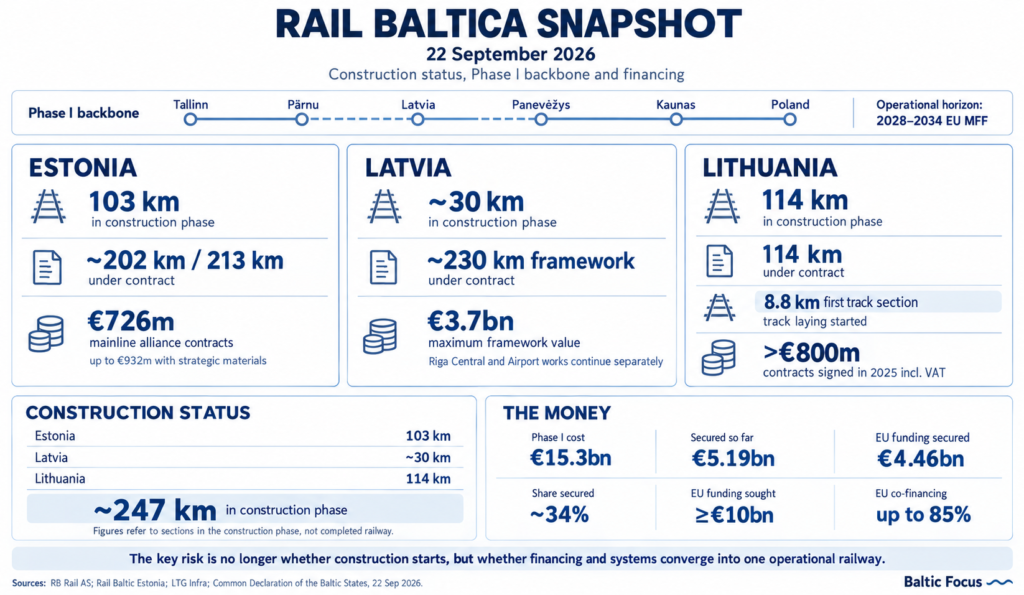
Estonia: 103 km under construction
RB Rail reported on 9 September that 103 km of the Estonian main line had been handed over for construction. Signed construction contracts cover approximately 202 km of Estonia’s 213 km main line.
Two major alliance contracts for the Estonian main line have an estimated base value of €726 million, potentially rising to €932 million if options for strategic materials such as rails, sleepers, switches and ballast are exercised.
Latvia: around 30 km under active construction
Latvia currently has around 30 km of the priority main line in active construction, alongside continuing work at Riga Central Station and Riga Airport.
The main-line construction contract outside Riga covers approximately 230 km. The contract was structured as a framework for works to be activated progressively rather than as a single simultaneously constructed section.
Lithuania: 114 km and the first track
Lithuania has 114 km of Rail Baltica construction works between Kaunas and Panevėžys.
It also has the clearest physical railway progress on the new line: track laying has started on the first 8.8 km section. Rail Baltica contracts signed in Lithuania during 2025 exceeded €800 million including VAT.
| Country | In construction | Under contract |
| 🇪🇪 Estonia | 103 km | ~202 km / 213 km |
| 🇱🇻 Latvia | ~30 km | ~230 km framework |
| 🇱🇹 Lithuania | 114 km | 114 km |
| Baltic total in construction | ~247 km |
The numbers describe different stages of delivery. “In construction” includes sections where civil engineering, embankments, bridges and other railway structures are being built; contract coverage can extend substantially beyond the sections where physical works are currently active.
Sources: RB Rail AS, Rail Baltic Estonia, LTG Infra.
Around one-third of Phase I cost is secured
RB Rail says approximately €5.19 billion in financing has been secured so far, including around €4.46 billion from EU sources.
The current estimated investment cost of Phase I is €15.3 billion. On that basis, secured financing corresponds to roughly 34% of the present Phase I cost estimate.
The 22 September declaration therefore moves the financing question to the centre of the next implementation stage. The three governments are now jointly seeking at least another €10 billion of dedicated EU funding and want EU co-financing of up to 85% to remain available.
| Indicator | Amount |
| Estimated Phase I cost | €15.3bn |
| Financing secured so far | €5.19bn |
| Of which EU funding | €4.46bn |
| Share of Phase I cost secured | ~34% |
| Dedicated EU funding sought in next MFF | ≥ €10bn |
| Requested EU co-financing rate | up to 85% |
Sources: RB Rail AS; Common Declaration of the Baltic States, 22 September 2026.
The figures also show why the next MFF matters. Construction is already spread across all three countries, but the majority of the estimated Phase I financing still has to be secured while work continues.
The first train tender ended without a compliant bid
Infrastructure is not the only unresolved procurement.
The first joint tender by Estonia’s Elron, Latvia’s Vivi and Lithuania’s LTG Link for up to 20 regional Rail Baltica trains ended in September without a compliant bid.
Six manufacturers registered for the procurement, but none submitted an acceptable offer by the 8 September deadline. Two manufacturers continued raising questions and comments until the final days about technical requirements and contractual terms. The operators have not publicly identified a single reason for the failed tender and plan to revise the documentation before launching a new procurement.
The trains are intended for the 1,435 mm network and specified for speeds of up to 200 km/h.
The risk has shifted from starting construction to completing the system
By September 2026, Rail Baltica is no longer primarily facing the question of whether large-scale construction will begin. It already has.
The more important risk is whether financing, national construction programmes, railway systems and rolling stock can converge on the same operational timetable.
Around 247 km of main line are in the construction phase, while only about 34% of the estimated Phase I cost is currently covered by secured financing. The 22 September agreement effectively ties the next stage of delivery to the EU’s 2028–2034 budget cycle.
For the first operational Tallinn–Kaunas–Poland backbone, the central question is therefore shifting from how much construction has started to whether the remaining financing and system procurement can be assembled quickly enough to turn those separate construction fronts into one functioning railway.