Analysis · Transport & Logistics
Klaipėda Expands Its Lead as Baltic Port Traffic Diverges in H1 2026
The first half of 2026 widened the gap between the principal ports of the Baltic States.
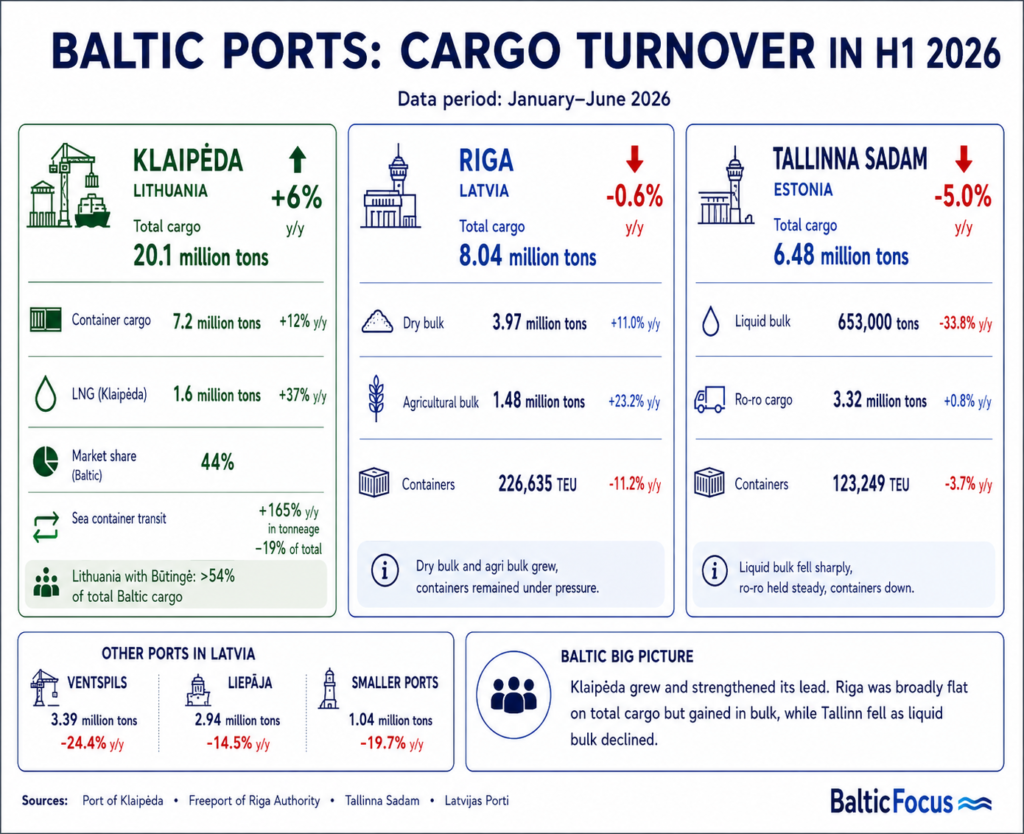
The first half of 2026 widened the gap between the principal ports of the Baltic States.
Klaipėda was the only major port in the region to increase cargo turnover. It handled 20.1 million tonnes, 6% more than a year earlier, and expanded its share of the Baltic States’ port market from slightly below 41% to 44%.
Latvia’s ports moved in the opposite direction. Their combined cargo turnover fell by 11% to 15.4 million tonnes. Riga came close to matching its previous-year result after recovering part of its early-year decline, but Ventspils and Liepāja recorded much deeper losses.
Tallinna Sadam handled 6.5 million tonnes, down 5%. Its decline, however, was concentrated almost entirely in liquid bulk, while ro-ro and other major cargo categories remained comparatively stable.
The figures do not show one common Baltic port trend. Klaipėda is increasing volumes across several cargo segments, Tallinna Sadam is adapting to the contraction of liquid bulk while adding new infrastructure, and Latvia is facing a more difficult question: how to maintain and repurpose a port system built for substantially larger transit flows.
Klaipėda strengthens Lithuania’s lead
Klaipėda handled 20.1 million tonnes in the first six months of 2026, up 6% year on year.
Containerised cargo remained the port’s largest segment, rising by 12% to 7.2 million tonnes. Klaipėda approached 700,000 TEU during the period.
Ro-ro cargo increased by 4% to almost 3.4 million tonnes. Oil products rose by 12% to 2.3 million tonnes, LNG by 37% to almost 1.6 million tonnes, and fertiliser cargo by 14% to 894,000 tonnes.
Several traditional cargo groups were weaker. Grain turnover declined by 7.1% to almost 1.3 million tonnes, while timber cargo fell by 153,000 tonnes. Minerals and construction materials decreased by around 6% to 943,000 tonnes. Growth in containers, energy cargo and ro-ro was nevertheless sufficient to lift the port’s total result.
According to the Klaipėda State Seaport Authority, maritime container transit increased by 165% in tonnage and now accounts for around 19% of the port’s total cargo turnover. The authority links the increase to expanding maritime transit, Klaipėda’s inclusion in an ocean service connecting the port with Asia and the development of short-sea routes. The underlying transit volume and its distribution between Klaipėda’s container terminals have not been published.
Klaipėda’s share of the Baltic States’ port market reached 44%, compared with slightly less than 41% in the first half of 2025. The Port Authority estimates that Lithuania’s combined share, including Klaipėda and the Būtingė oil terminal, now exceeds 54%.
Klaipėda is therefore planning its next expansion from a position of market strength.
The proposed development of the southern port would create approximately 100 hectares of new territory, 1.3 kilometres of quays and annual capacity for up to 30 million tonnes or 2.5 million TEU. The Port Authority estimates preliminary investment in the new territory and basic infrastructure at approximately €600 million.
This is separate from Klaipėda’s current infrastructure investment programme. In May, the Nordic Investment Bank agreed a €55.5 million, 11-year credit facility for projects covering port access, maritime safety, passenger infrastructure, shore-side electricity, green hydrogen, radar systems and cyber resilience. Around 45% of the supported investment programme is intended for the construction of a new cruise terminal.
Together, the projects show that Klaipėda is investing across several functions at once: cargo capacity, passenger infrastructure, energy transition and security.
Latvia loses 11% of port cargo
Latvian ports handled 15.4 million tonnes during the first half of 2026, down 11% from a year earlier.
One Klaipėda port therefore handled approximately 4.7 million tonnes more cargo than all Latvian ports combined.
| Port or market | Cargo turnover, H1 2026 | Change year on year |
|---|---|---|
| Klaipėda | 20.10 million tonnes | +6.0% |
| Latvia, all ports | 15.40 million tonnes | −11.0% |
| Riga | 8.04 million tonnes | −0.6% |
| Tallinna Sadam | 6.48 million tonnes | −5.0% |
| Ventspils | 3.39 million tonnes | −24.4% |
| Liepāja | 2.94 million tonnes | −14.5% |
The Latvian decline was highly uneven. Riga almost recovered to the previous year’s level, while Ventspils and Liepāja suffered much larger contractions.
The longer-term change is considerably deeper than the latest six-month result. Rail transit through Latvian ports fell from almost 20 million tonnes in the first half of 2016 to less than 2 million tonnes in the first half of 2026.
The infrastructure built for the former transit scale — access channels, breakwaters, berths and railway approaches — still has to be maintained despite a much smaller revenue base. This helps explain why Latvia has begun discussing possible state-budget support for port infrastructure maintenance.
Riga recovers from a weak start
Riga handled 8.038 million tonnes, only 0.6% less than in the first half of 2025.
That near-flat result conceals a change during the period. At the end of April, cumulative turnover was still approximately 5.5% below the previous year. By the end of June, the gap had narrowed to 0.6%, indicating considerably stronger cargo volumes in May and June.
Based on the cumulative figures, Riga handled around 2.68 million tonnes during those two months, approximately 11% more than in May and June 2025.
The recovery was driven principally by bulk cargo. Total dry bulk increased by 11% to almost 4 million tonnes. Agricultural bulk rose by 23.2%, while wood-pellet cargo increased by 26.5%.
These gains compensated for weaker general cargo. General cargo declined by 12.3%, containerised cargo by 6% in tonnes and container turnover by 11.2% to 226,635 TEU. Timber cargo fell by 26.4%.
Liquid bulk rose by 7.1%, supported by a more than twofold increase in liquefied-gas cargo. Oil-product turnover declined by 5.4%.
Riga therefore did not maintain its total result by preserving the same cargo structure. Stronger agricultural bulk, pellets and liquefied gas offset falling containers, timber and several other categories.
The port has also continued to add services. Two additional weekly container lines began calling at Riga early in 2026, while a new route launched in June connected Riga directly with Portuguese ports for the first time.
Ventspils records the largest absolute loss
Ventspils handled approximately 3.39 million tonnes, down 24.4%.
The port lost almost 1.1 million tonnes year on year, the largest absolute reduction among Latvia’s major ports.
Oil products accounted for a substantial part of the decline. Chemical and agricultural cargo also weakened, while coal turnover had almost disappeared.
Ro-ro and timber performed better, but their growth was insufficient to offset the loss of traditional bulk and transit cargo.
Ventspils illustrates the scale of the adjustment facing ports whose infrastructure and commercial model were historically tied closely to east-west transit.
Liepāja is hit by weaker agricultural cargo
Liepāja handled approximately 2.94 million tonnes, down 14.5%.
The principal loss came from agricultural cargo, which declined by almost 375,000 tonnes. Grain and grain products remained the port’s largest cargo category, but their volume fell substantially from the previous year.
Construction materials and ro-ro cargo also declined. Timber and several smaller categories provided some support, but not enough to prevent a double-digit fall in total turnover.
Unlike Ventspils, Liepāja’s decline cannot be explained mainly through oil transit. Its performance shows the exposure of a smaller port to fluctuations in agricultural and regional bulk markets.
Tallinna Sadam: one segment explains almost the entire decline
Tallinna Sadam handled 6.481 million tonnes, 5% less than in the first half of 2025.
The reduction amounted to 344,000 tonnes. Liquid bulk alone fell by 333,000 tonnes, or 33.8%. Almost the entire decline in the company’s total cargo turnover therefore came from this one segment.
Other cargo categories were considerably more stable:
- ro-ro increased by 0.8% to 3.316 million tonnes;
- dry bulk declined by 4.8%;
- container cargo fell by 2.2%;
- container turnover decreased by 3.7% to 123,249 TEU;
- general cargo increased by 14.6%.
Tallinna Sadam’s result should therefore not be presented as a broad retreat across all cargo activity. Its ro-ro, container and general-cargo operations remained broadly stable while liquid bulk contracted.
Tallinna Sadam is also a group of harbours rather than the complete Estonian port market. Its figures are suitable for comparison with individual large port operators but not as a full national total.
Tallinn adds a dual-use quay
Lower cargo turnover has not stopped Tallinna Sadam from bringing new infrastructure into operation.
In February 2026, a new multipurpose quay at Paldiski South Harbour received its operating permit. The quay is 310 metres long, has a depth of 13.5 metres and includes a ten-hectare back-up area.
It was developed for wind-energy components and other heavy cargo, but the project also provides infrastructure for civilian and military use, including the handling of heavy equipment and ro-ro cargo.
The first scheduled calls were intended to carry components for an onshore wind farm under construction in Latvia. Tallinn has therefore already placed into operation a specific asset that combines industrial logistics, renewable-energy supply chains and military mobility.
Latvia begins discussing budget support
Latvia is reaching a different stage in the port transition.
In July, the Ports, Transit and Logistics Council considered financing port-infrastructure maintenance from the state budget when port-fee revenues are insufficient. The council subsequently instructed the Ministry of Transport and the major ports to prepare proposals for a possible financing mechanism.
No permanent programme or budget allocation has yet been approved. The discussion concerns support for maintaining existing infrastructure rather than financing a new expansion project.
Latvia is nevertheless investing in selected new port assets. The Ministry of Transport has approved a programme of at least €25.1 million for dual-use public infrastructure in Liepāja and Ventspils, including €21.3 million from the EU Cohesion Fund and at least €3.8 million in private financing.
The Liepāja project includes upgrading a berth for military and commercial ro-ro vessels, increasing the water depth to 12 metres and improving navigation systems. Ventspils plans to reinforce strategically important infrastructure, including a bridge over the Venta, radar power supply and systems for detecting air, surface and underwater objects.
The distinction between the two policy tracks is important. Cohesion funding is supporting selected new dual-use projects. The state-budget discussion concerns whether present cargo revenues are sufficient to maintain the wider infrastructure inherited from a much larger transit economy.
The question facing Latvia has changed
The first-half figures show that attracting replacement cargo remains possible. Riga’s improvement in May and June demonstrates that individual cargo groups and new routes can still alter the short-term result.
But replacing selected flows is not the same as rebuilding the former transit model.
Latvia must now decide what scale and configuration of port infrastructure can be sustained by the cargo base that is actually emerging. The central question is no longer only how much new cargo can be attracted. It is whether a port system built for much larger east-west flows can remain financially self-supporting at today’s level of activity.