Analysis · Transport & Logistics
Klaipėda Widens Its Baltic Port Lead as Latvia Loses Coal and Oil Cargo
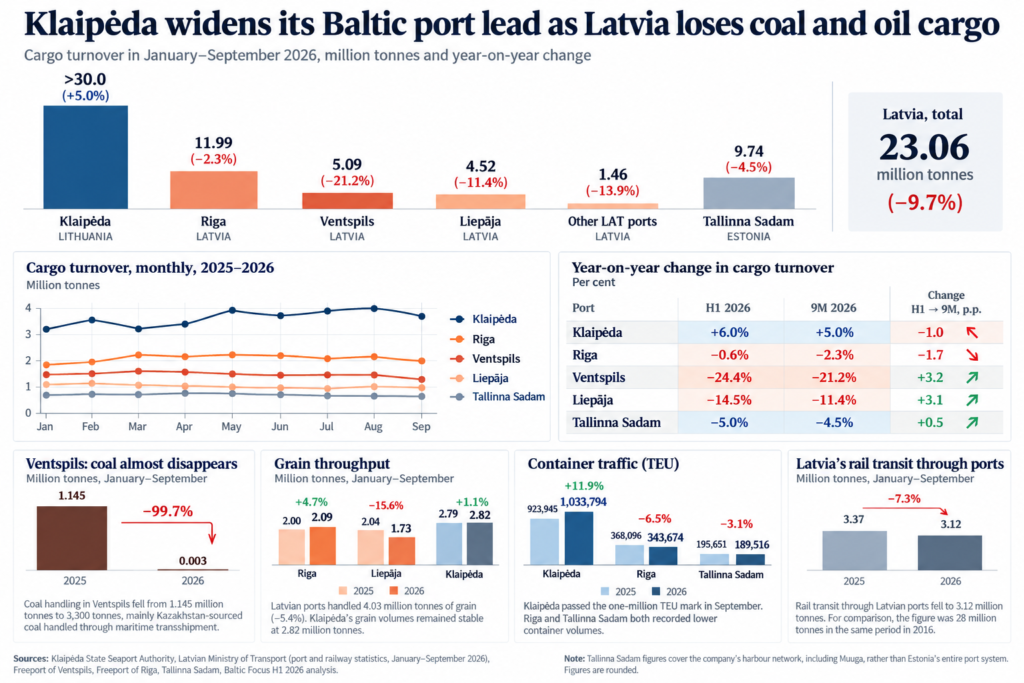
Klaipėda handled more than 30 million tonnes of cargo in January–September 2026, up 5% year on year, while Latvia’s ports collectively recorded a 9.7% decline to 23.06 million tonnes. Lithuania’s largest seaport handled almost 7 million tonnes more cargo than all Latvian ports combined.
The latest figures confirm the divergence identified in Baltic Focus’s first-half analysis. However, the detailed cargo statistics reveal different pressures across the region, ranging from the near-disappearance of coal in Ventspils to weaker container and timber traffic in Riga.
Baltic port cargo turnover, January–September 2026
| Country | Port | Million tonnes | YoY change |
|---|---|---|---|
| Lithuania | Klaipėda | >30.0 | +5.0% |
| Latvia | Riga | 11.99 | −2.3% |
| Ventspils | 5.09 | −21.2% | |
| Liepāja | 4.52 | −11.4% | |
| Other Latvian ports | 1.46 | −13.9% | |
| Latvia, total | 23.06 | −9.7% | |
| Estonia | Tallinna Sadam | 9.74 | −4.5% |
Tallinna Sadam figures cover the company’s harbour network, including Muuga, rather than Estonia’s entire port system. Figures are rounded.
Ventspils loses nearly all its coal cargo
Ventspils recorded the sharpest contraction among the major Latvian ports, with cargo turnover falling 21.2% to 5.09 million tonnes.
The detailed figures from Latvia’s Ministry of Transport identify the principal source of the decline. Coal handling collapsed from 1.145 million tonnes in January–September 2025 to just 3,300 tonnes this year, a reduction of 99.7%.
The coal handled in 2025 originated in Kazakhstan and was part of a maritime transshipment operation rather than the port’s traditional rail-based East–West transit model. According to the Freeport of Ventspils Authority, Kazakh coal transshipment increased by 47% over the full year, with cargo arriving and departing by sea reaching 1.3 million tonnes.
The near-disappearance of this traffic in 2026 therefore represents the loss of a relatively recently developed maritime cargo flow. The available statistics do not establish why it ceased.
The loss of approximately 1.14 million tonnes of coal accounted for more than 83% of Ventspils’ total year-on-year cargo decline. Oil-product handling also decreased, by 7.8%, although ro-ro volumes increased by 6.5%.
Riga, meanwhile, remained Latvia’s most resilient major port, but its performance weakened during the third quarter. After a decline of only 0.6% in the first half, its cumulative nine-month result was down 2.3%. Calculations based on the published half-year and nine-month figures indicate a third-quarter fall of approximately 5.6% year on year.
Riga’s main losses came from timber, down 423,000 tonnes, oil products, down 206,000 tonnes, and containerised cargo, down almost 149,000 tonnes. Container traffic fell 6.5% to 343,674 TEU.
Grain offers a different picture
Agricultural cargo presents a more mixed picture than the overall port figures.
Latvian ports handled 4.03 million tonnes of grain and grain products during the first nine months, 5.4% less than a year earlier. Yet Riga increased its grain throughput by 4.7% to 2.09 million tonnes, while Liepāja recorded a 15.6% decline to 1.73 million tonnes.
Klaipėda handled 2.82 million tonnes of grain, slightly above its 2025 level. According to the Lithuanian port authority, much of the grain originates in Lithuania and is shipped to markets including Mozambique, Tanzania, Kenya and South Africa.
These trade routes overlap with those served by Latvian ports. In September, a vessel carrying 59,000 tonnes of Latvian and Lithuanian wheat departed Riga for Dar es Salaam, Tanzania.
Riga’s experience also illustrates the adaptation of former transit infrastructure. The STREK terminal on Krievu Island, originally developed primarily for coal handling, has invested in grain storage and loading facilities. Its grain supplies now come from farmers in both Latvia and Lithuania.
The figures demonstrate competition for agricultural cargo, although they do not establish whether Klaipėda’s recent gains have come at the expense of Latvian ports.
Container traffic reinforces Klaipėda’s position
Containerised cargo remains Klaipėda’s largest segment, growing 12% to 10.68 million tonnes. The port handled 1,033,794 TEU in nine months, passing the one-million threshold in September.
Klaipėda also reported a more than twofold increase in maritime container transit, although the latest announcement did not disclose its absolute volume.
By comparison, Riga handled 343,674 TEU, down 6.5%, and Tallinna Sadam processed 189,516 TEU, down 3%.
Klaipėda’s growth also included LNG throughput, up 22% to 2.08 million tonnes, and fertilisers, up 22% to 1.37 million tonnes. These segments reflect Lithuania’s energy infrastructure and industrial exports rather than direct competition with the traditional cargo flows of Latvian ports.
Tallinna Sadam’s decline was also concentrated in particular segments. Liquid bulk fell 33.4%, while ro-ro traffic increased 1.8% to 4.90 million tonnes.
Latvia’s longer-term transit adjustment
Rail freight statistics underline the scale of the structural change affecting Latvian ports. Rail transit through the ports amounted to 3.12 million tonnes in the first nine months of 2026, down 7.3% year on year. During the corresponding period in 2016, the figure was 28 million tonnes.
The region’s port statistics therefore describe more than a shift in market shares. Klaipėda is expanding through container traffic, energy cargo and industrial exports, while Latvian ports face both the long-term contraction of traditional transit flows and the volatility of newer maritime transshipment operations.
The third-quarter figures also show that this adjustment is uneven: Riga’s performance deteriorated, whereas Ventspils and Liepāja narrowed their cumulative year-on-year declines.
Sources: Klaipėda State Seaport Authority, Latvian Ministry of Transport (January–September 2026 port and railway statistics), Freeport of Ventspils Authority, Freeport of Riga, Tallinna Sadam, Baltic Focus H1 2026 analysis.