Students, truck drivers and construction workers: who is coming to Latvia as its population shrinks

In 2025, almost everything in Latvia was shrinking: the population, births, remigration, immigration and even the number of deaths. Yet employers and universities continued to draw thousands of people from abroad. Their numbers are far too small to reverse the demographic decline, but large enough to help fill labour needs in transport, construction, catering and infrastructure.
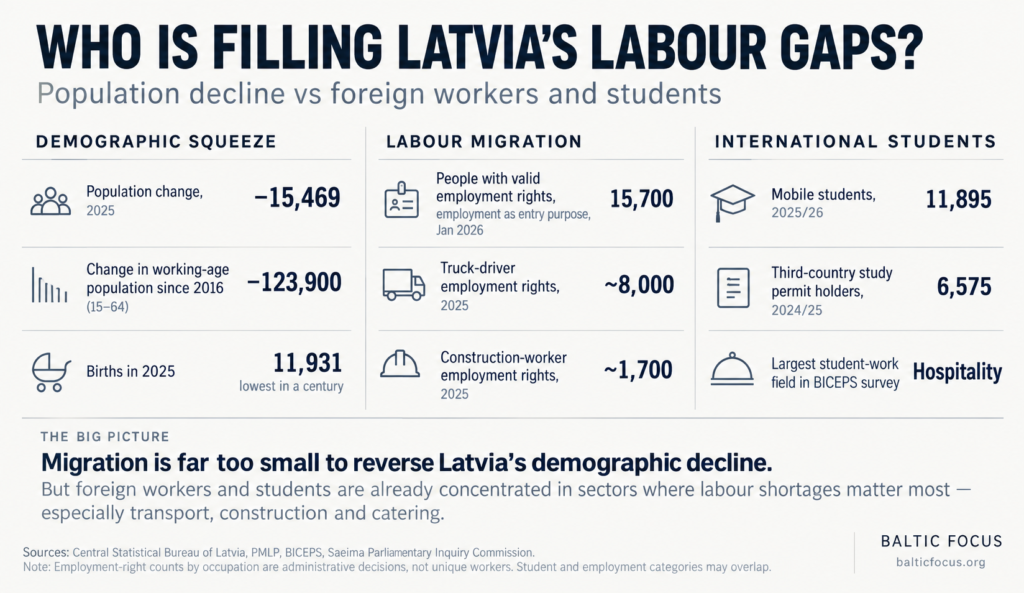
According to the Central Statistical Bureau (CSB), Latvia entered 2026 with 1.845 million residents, 15,469 fewer than a year earlier. The loss was smaller than in 2024 mainly because fewer people left the country. Immigration also fell.
The migration deficit narrowed from 4,236 people in 2024 to 1,291 in 2025, while natural population decline deepened slightly from 13,774 to 14,178.
| Latvia’s demographic balance, 2025 | |
|---|---|
| Population, 1 January 2026 | 1,845,096 |
| Population change | −15,469 |
| Natural change | −14,178 |
| Net migration | −1,291 |
| Births | 11,931 |
| Deaths | 26,109 |
Source: Central Statistical Bureau of Latvia.
Only 11,931 children were born in Latvia in 2025, 7.4% fewer than a year earlier and the lowest number in a century. The total fertility rate fell to 1.16, its lowest since 1998.
Life expectancy, meanwhile, reached 76.8 years. Since 2016, Latvia’s population aged 15–64 has fallen by almost 124,000, while the number aged 65 and over has increased by more than 26,000. The CSB itself uses this ten-year comparison in its latest demographic review.
Foreign migration is nowhere near large enough to replace that loss nationally. Its significance appears elsewhere: in particular labour markets where a few thousand people can matter much more than they do in a population of 1.845 million.
Return migration falls, other immigration rises
Latvia received 13,826 immigrants in 2025, 6% fewer than in 2024. Emigration fell much faster, by 20.2%, from 18,937 to 15,117. That explains most of the improvement in the migration balance. Central Statistical Bureau of Latvia
The composition of immigration changed more sharply.
Some 7,600 arrivals were remigrants, down from around 10,000 in 2024. Their share of immigration fell from 67.8% to 55.1%. Using the CSB totals and its rounded remigration figures, the number of arrivals who were not remigrants increased from roughly 4,700 to 6,200 — about 30%. This is a Baltic Focus calculation based on CSB data.
Those newcomers arrive through very different routes. Some move freely within the EU. Some are recruited for work. Others come to study or join family members. Annual migration figures also tell us nothing about the thousands of foreign citizens who were already living in Latvia before 2025.
PMLP’s Physical Persons Register illustrates the scale. At the start of 2026, it included 6,145 Indian citizens, 5,091 Uzbek citizens and 4,798 Lithuanian citizens. There were also 2,516 Germans, 1,460 British citizens, 1,205 Estonians, 1,103 Italians, 961 French, 952 Americans and 838 Swedes. Pilsonības un migrācijas lietu pārvalde
| Selected foreign citizens registered in Latvia, 1 Jan 2026 | |
|---|---|
| India | 6,145 |
| Uzbekistan | 5,091 |
| Lithuania | 4,798 |
| Germany | 2,516 |
| United Kingdom | 1,460 |
| Estonia | 1,205 |
| Italy | 1,103 |
| France | 961 |
| United States | 952 |
| Sweden | 838 |
Source: PMLP Physical Persons Register. Selected groups relevant to recent mobility; this is not a ranking of Latvia’s largest foreign populations. The much larger Russian population and the historically and war-related Ukrainian and Belarusian groups have different structures and are not shown here.
Citizenship alone says little about a person’s role in the economy. An Uzbek citizen may be a truck driver, student or family migrant. A German may be an employee, entrepreneur, researcher, student or spouse. Students and family migrants can also work.
That becomes important once Latvia tries to count foreign labour.
Transport stands out
In 2025, 22,917 employment rights were granted to third-country nationals. This does not mean 22,917 individual foreign workers entered Latvia. PMLP data show that one person may receive several employment rights, for example when working for more than one employer or when an employment period is extended.
On 1 January 2026, 15,700 people were staying in Latvia with valid employment rights and employment recorded as their purpose of entry. The parliamentary inquiry commission stresses that these two numbers are not directly comparable. www.vestnesis.lv
Transport dominates the administrative data. Nearly 10,000 employment rights were connected with land transport, including roughly 8,000 for truck drivers. Around 2,500 were issued for auxiliary workers and about 1,700 for construction workers. www.vestnesis.lv
The scale is easier to see against employment in the sectors themselves. Latvia had an average of 62,700 occupied jobs in transportation and storage in 2025, 58,200 in construction and 33,800 in accommodation and food services. Central Statistical Bureau of Latvia
The nearly 10,000 employment rights in land transport cannot simply be divided by the 62,700 occupied jobs to produce a foreign-worker share. Employment rights are not unique people, some are repeated, and “land transport” is narrower than the CSB’s transportation and storage category.
But the comparison does show that permit activity is large relative to the size of the sector. Road transport stands out much more clearly than the economy as a whole.
Construction also uses several foreign-labour channels, including direct recruitment and posted workers. The available public data do not allow the same clean assessment of dependence, and the evidence for catering is weaker still: foreign students are visibly present there, but no administrative dataset tells us their share of the workforce.
The limits of the system become particularly clear in the Uzbek figures.
PMLP granted around 7,200 employment rights to Uzbek nationals during 2025, yet only 5,091 Uzbek citizens were registered in Latvia at the beginning of 2026. There is no contradiction: one figure is a flow of administrative decisions and the other a stock of people at one date. Some Uzbek citizens may also be students or family migrants rather than labour migrants. www.vestnesis.lv
But the gap also shows why employment-right statistics cannot be treated as a headcount of workers.
The parliamentary inquiry commission reached a more serious conclusion: no institution has precise information on how many granted employment rights are actually used. www.vestnesis.lv
Students enter through another route
Latvia’s international students are another sizeable young foreign population, and they are not synonymous with third-country migration.
The CSB counted 11,900 mobile students in the 2025/26 academic year, 7.5% more than a year earlier. Three quarters had received their previous education outside the EU. Among all mobile students, 28.7% had previously studied in India, 11.1% in Uzbekistan, 8.6% in Sweden, 6.4% in Ukraine and 5.6% in Germany. These figures refer to the country of previous education, not necessarily citizenship. Central Statistical Bureau of Latvia
| Mobile students in Latvia, 2025/26 | Share by country of previous education |
|---|---|
| India | 28.7% |
| Uzbekistan | 11.1% |
| Sweden | 8.6% |
| Ukraine | 6.4% |
| Germany | 5.6% |
Source: Central Statistical Bureau of Latvia.
The European and non-European flows look very different inside universities.
At Rīga Stradiņš University, only 12.5% of mobile students had received their previous education outside the EU and 97.8% studied health and welfare. At Riga Technical University, 96.1% had previously studied outside the EU; the largest fields were social sciences, business and law, followed by science, mathematics and IT. Central Statistical Bureau of Latvia
The distinction is important because the current political debate is focused mainly on students from third countries, while a substantial part of Latvia’s international education market is European.
A 2025 BICEPS study counted 6,575 third-country nationals studying on temporary residence permits in 2024/25, up from 5,788 a year earlier. They made up 57% of foreign students and 9.8% of all students. BICEPS
BICEPS also surveyed 363 current third-country students and 102 graduates. The authors explicitly state that the sample is not representative of the entire population. BICEPS
Within that sample, hospitality was the largest employment field among working students: roughly one in five reported jobs in restaurants, cafés, catering or other hospitality businesses. Retail and courier work were also common. Among graduates recalling their last employment during their studies, professional occupations and IT were much more prominent. BICEPS
The survey also pushes against a simple narrative that third-country students choose Latvia mainly as a route to employment. Affordable tuition was cited by 74.6% of current students, living costs by 69.6% and education quality by 61.6%; the possibility of working while studying was cited by 21%. BICEPS
What happens after graduation is harder to establish.
Among the 102 graduates deliberately included in the BICEPS survey, 52 were living in Latvia and 50 had left. The resulting 51% should therefore not be treated as a national retention rate: the research design specifically aimed to recruit substantial groups of both stayers and leavers. Among current students, meanwhile, only 20.5% said they planned to remain in Latvia, while 42.6% expected to move to another country. BICEPS
The useful conclusion is not a retention percentage. It is that Latvia still lacks a reliable way to follow people as they move from study into employment, further study, family status or departure.
Restrictions are coming — but the next parliament will decide
On 22 September 2026, less than two weeks before the parliamentary election, the government approved a 71-measure immigration-control plan.
The plan calls for the state to set the number of third-country nationals who may enter and reside in Latvia through new Cabinet regulations. It also proposes limits on the share of third-country students among foreign students, tighter scrutiny of intermediaries and self-employment, and stronger monitoring of platform work. Platforms would be required to provide information on foreigners’ actual working time. Iekšlietu ministrija
That last proposal is revealing: the government itself is trying to close part of the data gap between permission to work and actual employment.
The policy is not settled, however.
Latvia elected a new Saeima on 3 October. Under the Constitution, the 15th Saeima will take office at its first sitting on the first Tuesday of November, when the mandate of the outgoing parliament expires. Many elements of the September migration plan require legislation or new regulations, so their implementation will fall to the new Saeima and the government it supports. saeima.lv
Government formation has already begun. On 6 October, President Edgars Rinkēvičs said that incumbent Prime Minister Andris Kulbergs had broad support among the parties elected to the new parliament to begin coalition talks. President.lv
The next government will therefore inherit both the proposed restrictions and the holes in the data behind them.
Latvia knows how many employment rights it grants, but not precisely how many are used. Citizenship records do not reveal whether somebody is working, studying or living in Latvia for family reasons. Study, work and family statuses overlap. The public data also do not show reliably how many international graduates enter Latvian employment and stay.
A practical first step would be to link, at an aggregate level, PMLP data on residence and employment rights with State Revenue Service data on registered employment and sectors. That would separate permits issued from people actually working.
Migration is not reversing Latvia’s demographic decline. But in road transport and parts of construction, services and catering it is already economically visible.
The next Saeima and government will decide how tightly those flows should be restricted. Before doing so, Latvia needs to know much more precisely who is already here, where they work and which parts of the economy have begun to rely on them.