Analysis · Transport & Logistics
What did Škoda find on Latvia’s shrinking railway? (Updated with Škoda Group ownership structure)
Škoda Group has bought 36% of L-Ekspresis
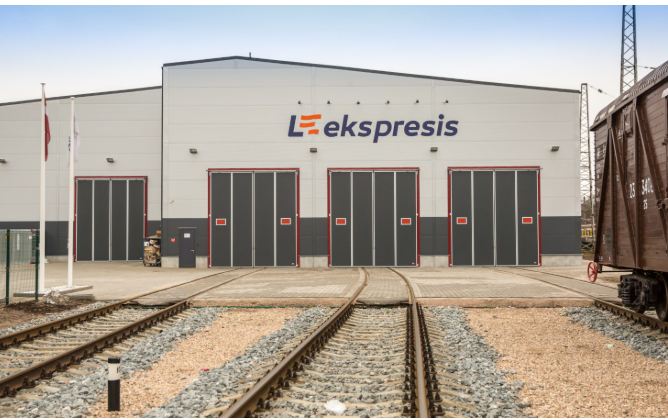
Škoda Group has bought 36% of L-Ekspresis, a company whose history goes back to passenger trains from Riga to Moscow, St Petersburg and Minsk. Today the same railway asset is being positioned as a service base for Škoda’s Baltic business.
On September 3, Škoda Group announced the acquisition of a 36% stake in Latvian railway company L-Ekspresis. The price was not disclosed. Škoda also received an option to acquire the remaining 64% by the end of 2028.
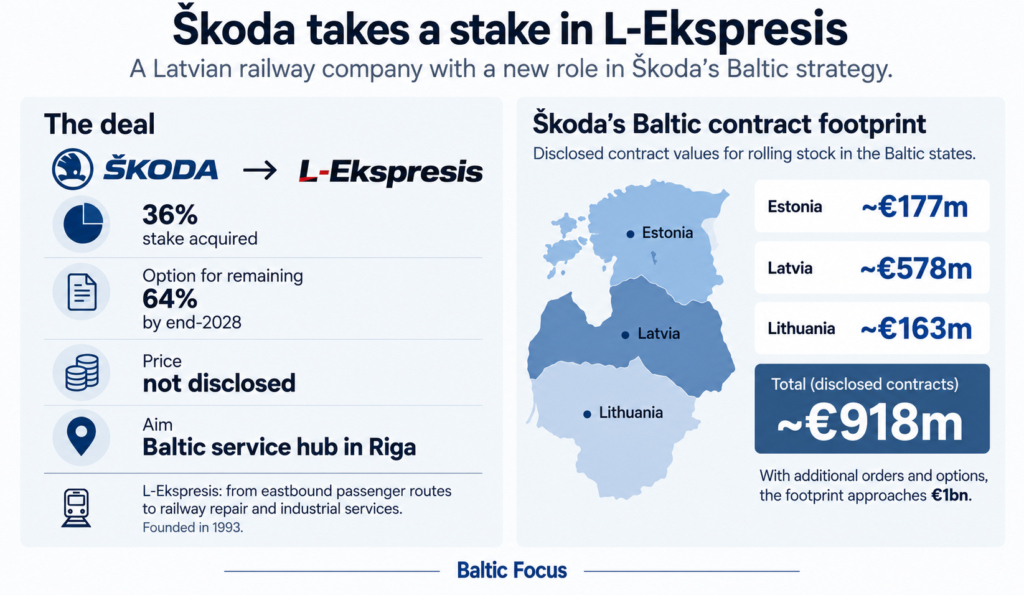
According to the company, the investment is part of its strategy to expand long-term service operations and create a railway maintenance and service hub in Riga for the Baltic region.
The choice is less obvious when viewed against the traditional Latvian railway market. According to Latvia’s Central Statistical Bureau, rail freight fell from 21.8 million tonnes in 2021 to 9.5 million tonnes in 2025. In 2025 alone, rail freight declined by 14.4%, while international rail freight fell by 18.1%.
L-Ekspresis also comes from a different railway era. Its business history goes back to 1993 and included international passenger services linking Riga with Moscow, St Petersburg and Minsk, ticket sales and rolling-stock servicing.
As those routes disappeared, the company retained its railway infrastructure and shifted towards repair, modernisation and industrial work.
So what does Škoda see in the asset today?
The business changed before Škoda became a shareholder
Before the transaction, according to Firmas.lv data cited by LSM, 90% of L-Ekspresis belonged to SIA Dziela, owned equally by Druvis Mūrmanis and Kristīne Mūrmane. The remaining 10% belonged to SIA RG Investīcijas, owned by Rolands Gorodeckis.
The owners are relevant to the development of the company.
Mūrmanis comes from banking and investment. In 2004 Hansabank appointed him head of the group’s Russian operations after more than a decade at the bank; he subsequently joined the Hansabank Group management board. He later became one of the founders of INDEXO. Today he sits on the INDEXO supervisory council, with responsibility for capital and liquidity management. INDEXO itself expanded from pension management into banking, launching INDEXO Bank in 2024.
Gorodeckis represents the operational railway side and is now CEO of L-Ekspresis.
Under this ownership, L-Ekspresis increasingly moved towards repair, modernisation and industrial cooperation. The company reported turnover of €8.2 million in 2023, of which €5.6 million, or almost 70%, came from exported services. More than 90% of those exports went to EU markets including the Czech Republic, Estonia and Lithuania.
According to Firmas.lv data cited by LSM, turnover reached €9.66 million in 2025 and profit was €0.5 million.
Škoda was already part of this transition before becoming a shareholder.
On 26 April 2024, L-Ekspresis reported that it had begun receiving and carrying out installation work in Riga on Škoda electric trains for Estonian passenger operator Elron. Sixteen trains were expected to pass through the project by the end of 2025.
Gorodeckis now says the companies had worked together in manufacturing for several years and that L-Ekspresis had participated in the production and delivery of new electric trains for both Latvia and Estonia.
The equity investment therefore follows an existing industrial relationship.
More than €900 million in disclosed Baltic contracts
The scale of Škoda’s existing business in the region helps explain why it wants its own Baltic service capacity.
Latvia’s Transport Ministry put the contract price for 32 Škoda electric trains at €241.9 million. The amount included the trains, maintenance equipment, a spare-parts stock for the first five years and personnel training.
In December 2025 Latvia signed another €89.4 million contract for nine Škoda battery-electric trains, with an option for seven additional units if financing is secured.
Škoda also has a substantial position in Riga’s urban transport.
Rīgas satiksme says its 2008 contract for 20 low-floor Škoda trams was worth €52 million excluding additional equipment. A further contract signed in 2016 covered another 20 trams for €62.59 million.
In 2013, Rīgas satiksme signed a €131.8 million contract with Škoda Electric for 125 articulated trolleybuses, with an option for additional vehicles. Riga had already received 150 Škoda 24Tr trolleybuses under an earlier procurement, whose value is not included in the calculation here.
In Estonia, the total contract for 16 Elron electric trains is worth about €147 million.
Tallinn also ordered 40 Škoda battery trolleybuses for €30.14 million and later approved the use of an option for another 30. The full price of the additional order has not been publicly disclosed.
Lithuania operates 13 Škoda EJ575 double-deck electric trains. Lietuvos geležinkeliai previously put their combined acquisition cost at €111 million; an official Lithuanian document still lists 13 EJ575 units in the passenger fleet in 2026.
Vilnius has meanwhile bought 91 Škoda 32Tr trolleybuses under a €52.3 million contract. Another 41 Solaris trolleybuses operating in the city use Škoda traction equipment, although Škoda’s share of that earlier contract is not public and is therefore not included in the total.
Taken together, the large contracts above with publicly disclosed values amount to approximately €918 million.
This is not the current value of Škoda’s Baltic fleet and it is not an estimate of the service market available to L-Ekspresis. The contracts span different years and some include equipment, spare parts, training or financing.
The figure serves a narrower purpose: it shows the accumulated scale of Škoda’s contract presence in the three Baltic states. It also excludes several orders and options for which a comparable price is not publicly available.
Against that background, a regional service operation in Riga is easier to explain.
Why L-Ekspresis fits Škoda’s Baltic strategy
Škoda does not need L-Ekspresis to prove that a service market exists. The manufacturer already has trains operating or ordered across the Baltic states, while L-Ekspresis has already worked on Škoda’s Latvian and Estonian projects.
The Latvian company brings an existing railway site, repair capabilities, specialists and experience working inside Škoda’s production and delivery chain.
Škoda, in turn, says its objective is to remain involved with customers throughout the vehicle lifecycle and to build up service activities in the markets where its rolling stock operates.
The acquisition of 36%, with an option for the remaining 64% by the end of 2028, therefore extends an existing relationship from industrial cooperation into ownership.
For L-Ekspresis and its owners, it also marks another stage in a longer transition. A company once linked to eastbound international passenger services now earns most of its business from railway repair and industrial work and has attracted one of Europe’s major rolling-stock manufacturers as a shareholder.
And what about Daugavpils?
L-Ekspresis is not Latvia’s only railway repair asset.
Daugavpils Lokomotīvju Remonta Rūpnīca remains an active industrial company. According to annual-report data compiled by Kombo, the standalone company recorded net sales of €24.6 million in 2025 and employed 81 people.
Its current service profile, however, reflects a different generation of railway technology. Latvijas dzelzceļš’s 2026 network statement lists maintenance and repair services in Daugavpils for locomotive series including 2M62, 2TE116 and ČME3, as well as several other diesel locomotive types.
That does not put Daugavpils and the future Škoda service operation in direct competition today.
But the Baltic rolling-stock fleet is changing.
Latvia is replacing older trains with new electric and battery units. Estonia is adding new Škoda electric trains. Lithuania is also renewing its passenger fleet while retaining its existing EJ575 trains.
L-Ekspresis has already found one way into that new railway economy: cooperation with a manufacturer whose modern rolling stock is spreading across the region.
This leaves a straightforward question for the rest of Latvia’s railway repair industry:
as the old fleet is replaced, will independent repair companies such as Daugavpils find a role in servicing the new generation of rolling stock, or will more of that work move into service structures controlled by the manufacturers themselves?
The Škoda–L-Ekspresis transaction cannot answer that question.
It does show that one Latvian railway asset has already moved from an old business model into a new one — and that Škoda considers the result worth buying into.
Which Škoda bought into Latvia?
The name can be misleading. The investor in L-Ekspresis is Škoda Group, the Czech manufacturer of trains, trams, metro vehicles and trolleybuses — not Škoda Auto, the Volkswagen Group carmaker.
Škoda Group has been owned since 2018 by PPF Group, one of the Czech Republic’s largest private investment groups. PPF had €42.6 billion in assets at the end of 2025 and operates across telecommunications, media, financial services, e-commerce, real estate and engineering.
The ultimate owners are Renáta Kellnerová and her three daughters — Anna Kellnerová, Lara Kodl Kellnerová and Marie Isabella Kellnerová. In 2025 they acquired the remaining 10% stake held by Petr Kellner Jr. and became the sole shareholders of PPF Group. The family has consolidated much of its ownership through the AMALAR holding structure.
The two Škoda businesses share historical roots and the name, but today they are separate companies. Škoda Group is also preparing a complete rebranding, with the transition away from the Škoda name due to be completed by June 2029.