BALTIC FOCUS: Baltic Check Point — 01/07–15/07
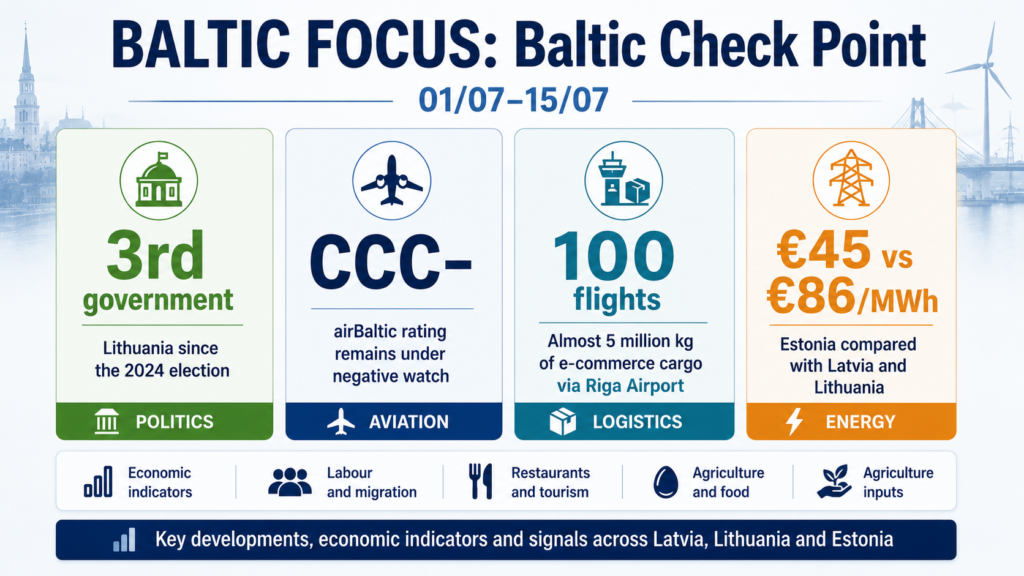
The first half of July brought several developments that changed the operating environment for business, infrastructure and public policy across the Baltic region.
— Lithuania has a new government, but not a new economic course.
— airBaltic is approaching another financing decision as liquidity pressure moves closer to restructuring.
— Riga’s Asian e-commerce cargo corridor has reached operational scale just as the EU introduced a new duty on low-value parcels.
— Baltic electricity prices remain divided even when Lithuania covers almost all its weekly demand with domestic generation.
MAIN DEVELOPMENTS
Lithuania’s third government inherits the same constraints — and a China problem
Lithuania’s new government took office on 14 July, becoming the third cabinet formed since the 2024 parliamentary election. Prime Minister Mindaugas Sinkevičius inherits most of the existing strategic commitments, spending framework and foreign-policy direction.
The clearest new business-facing element is the intention to normalise diplomatic relations with China to the level maintained by other EU states, while leaving Lithuania’s wider foreign and security policy unchanged.
Vilnius would like to restore diplomatic representation, consular services and commercial access without reversing the political decisions that damaged relations with Beijing. China may not separate economic normalisation from the underlying dispute so neatly.
The proposed reset also reflects disappointment with the economic results of Lithuania’s closer relationship with Taiwan. Lithuanian officials told MPs that around €500 million of a previously announced €1.2 billion package had been deployed. The figure, however, combines different forms of financing and cooperation and is not equivalent to direct Taiwanese investment.
For Lithuanian companies, the government has produced a political signal, but not yet a practical route back into the Chinese market.
The question: How far can Lithuania restore trade and investment relations with China while its underlying political positions remain unchanged?
airBaltic’s liquidity warning is becoming a shareholder decision
Fitch Ratings maintained airBaltic’s Long-Term Issuer Default Rating at CCC− and placed both the airline and its €380 million senior secured notes on Rating Watch Negative.
The action is not a legal finding of insolvency, but it shows how little financial room remains. Without new financing, the liquidity shortage could lead to a distressed debt exchange, creditor negotiations or another restructuring economically close to default.
The consequences extend beyond the company and its bondholders. airBaltic is central to Riga’s direct connectivity, Riga Airport’s passenger traffic and Latvia’s position as the principal Baltic aviation hub.
Latvia has expected airBaltic to move towards an ordinary commercial financing model while continuing to treat it as a strategic national asset. The current liquidity position is forcing those expectations back into the same decision.
Private capital may still be available, but on increasingly difficult terms. Another state intervention would reopen the question successive governments postponed: how much of airBaltic’s strategic role should be financed by the shareholder?
The question: Which external financing source remains available — and how much responsibility is Latvia prepared to accept?
Riga’s Asian cargo corridor meets a new EU parcel duty
The partnership between Riga Airport, Latvijas Pasts and Fly Khiva completed its 100th e-commerce cargo flight from Asia in July. Since operations began in late 2025, almost 5 million kilograms of shipments have arrived for customs clearance in Riga and onward distribution across Central and Northern Europe.
The wider network links Riga with Hong Kong through Central Asian and Middle Eastern hubs. Latvijas Pasts provides customs processing and final delivery. During the first month alone, it processed almost 250 tonnes of cargo.
The disclosed totals imply an average of almost 50 tonnes per flight. Fly Khiva lists a maximum payload of up to 56 tonnes for its converted Boeing 767-300 freighters. This is not a disclosed load factor, but it shows that the corridor has moved beyond a lightly used test route.
Its growth coincides with a change in EU e-commerce economics. From 1 July 2026, parcels worth less than €150 became subject to a temporary customs duty of €3 for every tariff category contained in a shipment. A parcel containing goods from three categories therefore incurs a €9 duty.
Around 4.6 billion low-value items entered the EU in 2024, and 91% originated in China.
Riga can compete through airport capacity, rapid customs processing and fast onward delivery. Those advantages may become less valuable if the duty substantially reduces the price advantage of the goods.
The reverse route also remains unresolved. Latvijas Pasts presents the corridor as a potential European export channel towards Central Asia and Asia, but the partners have not disclosed what currently fills the aircraft on return journeys.
The question: Can Riga retain the flow after the tariff change — and what can make the reverse route commercially viable?
REGIONAL SIGNALS
More local generation does not yet produce one Baltic electricity price
During 6–12 July, the average wholesale electricity price reached approximately €86/MWh in Latvia and Lithuania, compared with €45/MWh in Estonia.
Lithuanian power plants generated 231 GWh during the week, covering around 98% of national demand. Yet Lithuania’s price remained almost twice the Estonian level.
Domestic generation and market price are not interchangeable indicators. The final price also depends on when electricity is generated, access to cheaper imports, cross-border constraints and balancing needs.
The divergence was already visible in June:
| June 2026 average wholesale price | EUR/MWh |
|---|---|
| Estonia | 64.40 |
| Latvia | 92.23 |
| Lithuania | 93.71 |
One year earlier, the monthly difference between Estonia and Latvia was below €2/MWh. By June 2026, it had widened to almost €28/MWh.
Latvia and Lithuania recorded identical prices during 95.6% of June’s 15-minute settlement intervals. Estonia and Latvia matched during 57.2%, while Finland and Estonia matched during only 30.9%. Estonia functioned as a northern hinge, while Latvia and Lithuania formed the most closely coupled price pair.
Future generation also faces financing constraints. Lithuania’s planned 700 MW Curonian Nord offshore wind farm, estimated at around €3 billion, is not commercially feasible under current market conditions, according to Energy Minister Žygimantas Vaičiūnas.
Poland’s 1.2 GW Baltic Power offshore project delivered electricity to the grid for the first time on 10 July. Lithuania and Poland are also preparing the land-based Harmony Link interconnector, expected to be energised by the end of 2030.
More generation can expand supply, but price convergence also requires financed projects and sufficient grid capacity between national price areas.
LVM’s largest land purchase combines forest value with border geography
Latvian State Forests, or LVM, paid €26.4 million for two companies holding approximately 5,800 hectares of land, including around 4,800 hectares of forest, in Pasiene parish near Latvia’s eastern border. The previous owners were Swedish citizens.
The transaction implies an average price of approximately:
- €4,550 per hectare across the entire property;
- €5,500 per hectare of forest, excluding non-forest land.
The portfolio includes around 1,600 hectares of spruce, 1,500 hectares of birch and 600 hectares of pine. LVM estimates production of approximately 3.45 million cubic metres of timber and energy wood over a 120-year forestry cycle.
The headline price alone does not establish whether the portfolio was discounted. Valuation would require information about forest age, standing timber, accessibility, restrictions and future cash flows.
The eastern-border location adds a strategic dimension. Scandinavian owners have been restructuring parts of their Baltic forest portfolios, but available evidence does not show a deliberate withdrawal from border areas because of geopolitical risk.
The open question is whether this was simply the realisation of forest value or an early case of border geography affecting Baltic asset ownership.
Lithuania proposes faster access to workers — while designing rotation into the system
Lithuania is considering an accelerated fixed-term employment route for workers from selected non-EU countries in shortage occupations, including long-distance driving and construction.
Permits would be valid for up to two years. Workers would then have to leave Lithuania for at least six months before returning through the temporary route. Highly qualified workers would be exempt, and the overall immigration quota would not increase.
The model offers employers faster recruitment but builds compulsory rotation into the system. Repeated hiring, onboarding, training and intermediary costs could absorb part of the benefit.
Estonia provides a nearby comparison. By 29 June, it had registered 2,396 short-term foreign workers, against 4,980 permits during the whole of 2025. Agricultural employers report worker turnover, documentation delays, accommodation and transport expenses, and competition from better-paid jobs elsewhere in Europe.
The Estonian experience does not prove that Lithuania’s model will fail. It does show that temporary access to labour does not automatically produce workforce continuity.
BALTIC ECONOMIC INDICATORS
The latest comparable figures available by 15 July show different national cycles beneath the shared Baltic headline.
| Indicator | Estonia | Latvia | Lithuania |
| June annual HICP | 2.0%* | 3.3%* | 5.4% |
| May goods exports | €1.72bn | €1.74bn | €3.11bn |
| May goods imports | €1.95bn | €2.12bn | €3.97bn |
| May trade balance | −€224m | −€374m | −€855m |
| May industrial output, YoY | −3.0% | +6.2% | +1.2% |
| May retail trade, real YoY | −1.0% | +3.3% | +7.4% |
* June flash estimate.
Sources and methodology: Baltic Focus calculations based on Eurostat and national statistical authorities. HICP is used for cross-country inflation comparisons; national CPI is analysed separately for monthly movements and country-specific drivers.
Trade: energy lifted all three headlines
Goods exports increased in May by 9% in Estonia, 6.9% in Latvia and 1.4% in Lithuania.
Mineral products contributed strongly in all three countries. Excluding them, Baltic Focus estimates export growth at approximately 4.4% in Estonia, 1.8% in Latvia and −7.6% in Lithuania.
Estonia retained moderate underlying growth, Latvia moved close to stagnation, and Lithuania entered contraction despite remaining the largest Baltic trading economy by value.
Intra-Baltic trade remained significant. Lithuania accounted for 18.9% of Latvian exports and 22.5% of its imports, while Latvia was Lithuania’s largest export market during January–May.
Inflation: June separated the region
| Annual HICP | April | May | June |
| Estonia | 3.2% | 3.6% | 2.0%* |
| Latvia | 2.9% | 3.5% | 3.3%* |
| Lithuania | 4.9% | 5.1% | 5.4% |
* Flash estimate for Estonia and Latvia.
Estonia recorded a sharp slowdown, Latvia eased slightly, and Lithuania’s inflation continued to accelerate. Shared energy, fuel and food pressures are being transmitted through different national price structures.
Industry and retail have different Baltic leaders
Latvia recorded the strongest industrial result in May, with output rising 6.2% year on year. Lithuania remained positive at 1.2%, while Estonia fell by 3% and manufacturing recorded its fourth consecutive annual decline.
Retail produced a different ranking. Real turnover increased by 7.4% in Lithuania and 3.3% in Latvia, while Estonia contracted by 1%.
Lithuanian non-food retail grew by 15.3%, and online and mail-order sales rose by 22%. Latvia’s online sales increased by 12.3%. Some purchases may have been brought forward before the new EU parcel duty, although the effect cannot be isolated from available data.
SIGNALS TO WATCH
Latvia’s weaker forecast narrows the room for new policy
Latvia’s Finance Ministry reduced its economic growth forecast for 2026 by 0.6 percentage points to 2% and lowered the 2027 forecast by 0.7 percentage points, also to 2%. Inflation projections were raised to 3.6% in 2026 and 3.3% in 2027.
Under a no-policy-change scenario, the general government deficit is projected to rise from 2.9% of GDP in 2026 to 4.2% in 2027 and 5.4% in 2028.
Fiscal space for 2027 is estimated at negative €280 million, while government debt could approach 54% of GDP by 2030.
This is not an immediate fiscal-crisis forecast. It signals that slower growth, defence commitments and existing expenditure plans leave the next government little room for new policies without spending cuts, additional revenue or borrowing.
What to watch: Which expenditure, tax or borrowing decisions will be used to close the gap after the parliamentary election?
Baltic restaurants report the same margin pressure — but not the same cause
Restaurant industries in Latvia and Estonia are both warning that their operating models are becoming harder to sustain.
In Latvia, the debate is closely tied to tourism. First-quarter foreign visitor arrivals fell by 7.2%, while nights spent by foreign guests declined by 7.5%. Industry representatives also cite expensive transport access, weak international marketing and security concerns.
From January 2027, Riga will double its tourist tax from €1 to €2 per night, directing additional revenue towards international marketing and business tourism.
Estonia presents a different picture. Accommodation establishments served almost 320,300 tourists in May, 5% more than a year earlier. Foreign tourist numbers increased by 9%, while overnight stays rose by 6%.
Estonian restaurants are reporting losses and closures despite growing foreign visitor flows, pointing instead to higher VAT, operating costs and weaker domestic demand.
The shared signal is margin compression. The causes are not identical, and industry associations do not necessarily represent the performance of the entire market.
Oxylabs becomes a transaction-backed Lithuanian unicorn
Lithuanian web-data infrastructure company Oxylabs received a $130 million minority investment from Warburg Pincus, valuing the company at approximately $3.6 billion. It was the company’s first external investment since its foundation in 2015.
The valuation is therefore supported by an actual transaction rather than only an internal estimate.
Oxylabs operates in a less visible layer of the AI economy: proxy infrastructure, web-data collection and tools that allow automated systems and AI agents to access current online information.
What to watch: Whether the capital is used mainly for product expansion or begins a cycle of international acquisitions.
Eggs expose Baltic regulatory arbitrage
Estonia plans to phase out caged-hen production by 2035. Around 80% of the country’s laying hens are still kept in cages, while cage eggs remain the cheapest consumer segment.
Producers say that many low-price cage eggs sold in Estonia already come from Latvia and Lithuania. Estonia’s Ministry of Economic Affairs has warned that unilateral restrictions could disadvantage domestic producers unless neighbouring countries introduce comparable standards.
Available data do not show what share of the low-price segment is supplied from neighbouring countries. The argument therefore identifies a plausible mechanism rather than a measured market outcome.
A national welfare standard could reduce Estonian production without removing cage eggs from Estonian shops. In a price-sensitive and easily transported product, stricter domestic requirements may change where eggs are produced rather than which eggs consumers buy.
Fertiliser support creates fiscal arbitrage inside one agricultural market
Nitrogen fertiliser prices faced by Estonian farmers in May were approximately 70% above their 2024 average, while phosphorus fertilisers were around 22% more expensive. Farmers are reducing use and reconsidering which crops remain viable.
A proposed European crisis package would allocate Estonia around €3.1 million and allow the government to supplement EU support by up to 200%. Estonia argues that the formula does not reflect its cost increase, low livestock density or dependence on imported fertilisers.
The wider Baltic issue is the ability of national governments to top up common EU support from their own budgets. Farmers competing in the same regional market may receive substantially different protection depending on national fiscal capacity and political choices.
The adjustment may therefore be distributed differently across budgets, farm margins, production volumes and consumer prices in the three Baltic states.