Editorial · Transport & Logistics
Latvia Big Figure: 13,000–15,000 vehicles cross Pāternieki each month
13,000–15,000 vehicles cross Latvia’s Pāternieki border checkpoint in an average month.
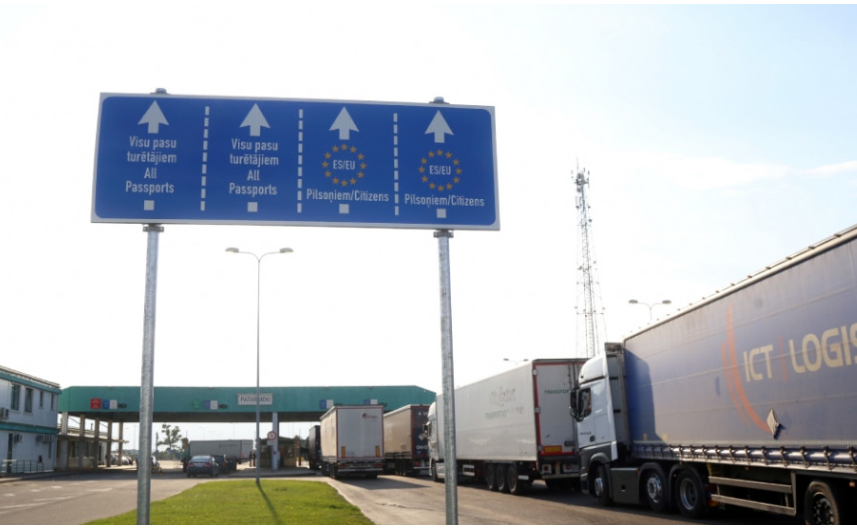
normally cross the Latvia–Belarus border through the Pāternieki checkpoint every month, according to the Latvian road haulage association Latvijas Auto.
Pāternieki is Latvia’s only operating road border crossing with Belarus. Traffic through it stopped on 31 July after failures in the State Border Guard’s information systems made border controls impossible.
But the disruption did not remain merely a technical problem.
Interior Minister Jānis Dombrava of the National Alliance, who entered office at the end of May, announced the closure of the Latvia–Belarus border for “technical reasons”. Shortly before that, he had publicly urged Latvian residents not to travel to Belarus and advised those already there to return, warning that movement between the countries could become difficult.
Four days after the systems stopped working, the Interior Ministry submitted a draft government decision proposing the official suspension of crossings at Pāternieki for residents and freight transport.
This creates an open question about the sequence of events.
Was the proposed formal suspension simply a response to a technical failure that could not be repaired quickly, or did the failure accelerate a border-policy decision that the ministry was already considering?
The available public information does not answer that question. It does, however, show that the technical disruption and the subsequent political proposal cannot be treated as entirely separate developments.
CERT.LV said that the information available to it did not indicate external interference with the Pāternieki systems. It had received a report of local technical problems in the State Border Guard’s information systems and was assisting with the investigation.
For carriers, the immediate problem was the absence of operational communication.
Latvijas Auto said it had received no official explanation from either the Interior Ministry or the Transport Ministry about what had happened, how long the disruption might last or what companies should do.
The association estimated that around 600 vehicles in total had been affected during the first four days. If the crossing remained unavailable, approximately 150 additional trucks could face the same problem on each following day. These are therefore a cumulative estimate and a projected daily flow, not two separate measures of the initial backlog.
Cargo and customs documents had already been prepared for Pāternieki. Vehicles assigned to this route could not necessarily be redirected immediately to another country or checkpoint.
Alternative crossings with Belarus remain open elsewhere.
On the Lithuania–Belarus border, road traffic can use Medininkai–Kamenny Log and Šalčininkai–Benyakoni.
On the Poland–Belarus border, freight traffic can use Bobrowniki–Berestovitsa and Koroszczyn/Kukuryki–Kozlovichi. Passenger traffic also continues through Kuźnica–Bruzgi and Terespol–Brest.
But these are not automatic substitutes for the Latvian route. Rerouting can mean additional distance, new queues and changes to customs, veterinary or transport documentation.
Update — 4 August 2026
The Latvian government did not support the Interior Ministry’s proposal to formally close Pāternieki, the country’s only road crossing on the Latvia–Belarus border.
The checkpoint had remained out of operation since 31 July, with technical problems in the State Border Guard’s information systems given as the official reason. After the government’s decision, Interior Minister Jānis Dombrava said the problems were almost resolved and that Pāternieki was expected to reopen on the evening of 4 August.
The episode nevertheless left carriers facing several days of uncertainty, disrupted routes and little official guidance.
Why it matters
This is not a coordinated regional closure of road traffic with Belarus. Lithuania and Poland continue to operate selected crossings on their borders with Belarus.
The disruption is specific to Latvia and affects a route handling 13,000–15,000 vehicles a month.
It is also more than an isolated IT failure. A recently appointed minister first warned that travel between Latvia and Belarus could become difficult. The last operating road crossing then stopped functioning for technical reasons. Businesses received no advance operational information, CERT.LV found no indication of external interference, and the Interior Ministry subsequently moved to formalise the suspension.
None of this proves that the technical failure was deliberate or politically initiated.
It does show that a technical disruption, a ministerial decision and a broader border-policy shift have become part of the same sequence — while the immediate financial and logistical costs are being absorbed by carriers.
Sources: LSM, Latvijas Radio, Latvijas Auto, CERT.LV and national border authorities
4 August 2026