BALTIC FOCUS: Baltic Check Point — 16/07–02/08 (UPDATED with the new airBaltic bondholder meeting date)
BALTIC BIG FIGURE
BALTIC BIG FIGURE
€2.244bn / €765m / €523m — Q1 services surpluses in Lithuania, Estonia and Latvia. Only Lithuania’s surplus fully covered its goods deficit.
Baltic Trade and Services in Q1 2026
800 parcel lockers and collection points —
move into DHL’s Baltic network.
DHL eCommerce has agreed to acquire Venipak’s operations in Lithuania, Latvia and Estonia.
The transaction gives DHL an established regional sorting, courier and parcel-locker network across all three Baltic markets. The deal remains subject to regulatory approval, and its value has not been disclosed.
Active Restructuring Is Beginning in the Baltic Postal Market — Who Could Be the First to Exit?
3.28 million passengers — RIX remained the largest individual Baltic airport in H1 2026, while Lithuania’s three-airport system handled more passengers in total.
Baltic Airports in H1 2026
107 km / about 30 km / 114 km — active Rail Baltica works in Estonia, Latvia and Lithuania, at different construction stages. Latvia’s figure mainly covers substructure; Lithuania has laid the first 8.8 km of new 1435 mm track.
Rail Baltica on 21 July 2026
More than €130bn versus €15.9bn — OTP’s assets compared with Luminor’s. The proposed acquisition would increase OTP’s total assets by approximately 13%.
OTP’s acquisition of Luminor: how large is the new owner?
16.8m / 15.3m / 5.1m tonnes — Klaipėda, all Latvian ports combined and the Port of Tallinn in H1 2026. Klaipėda grew by 9.2%; Latvia and Tallinn declined by 4.4% and 3.8%.
Klaipėda Expands Its Lead as Baltic Port Traffic Diverges in H1 2026
12 stores and €31.57m in annual turnover — the scale of Mere’s Latvian network before EU sanctions against its owner led to store closures in Latvia and Lithuania.
EU sanctions close Mere stores in Latvia and Lithuania
MAIN DEVELOPMENTS
Latvia closed its only Belarus road crossing without warning freight operators
Latvia closed the Pāternieki checkpoint on 31 July after failures in border-control information systems. It is Latvia’s only operating road crossing with Belarus.
Two days earlier, Interior Minister Jānis Dombrava had advised Latvian residents to leave Belarus and avoid travelling there. The warning was directed at residents. Freight operators interviewed by Latvian media said they had received no advance notice of the closure.
One driver carrying Grindeks medicines to Minsk said the shipment documents allowed him to cross only at Pāternieki. A diversion through Lithuania was therefore unavailable for that cargo.
Why Baltic Focus is watching
Latvia issued a security warning to residents while businesses continued dispatching cargo through the country’s only direct road route to Belarus. The wider context of the closure and the treatment of freight operators remain unclear.
airBaltic reaches its next creditor test
airBaltic’s bondholders were originally due to meet on 3 August 2026. The meeting has been rescheduled for 17 August 2026. The airline is seeking short-term financing and consent to changes in its trust arrangements.
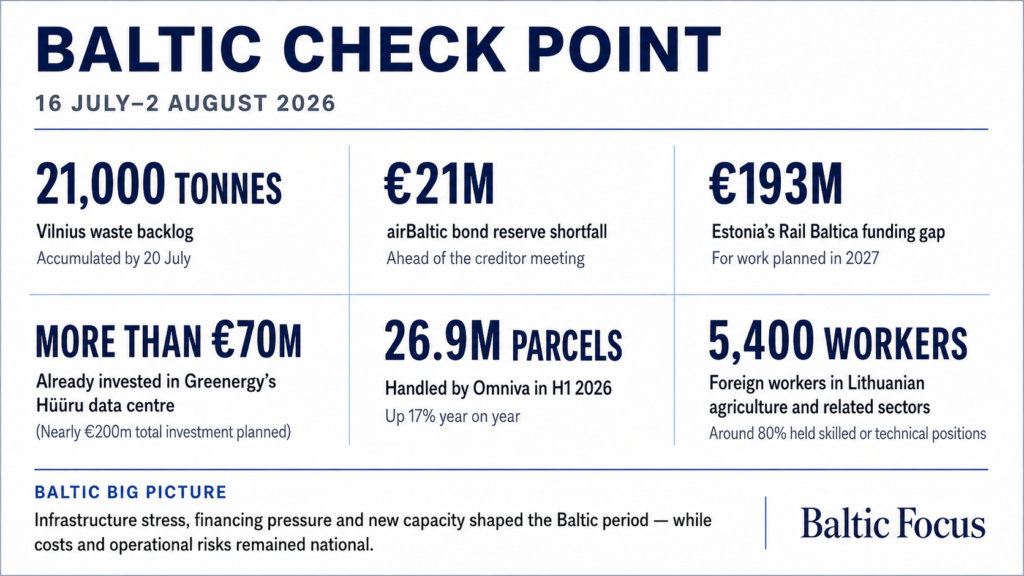
The meeting follows airBaltic’s failure on 26 June to raise its bond reserve account to the required level. Fitch estimated the missing contribution at approximately €21 million.
The Latvian state is exposed on both sides. It owns €50 million of airBaltic’s secured bonds and provided a €30 million short-term loan in April. The first €6.4 million instalment was repaid in May, with the remaining repayment schedule extending into August.
The government has selected a strategic direction for the airline. The business plan, creditor agreement and source of new capital remain unsettled.
Why Baltic Focus is watching
The immediate issue is whether bondholders provide bridge financing and on what terms. The wider issue is how the remaining risk is divided between creditors, a potential investor and the Latvian state.
One Baltic railway is being built as three national systems
Rail Baltica officially remains one cross-border Baltic project with a common 2030 completion target.
Estonia, Latvia and Lithuania finance, build and prepare to operate separate national sections under different economic conditions and priorities.
Estonia retains the 2030 timetable but has a €193 million gap between the €686 million of work planned for 2027 and the financing already secured. Latvia has yet to formalise the revised timetable and configuration of its section.
Even with the full corridor completed, Latvia would carry the cost of maintaining its central section between Poland and Estonia.
Latvia will operate a second railway infrastructure system alongside its existing 1520 mm network. The 1435 mm line will require its own track, engineering structures, signalling, safety systems and traction-power infrastructure built to European technical requirements.
The long-term cost remains unknown. Missing figures include maintenance expenditure, infrastructure access charges, traction-power requirements and the cost of keeping the line ready if passenger and freight traffic remain below the designed service level.
Rail operations also require available traction capacity. The outstanding questions are how much capacity must be reserved, who pays for grid readiness and whether the cost enters railway or electricity-network tariffs.
Why Baltic Focus is watching
Rail Baltica shows why Baltic cooperation can no longer mean three countries returning to their own national boxes. Under the rhetoric of one regional project, each country pursued national priorities and expected national benefits.
Three nationally optimised sections may share a completion date without producing a financially balanced common railway. Latvia risks carrying the continuing cost of the middle section while its value to taxpayers and the domestic economy remains difficult to demonstrate.
Vilnius has 21,000 tonnes of waste and no agreed diagnosis
Around 21,000 tonnes of waste had accumulated in the Vilnius region by 20 July. The region produces approximately 700 tonnes of mixed municipal waste each day.
The crisis followed an April 2025 fire at the regional sorting facility. In May 2026, VAATC and Energesman signed a court-approved agreement covering reconstruction of the building and replacement of damaged equipment.
Two months later, the backlog remained and the government was considering additional incineration and assistance from other regional waste-management centres.
Why Baltic Focus is watching
Was the crisis caused mainly by fire-damaged infrastructure, the breakdown of the VAATC–Energesman arrangement, limited incineration capacity — or by all three failures reinforcing each other?
MARKET AND CAPACITY SIGNALS
Estonia expands AI capacity during a favourable electricity-price period
Greenergy Data Centers is targeting nearly €200 million in total investment in its Hüüru facility. More than €70 million has already been invested, with further expansion planned for AI computing and international customers.
The expansion coincides with the lowest average wholesale electricity price in the Baltic states. In Q2, Estonia averaged €59.7/MWh, compared with €77.4 in Latvia and €78.2 in Lithuania.
Estonia is connected to the cheaper northern electricity market through EstLink 1 and EstLink 2. Limited transmission towards Latvia also prevents full price convergence with the southern Baltic market. (elering.ee)
Greenergy has not disclosed the role of electricity prices in its investment decision. By 2030, Estonia’s current advantage will depend on new Finnish and Estonian demand, generation growth, hourly volatility and grid constraints.
Why Baltic Focus is watching
Estonia may be converting a current electricity-price advantage into permanent AI infrastructure. The next relevant figures are Greenergy’s IT load, grid connection, power contract, construction timetable and signed customers.
DHL is buying an existing Baltic last-mile network
DHL eCommerce has agreed to acquire Venipak’s operations in Lithuania, Latvia and Estonia.
The transaction gives DHL an established regional sorting, courier and parcel-locker network. Venipak operates around 800 parcel lockers and collection points across the Baltics.
The transaction remains subject to regulatory approval. Its value has not been disclosed.
Why Baltic Focus is watching
DHL has chosen to buy a Baltic network rather than build separate operations country by country. The missing figures are the transaction price and the resulting market shares in each country.
Omniva moves more parcels but remains loss-making
Omniva’s H1 revenue increased by 10% to €78.2 million. Parcel volumes rose by 17% to 26.9 million, while international transit revenue increased by 39% to €16.6 million.
The company recorded a normalised net loss of €1.3 million. Universal postal-service volumes fell by 11%, and periodical deliveries declined by 9%.
Why Baltic Focus is watching
The next test is whether international transit can offset price pressure and the continuing decline of traditional postal services.
SHORT SIGNALS
Latvia reports strong early harvest yields
Early winter-barley yields were reported at 6–8 tonnes per hectare. Wheat, rapeseed and other major crops were still in the fields.
Vegetable farms and the Baltijas dārzeņi cooperative also reported favourable growing conditions. Excess moisture, crop disease and storage conditions will determine the final result.
Why Baltic Focus is watching
A larger harvest will support farms only if grain quality and farm-gate prices cover another high-cost production season.
Lithuanian agriculture imports technical skills
On 1 July, around 5,400 foreign citizens were working in Lithuanian agriculture, forestry and related activities. Approximately 4,600 were third-country nationals.
Only about 20% held unskilled positions. The largest groups included 1,599 machinery and equipment operators, 1,167 skilled workers and 653 qualified agricultural, forestry and fisheries workers.
Employers were seeking tractor and combine operators, mechanics, heavy-vehicle drivers, agronomists and veterinary specialists.
Why Baltic Focus is watching
Mechanisation is shifting agriculture’s labour dependence towards imported technical skills.
THE BALTIC PICTURE
Latvia’s border crossing, airBaltic, Rail Baltica and the Vilnius waste system exposed the same gap: regional functions still depend on national financing, infrastructure and crisis management.
The border warning did not reach freight operators. airBaltic’s regional connectivity role remains attached to Latvian financial risk. Rail Baltica is common in purpose but national in financing, construction and future operation. Vilnius has yet to establish whether its waste crisis was physical, contractual or operational.
Electricity conditions support investment in Estonia, parcel networks are consolidating regionally, and Lithuanian agriculture is importing skills through an international labour market.
Regional value is increasingly created across national borders. The costs, regulation and political responsibility remain national.