Analysis · Transport & Logistics
airBaltic’s Distressed-Debt Gamble: Who Wins If It Survives?
Rescuing the airline could reward late bond buyers, protect Riga’s hub and preserve capacity for Lufthansa Group.
Rescuing the airline could reward late bond buyers, protect Riga’s hub and preserve capacity for Lufthansa Group. But a 36-aircraft fleet makes airBaltic’s old Baltic bargain impossible to maintain.
In recent weeks, the debate over airBaltic’s future has increasingly resembled betting on Polymarket. Would Latvia allow the airline to fail? Would bondholders accept a restructuring? Would a strategic investor arrive before the cash ran out?
What were you betting on?
The Distressed-Debt Trade
For some investors, this was not a metaphor. It was a distressed-debt trade unfolding in real time.
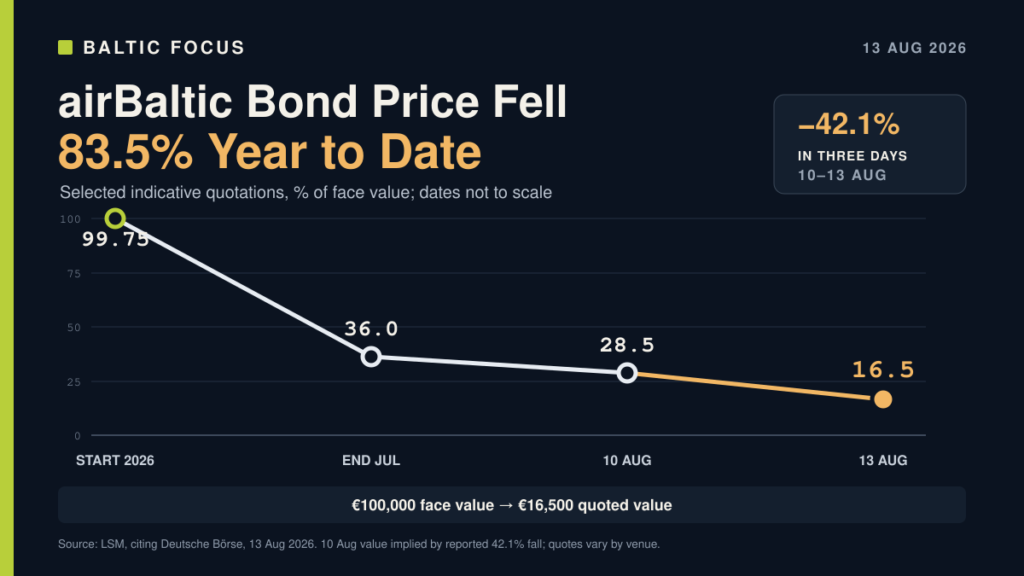
At the start of 2026, airBaltic’s €380 million senior secured notes due in 2029 were quoted at 99.75% of face value. By the end of July, the price had fallen to 36%. On 10 August it stood at approximately 28.5%, before dropping to 16.5% of face value on the morning of 13 August, according to Deutsche Börse data cited by LSM.
The 10 August figure is implied by the reported 42.1% decline over the following three days. A bond with a nominal value of €100,000 was therefore quoted at approximately €28,500 on 10 August and just €16,500 three days later.
This was not necessarily the price at which a €100,000 block, let alone a larger position, could have been traded. The market is illiquid, and quotations can differ sharply between venues. The 16.5% Deutsche Börse figure is therefore best read as evidence of severe distress, not as a universal executable price.
Fitch assigned the notes an RR4 recovery rating on 10 April, when it downgraded them to CCC−. The agency retained RR4 when it placed both the issuer and the bonds on Rating Watch Negative on 8 July.
RR4 corresponds to a broad recovery range of 31–50% of principal in a default scenario. It was not recalculated in response to the 13 August market quotation.
If an investor could acquire the bonds at 16.5% of face value and the eventual value realised matched Fitch’s 31–50% range, the illustrative gross capital gain would be approximately 88–203%.
That calculation excludes transaction costs, the time value of money and any requirement to provide new financing. It is not a forecast. Original investors who bought close to par would remain deep underwater. The potential winners are late buyers able to acquire the debt at distressed prices.
DATA CARD — THE BOND
99.75% — beginning of 2026
36% — end of July
Approximately 28.5% — 10 August, implied by the reported three-day fall
16.5% — Deutsche Börse quotation on 13 August
31–50% — Fitch RR4 recovery range, assigned in April and retained in July
+88% to +203% — illustrative gross gain from a purchase at 16.5% if that recovery range were realised
Latvia Is Both Owner and Creditor
Latvia sits on both sides of the negotiations. The state owns 88.37% of airBaltic and holds €50 million of its 2029 notes.
It also approved a €30 million unsecured short-term loan facility. airBaltic repaid a first €6.4 million instalment in May; the facility must be fully settled, with interest, by 31 August.
As a creditor, Latvia has an interest in limiting losses on the bonds and recovering the loan. As the controlling shareholder, it has an interest in preventing an uncontrolled collapse and preserving the airline’s wider economic value.
A hard restructuring could damage the state as a creditor. Another rescue would increase its exposure as owner.
The government now describes the situation as “very serious”, while stressing that strategic importance cannot justify unconditional state funding.
airBaltic is seeking up to €225 million in interim financing. Its proposed permanent capital structure envisages up to €225 million in new debt and €100 million in equity.
The first bondholder meeting on 3 August failed to reach a quorum. A reconvened meeting is scheduled for 17 August. Meanwhile, Prime Minister Andris Kulbergs has confirmed negotiations with an unnamed strategic investor. Latvia’s main condition is that Riga remain airBaltic’s principal hub.
Survival Does Not Settle Allocation
If airBaltic survives, the rescue will still have to distribute losses, capital and control.
New lenders are likely to demand stronger protection. Existing creditors may have to accept altered terms, longer maturities or reduced claims. A strategic investor could enter at a valuation and with an influence that would have been unavailable under the previous growth strategy.
Lufthansa Group already has a valuable position: a 10% stake, board representation and access to airBaltic aircraft through long-term wet-lease agreements.
The result could preserve the company without restoring the value of its old capital structure. The next question is not simply whether airBaltic survives, but which parts of its business receive the reduced capacity.
Thirty-Six Aircraft, Too Many Commitments
The first strategic decision has already been announced. airBaltic plans to reduce its fleet from 54 to 36 aircraft by the end of 2026 and then rebuild it only gradually to around 40 by 2031.
That is an 18-aircraft, or one-third, reduction. The previous ambition to operate close to 100 aircraft is no longer a realistic baseline, as the Latvian prime minister acknowledged in July.
The change also affects commitments built around the former strategy. Airbus said that airBaltic’s cumulative firm orders had reached 90 A220s. Two leased A220s were returned early at the end of June, showing that the lease portfolio was already being adjusted.
Capacity expectations were also incorporated into the plans of airBaltic’s wet-lease partners. Under ACMI agreements, airBaltic supplies the aircraft, crew, maintenance and insurance while another carrier sells the flights.
A three-year Lufthansa Group agreement provides for up to 21 airBaltic aircraft in summer and five in winter.
Separately, at the 2026 summer peak, SWISS planned to use 11 airBaltic aircraft. SWISS has said it still needs extensive wet-lease support because of continuing engine problems, although its longer-term objective is to reduce that dependence.
This creates risk in both directions. If airBaltic cannot provide the planned aircraft, its partners must replace the missing capacity. If SWISS reduces wet leasing once more of its own fleet becomes available, airBaltic must replace the revenue.
DATA CARD — THE FLEET
54 — current fleet in August 2026
36 — target for the end of 2026
Around 40 — planned fleet in 2031
Up to 21 — Lufthansa Group’s summer ceiling under the wet-lease agreement
11 — airBaltic aircraft planned for SWISS at the 2026 summer peak
Riga Comes First
With fewer aircraft available, the Latvian state will logically prioritise Riga. The hub is the main strategic reason for keeping airBaltic alive.
Riga Airport handled 7.1 million passengers in 2025. Around 1.4 million, or 20%, were transfer passengers, while airBaltic accounted for 57.2% of the airport’s passenger market.
But Riga is competing more intensely with its neighbours. According to Lithuanian Airports CEO Simonas Bartkus, whose figures were reported by LRT, Vilnius handled approximately 535,000 embarking and disembarking passengers in May 2026, compared with around 499,000 in Riga after terminal-only transit passengers were excluded.
Bartkus described it as the first time Vilnius had surpassed Riga on this monthly measure.
One month does not establish a long-term trend. It does show why Latvia cannot treat Riga’s regional lead as guaranteed.
Tallinn and Vilnius are likely to feel the fleet reduction. airBaltic offered 25 direct destinations from Tallinn in summer 2026, prompting Tallinn Airport board member Eero Pärgmäe to say the new routes strengthened Estonia’s international connectivity.
In January, CEO Erno Hildén said airBaltic wanted to strengthen its presence in Lithuania, particularly Vilnius, but added that profitability would remain the principal criterion for network expansion.
On 23 July, Lithuanian Transport Minister Juras Taminskas said his country was preparing a contingency plan in case airBaltic reduced its Lithuanian operations or withdrew.
Estonia declined an offer to buy up to 10% of airBaltic in 2025, choosing instead to offer no increase in airport charges until 2030. Lithuania said in April 2026 that it had not received a new formal proposal.
Both countries are entitled to avoid the financial risk. But they cannot assume that Latvia will indefinitely finance an airline that continually expands direct connectivity from Tallinn and Vilnius. If the previous level of service is to be preserved, part of the commercial risk will also have to be shared.
Whose Bet Runs Longest?
The immediate financing package can keep airBaltic flying. It does not yet define the boundaries of the airline Latvia intends to preserve.
Before the fleet reaches 36 aircraft at the end of 2026, the government must determine the minimum capacity to be based in Riga and the maximum share that can be committed to ACMI partners during peak periods.
Before any permanent restructuring of the 2029 bonds, it must set a target ownership structure and a limit on additional state exposure.
And before presenting a fleet of around 40 aircraft in 2031 as a sustainable endpoint, Latvia must decide which links to Tallinn and Vilnius are commercially viable, which have regional strategic value and who should pay when those two categories do not coincide.
Without those decisions, the rescue provides liquidity but not a durable strategy.
Saving airBaltic may prove to be the easier part.