Estonia Lost Its Export Lead. Is It About to Take It Back?
Estonia and Latvia are once again approaching parity in goods exports.
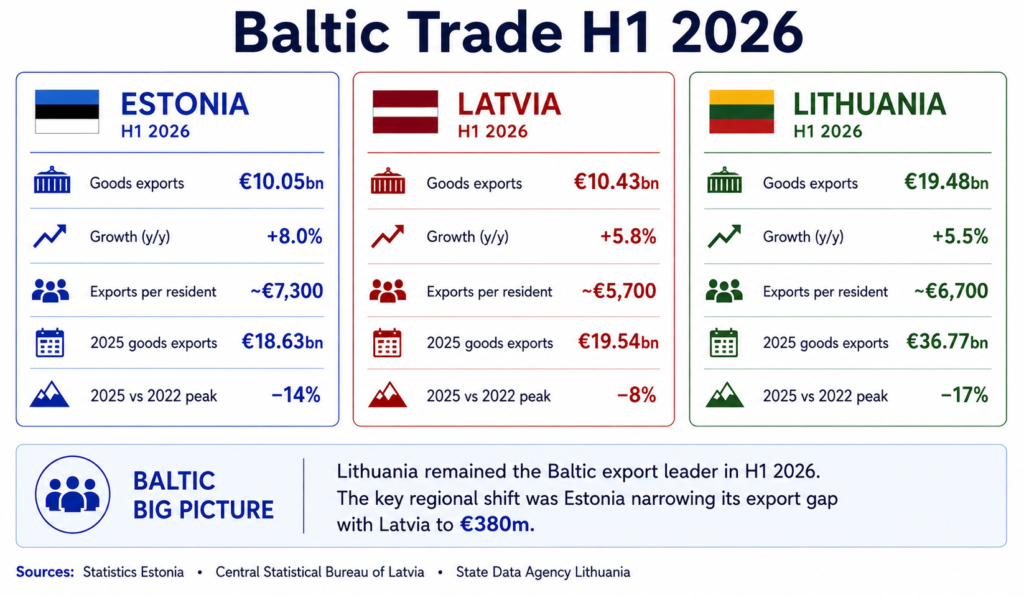
Estonia and Latvia are once again approaching parity in goods exports. In the first half of 2026, Latvia exported goods worth €10.43 billion, while Estonia reached approximately €10.05 billion. The gap between them was just €380 million.
That is striking for two reasons. Estonia has a considerably smaller population, and it is still recovering from a much deeper export downturn. But the longer-term figures reveal something else: Estonia is not approaching Latvia’s export level for the first time. It is reclaiming a position it lost after 2022.
From parity to divergence
In 2022, Estonia exported approximately €21.67 billion worth of goods, slightly more than Latvia’s €21.33 billion. Both figures were inflated by high energy and commodity prices, but the two countries nevertheless entered the subsequent downturn from almost exactly the same point.
Their paths then separated.
Estonian goods exports fell by 16% in 2023, to €18.18 billion, and declined by another 4% in 2024, to approximately €17.4 billion. Latvia also suffered a significant correction, but its decline was less severe: exports fell by 11.2% in 2023, to €18.94 billion, and by only 1.9% in 2024, to €18.68 billion.
By 2024, Latvia had built an export lead of approximately €1.3 billion. But this was driven as much by Estonia’s deeper collapse as by Latvia’s own performance.
In 2025, the gap began to narrow. Estonian exports increased by 7%, reaching €18.63 billion, while Latvian exports grew by 3.7%, to €19.54 billion. The same pattern continued in the first half of 2026: Estonia recorded growth of 8%, compared with 5.8% in Latvia.
As a result, the first-half gap fell from approximately €590 million in 2025 to €380 million in 2026.
A stronger export intensity
Estonia’s return to near-parity is especially notable when population is taken into account. In the first half of 2026, goods exports amounted to roughly €7,300 per resident in Estonia, compared with around €5,700 in Latvia.
This does not mean that Estonia’s industrial sector has fully recovered. Its headline export growth is partly being supported by re-exports.
In 2025, Estonia’s total goods exports grew by 7%, but exports of goods of Estonian origin increased by only 4%. Re-exports rose by 14%, reducing the share of domestically produced goods in total exports to 63%.
The picture became more balanced in June 2026, when both exports of Estonian-origin goods and re-exports increased by 15%. Electrical equipment, metal products and food contributed to the growth, but mineral products also played an important role. These included natural gas sent to Finland, shale fuel oil exported to the Netherlands and other re-exported mineral products.
Latvia’s export growth also contains a substantial mineral-trade component. Mineral products produced the largest increase in Latvian exports in 2025, while natural gas and electricity contributed to the strong June 2026 result.
Context
Neither country had returned to its nominal 2022 export peak by the end of 2025. Latvia remained approximately 8% below it, while Estonia was still around 14% lower.
The difference is that Estonia is now closing the remaining distance faster. It has restored much of the export parity lost during the 2023–2024 collapse, even though industrial production remains weak and part of the recovery comes from re-exports and energy flows.
The emerging story is therefore not simply that Baltic exports are growing again. Two countries that started from almost the same point in 2022 followed sharply different trajectories and, four years later, are arriving at almost the same point once more.
Sources: Statistics Estonia; Central Statistical Bureau of Latvia.
Correction: an earlier version of the visual contained incorrect data. The figures have been replaced with the correct H1 2026 data.