Agrone catches the last train in Baltic dairy
.Estonia’s Agrone is moving downstream just as Baltic dairy processing enters a new round of consolidation. The RPK deal shows why timing — and financing — now matter.
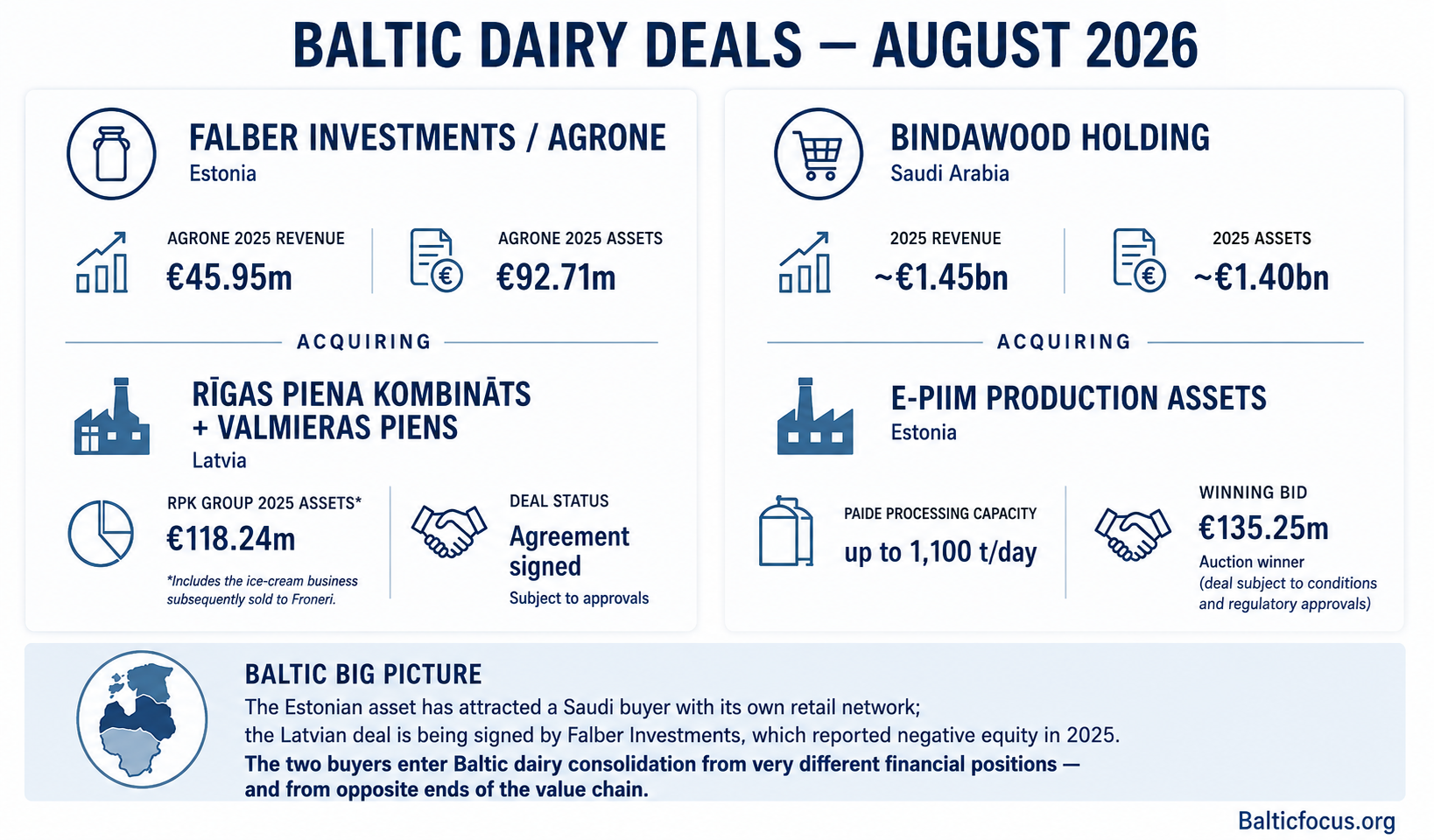
Falber Investments, the parent company of Estonia’s Agrone, has signed an agreement to acquire the AS Rīgas piena kombināts group, including AS Valmieras piens. The price has not been disclosed and the transaction still requires approval from competition authorities in Latvia and Estonia.
The deal gives Agrone control of one of Latvia’s largest dairy-processing businesses, including Kārums, one of the country’s best-known food brands. More importantly, it gives a large raw-milk producer an established processing, branding and export platform at a time when ownership of Baltic dairy assets is becoming increasingly concentrated.
Lithuanian processors are consolidating and adding capacity. Latvia’s processing industry is already heavily internationalised. In Estonia, meanwhile, one of the region’s newest large dairy plants is set to pass to Saudi Arabia’s BinDawood Holding.
Seen in that regional context, Agrone’s acquisition looks less like another Estonia-Latvia transaction than a move to secure a downstream position while substantial independent assets are still available.
WHAT AGRONE IS BUYING
| Buyer | Falber Investments / Agrone — Estonia |
| Target | Rīgas piena kombināts group — Latvia |
| Includes | AS Valmieras piens |
| Agrone raw-milk production | ~70,000 t/year |
| RPK export reach | 35 countries |
| Deal value | Undisclosed |
Agrone is buying an established route from raw milk into processing, branded products and export markets.
Sources: Agrone; Rīgas piena kombināts.
More than a factory in Riga
Agrone is one of Estonia’s largest agricultural groups. It manages about 14,500 hectares and produces approximately 70,000 tonnes of raw milk a year, as well as roughly 35,000 tonnes of grain and oilseeds and 40 million eggs.
RPK takes the group further down the value chain. The transaction includes both Rīgas piena kombināts in Riga and Valmieras piens, giving Agrone two Latvian processing sites.
Valmiera is particularly relevant geographically. It lies much closer to Estonia, in a regional dairy market where milk already moves across national borders.
RPK has guaranteed Valmieras piens obligations under milk-supply agreements for 2026–2028 with the Estonian suppliers Kabala Agro and OÜ Estonia. The link between Estonian milk production and Latvian processing therefore predates the acquisition.
The companies themselves emphasise vertical integration. RPK chairman Soren Lauridsen has pointed to higher-value categories such as cheese snacks, curd snacks, dairy drinks, yoghurts and ready meals.
For Agrone, this changes the economics of its milk business. Rather than selling raw material and leaving the rest of the value chain to processors, it gains access to production, product development, established brands, retail relationships and export channels. Processing also creates additional commercial streams, including whey products.
RPK already has a sizeable international footprint. At the end of 2025, it exported to 35 countries, five more than a year earlier, with South Korea among the new markets.
Agrone is therefore acquiring export infrastructure that would take time and capital to build independently.
A profitable producer moves into a heavier industrial structure
Agrone enters the deal from a profitable position.
According to Agrone’s 2025 annual report, the group generated €45.95 million in revenue, with €8.20 million in operating profit and €6.90 million in pre-tax profit. Assets stood at €92.71 million, equity at €47.08 million and liabilities at €45.63 million.
RPK has a very different financial profile.
Its 2025 accounts show €155.39 million in consolidated revenue, €118.24 million in assets, €41.21 million in equity and €77.04 million in liabilities. The result before financial items was €4.29 million, while the pre-tax result was a loss of €0.72 million.
There is an important caveat. RPK’s 2025 accounts still include the ice-cream business that was subsequently separated and sold to Froneri. The €155 million revenue figure cannot therefore be treated as the pro-forma size of the dairy business that Falber is now acquiring.
Even so, the transaction will move Agrone into an industrial structure that is larger and more financially complex than its existing agricultural operations.
AGRONE AND RPK: 2025 FINANCIALS
| Agrone | RPK Group* | |
| Revenue | €45.95m | €155.39m |
| Operating / pre-finance result | €8.20m | €4.29m |
| Pre-tax result | €6.90m | –€0.72m |
| Assets | €92.71m | €118.24m |
| Liabilities | €45.63m | €77.04m |
*RPK’s 2025 figures still include the subsequently sold ice-cream business.
The acquisition takes a profitable agricultural producer into a substantially heavier processing business, making the financing structure an important part of the transaction.
Sources:Agrone 2025 annual report ; RPK audited accounts.
Who is financing Agrone’s move?
External financing would be normal for an acquisition of this scale. The more important issue is how the transaction is structured.
Falber Investments, Agrone’s parent company and the entity signing the RPK agreement, is considerably smaller on a standalone balance-sheet basis than the industrial business it is seeking to acquire.
Falber’s 2025 annual report, filed with the Estonian Business Register, shows €35.62 million in assets and negative equity of €3.57 million. The company recorded a loss of €1.43 million for the year.
These figures say little about the financing capacity of the wider ownership structure and do not show how the RPK acquisition will be funded. They do, however, make the eventual funding structure — including the amount, source and terms of any acquisition debt — an important part of the transaction.
There is also a recent corporate development worth noting.
On July 16, little more than a month before the RPK agreement was announced, Falber incorporated BestMilk OÜ with €10,000 in share capital. Its registered principal activity is “activities of financing conduits”, and Falber Investments owns 100% of the company. Raul Jeets is listed as its indirect beneficial owner.
There is no public evidence that BestMilk is being used as an acquisition vehicle for RPK, and its creation should not be interpreted as such without further disclosure.
For now, the more substantive question is how much additional leverage the buyer will carry after closing, and on what terms.
That question matters because RPK already comes with a substantial financing structure of its own.
RPK brings debt as well as brands
RPK’s total borrowings stood at €51.74 million at the end of 2025, up from €42.24 million a year earlier.
This included €36.91 million in related-party borrowings and €12.05 million in factoring liabilities. Financial expenses reached €5.01 million, exceeding the company’s €4.29 million result before financial items.
The assets of RPK and Valmieras piens, including current assets, are also pledged to GLAS Trust Corporation under the Food Union senior facility arranged by Deutsche Bank.
The undisclosed purchase price will therefore reveal only part of the economics of the transaction. The treatment of existing borrowings, related-party financing and collateral at closing — whether repaid, released, transferred or refinanced — will be at least as significant.
Agrone is acquiring processing capacity, brands and distribution. Depending on the financing structure, it may also enter its next stage of development with a much larger financial burden.
Latvia’s dairy sector is already international
The transaction is easy to frame as an Estonian company buying a Latvian dairy business. The ownership map is more complicated.
RPK is Latvian, its factories are in Latvia and Kārums remains one of the country’s most recognisable brands. But the capital behind the group has been international for years.
Hong Kong-based alternative investment firm PAG invested in Food Union Europe in 2017 and became its sole beneficiary in 2024 after founder Andrey Beskhmelnitsky and Meridian Capital left the beneficiary structure.
The former Food Union business has since been divided. Its European ice-cream operations went to Froneri, while the remaining Latvian dairy business continued through Rīgas piena kombināts and Valmieras piens. Falber/Agrone is acquiring that dairy core.
Nor is Estonian ownership new to Latvian processing. Tukuma Piens, producer of the Baltais brand, is almost entirely owned through four Estonian companies, each holding 24.82%.
Latvijas Piens has been controlled since 2017 by Germany’s Fude + Serrahn Milchprodukte. Lithuania’s Vilvi Group has expanded directly into Latvia through its new Bauska cheese plant, an investment of more than €60 million.
Latvian capital remains present. In March, the Competition Council approved Smiltenes Piens taking sole control of Cesvaines Piens.
The result is a dairy-processing sector in which national ownership has already become the exception rather than the organising principle.
LATVIA’S DAIRY OWNERSHIP MAP
| Major processing block | Ownership / control |
| RPK + Valmieras piens | Falber / Agrone — Estonia (pending approval) |
| Tukuma Piens / Baltais | Major shareholders — Estonia |
| Latvijas Piens | Fude + Serrahn — Germany |
| Baltic Dairy Board / Bauska | Vilvi Group — Lithuania |
| Smiltenes Piens / Cesvaines Piens | Latvian-controlled |
Agrone is entering an already internationalised processing market.
Why the timing matters
The regional picture explains why RPK is particularly valuable now.
Lithuanian dairy companies are consolidating while continuing to invest. Vilvi has completed its acquisition of Marijampolės pieno konservai and opened its new Bauska plant. Pienas LT is implementing a €50 million expansion intended to increase processing capacity from 650 to 1,300 tonnes a day. Žemaitijos pienas is planning additional production capacity in Telšiai.
This investment is proceeding even as Lithuania describes its dairy industry as being in a prolonged crisis. Weak market conditions have not stopped capital expenditure; rather, they are widening the divide between companies able to finance expansion and those that cannot.
Estonia offers the clearest illustration.
E-Piim Tootmine was declared bankrupt in March, but its new Paide plant — one of Estonia’s largest recent dairy investments — remained a valuable industrial asset.
The original project was estimated to cost about €154 million. The European Investment Bank described a plant designed to process up to 1,150 tonnes of milk a day and produce hard and semi-hard cheese, pasteurised cream and sweet whey powder.
Bankruptcy did not remove that capacity from the market. It changed its owner.
Saudi capital enters Baltic dairy
Saudi Arabia’s BinDawood Holding won the auction for E-Piim’s production assets through its wholly owned Estonian subsidiary JUUST & JUBN OÜ.
The winning bid was €135.25 million. BinDawood described the Paide operation as capable of processing up to 1,100 tonnes of milk a day and said the acquisition would be funded through available financing facilities.
The transaction is separate from the Agrone-RPK deal and the figures are not directly comparable. What is striking is the very different financial position from which the two buyers enter the same regional restructuring.
BinDawood reported 2025 revenue of SAR6.348 billion, total assets of SAR6.141 billion and operating cash flow of SAR670.8 million. Group equity was about SAR1.664 billion.
At the August 21 exchange rate, this was roughly €1.45 billion in revenue, €1.40 billion in assets, €379 million in equity and €153 million in operating cash flow.
This does not make BinDawood debt-free, nor does it remove the risks associated with the acquisition. It does, however, place the €135.25 million purchase within a much larger balance sheet and cash-generating business.
BinDawood is also a strategic rather than purely financial investor. The group is a major Saudi retailer expanding into distribution and food processing, potentially linking Baltic milk production to an owner with established downstream retail and distribution channels.
Its interest in the region may extend beyond Estonia.
Before the E-Piim auction was completed, BinDawood had already been examining investment in Lithuania. In August, chief executive Ahmad BinDawood said the group was considering either direct investment in a new food plant or the use of existing Lithuanian infrastructure to manufacture products for export to its home region. Lithuania had reportedly been under consideration for about six months.
The Lithuanian government separately confirmed talks about a possible dairy-processing plant supplying Saudi Arabia and indicated that the acquisition of all or part of existing Lithuanian processing capacity was among the options discussed.
This is not evidence of a defined Baltic acquisition strategy. It does, however, suggest that the E-Piim purchase was not simply a response to an unexpected bankruptcy auction. BinDawood had already been looking at Baltic food-production assets before the Estonian opportunity emerged.
Whether Paide becomes its only Baltic dairy asset or the first of several remains open.
BINDAWOOD / E-PIIM
| Winning bid | €135.25m |
| Current disclosed Paide capacity | up to 1,100 t/day |
| Original design capacity | up to 1,150 t/day |
| BinDawood 2025 revenue | ~€1.45bn |
| BinDawood 2025 assets | ~€1.40bn |
| Total equity | ~€379m |
| Operating cash flow | ~€153m |
A strategic investor with a much larger financial base and its own downstream market is entering Baltic dairy processing.
Sources: BinDawood Holding; EIB; Saudi Exchange disclosure. EUR equivalents use the August 21, 2026 SAR/EUR rate.
Milk already moves across the region
Changing ownership is only part of the restructuring. The underlying milk market is already regional.
Official Estonian sources show substantial raw-milk exports to neighbouring markets, with Lithuania among the main destinations. Exact bilateral raw-milk volumes are not published in a form that allows a clean Latvia-Lithuania comparison, so broader trade statistics have to be treated cautiously.
Statistics Estonia data for HS 0401 — milk and cream, not concentrated — show exports of €88.5 million to Latvia and €65.9 million to Lithuania in 2025.
Flows went in both directions. Estonia imported €39.6 million from Latvia and €1.6 million from Lithuania in the same category.
HS 0401 includes more than farm-gate raw milk and should not be treated as a precise measure of raw-milk trade. It nevertheless illustrates the extent to which the dairy market already operates across borders.
The supply agreements between Valmieras piens and Estonian producers make the same point more directly.
Agrone is not creating a regional milk market. It is taking a larger position within an existing one.
The “last train” is about processing
Agrone is not late to milk production. It is late to the current phase of Baltic dairy-processing consolidation.
Lithuanian groups are expanding capacity, Latvia’s larger processors already have a mixed ownership structure, and one of Estonia’s newest plants is moving to a Saudi strategic investor. Against that backdrop, RPK and Valmieras piens give Agrone something increasingly difficult to build from scratch: processing capacity, suppliers, recognised brands and existing export routes.
That is the “last train” logic — not the last plant or the last possible deal, but a narrowing opportunity to secure a substantial downstream position before more of the Baltic processing map is absorbed into larger groups.
The map is not yet settled. Jaunpils Pienotava remains one unresolved asset: SCE E-Piim still owns 100% of the company, while court restrictions limit disposal of the shares without prior approval.
The next phase will be visible in who finances the remaining acquisitions, where the remaining assets end up and whether new ownership begins to shift milk flows across the Baltics.
Primary source
Parent company of Agrone, Estonia’s Largest Raw Milk Producer, Signs Agreement to Acquire AS Rīgas piena kombināts