Analysis · Transport & Logistics
airBaltic Chapter 11: Who Benefits From Saving the Airline?
TThis week airBaltic’s Chapter 11 reaches its next important checkpoint. Objections to the final DIP financing order are due on October 2, ahead of the final hearing on October 9 in the U.S. Bankruptcy Court for the Southern District of New York, Case No. 26-12188 (LGB).
The question of who benefits already has a partial answer.
airBaltic can use the restructuring to unlock value tied up in aircraft financing. Existing secured lenders are repaid. New DIP lenders receive high-yielding debt and strong collateral. Existing bondholders are contesting how far that new priority should extend. For Latvia, the controlling shareholder, Chapter 11 preserves an operating airline and connectivity — but the ultimate treatment of equity has yet to be determined.
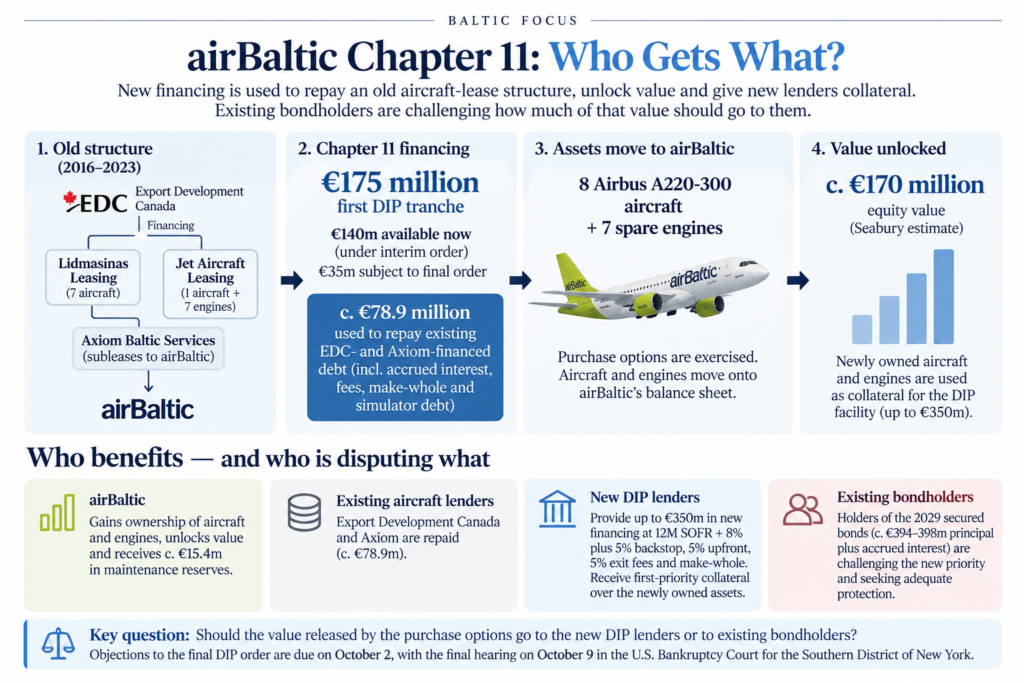
The first DIP tranche totals €175 million. Of that, €140 million became available under the interim order, with the remaining €35 million subject to the final order. The overall DIP facility is sized at about €350 million.
Around €78.9 million of Tranche 1 is intended to repay existing EDC- and Axiom-financed debt secured by aircraft and engines, including accrued interest, fees, make-whole amounts and EDC simulator debt. The filings do not provide a public breakdown showing how much of that amount is received by Axiom separately.
The transaction involves eight Airbus A220-300 aircraft and seven spare PW1521G engines.
According to Stephan T. Krastev of Seabury Global Aviation Advisors, airBaltic’s financial adviser, exercising the purchase options on those assets could unlock approximately €170 million of equity value. That is Seabury’s estimate on behalf of the debtor, not an independent valuation. Seabury also says that every financing proposal it reviewed contemplated using new financing to exercise those purchase options.
A further €15.4 million in previously paid maintenance reserves is expected to be returned to airBaltic for liquidity purposes.
So one of the first major operations under Chapter 11 is already clear: airBaltic uses new financing to repay an old aircraft-finance structure, exercises purchase options and brings valuable aircraft and engines onto its own balance sheet, where they can become collateral for the new financing.
And those assets had spent almost a decade inside a financing structure created when the A220 was still called the Bombardier CS300.
They were already inside the structure
Axiom Baltic Services and Lidmasinas Leasing can look, in some of the public discussion around Chapter 11, like unfamiliar companies that have suddenly appeared around airBaltic.
They did not.
Seven of the aircraft were held through a structure in which Lidmasinas Leasing Limited owned the aircraft, leased them to Axiom Baltic Services, and Axiom subleased them to airBaltic.
The eighth aircraft and seven spare engines were held separately through Jet Aircraft Leasing Limited.
All of these financed assets were subject to first-priority mortgages in favour of Export Development Canada. The Chapter 11 filings describe the full finance-lease pool as eight aircraft, seven spare engines and a simulator.
Both Axiom Baltic Services and Lidmasinas Leasing were incorporated in the Cayman Islands. Cayman SPVs are not unusual in international aircraft finance. The public documents reviewed by Baltic Focus, however, do not establish their ultimate beneficial ownership. That does not demonstrate irregularity; it simply limits what can be concluded about who ultimately stood behind the entities.
The documents also introduce a Danish aviation connection.
In Axiom Baltic Services documentation, Martin Møller Nielsen is listed as the recipient of contractual notices. This is an administrative role; the public documents reviewed by Baltic Focus do not establish his ownership, directorship or other formal position in Axiom.
In March 2016, Møller Nielsen and Lars Thuesen were co-owners of the Danish airline Jet Time.
A year later, Thuesen entered airBaltic. In April 2017 he took control of Aircraft Leasing 1, which at the time held roughly 20% of the Latvian airline, and joined airBaltic’s Supervisory Board.
Today Aircraft Leasing 1 holds 1.62% of airBaltic, while the Latvian state owns 88.37% and Lufthansa 10%. Thuesen remains a member of airBaltic’s Supervisory Board.
The available documents do not show that Thuesen owned Axiom or Lidmasinas, received income from those companies, or influenced specific decisions involving their contracts.
They establish a narrower fact: a current airBaltic board member and shareholder had previously been in aviation business with the person listed as Axiom’s contractual notice recipient.
That connection forms part of the corporate-governance history of the financing structure, but the public record does not establish an economic interest by Thuesen in Axiom or Lidmasinas.
A financing structure from the Bombardier era
Export Development Canada’s presence is easier to explain.
Today’s Airbus A220 began life as the Canadian Bombardier CSeries. airBaltic became the launch operator of the larger CS300 in late 2016. Airbus entered the programme later, and the A220 name appeared in 2018.
EDC was therefore financing the export of a Canadian Bombardier aircraft.
The CSeries name disappeared years ago. Part of its financing structure survived.
Chapter 11 is now being used to unwind it.
The cost of replacing the old financing
Replacing the old aircraft-finance structure is expensive. The DIP carries interest at 12-month SOFR plus 8% per year, payable monthly, with an additional three percentage points in default. On top of that come a 5% backstop commitment fee, a 5% upfront fee and a 5% exit fee, as well as make-whole protection if the financing is repaid early.
On a €350 million facility, each of the three 5% fees would equal €17.5 million, bringing the combined amount to €52.5 million before interest and any make-whole payment. A September 23 objection by bondholders specifically points to the size of those fees and to the priority they would receive relative to the 2029 bonds.
The maturity is short as well: the earlier of nine months after the petition date or 250 days after the closing of Tranche 1. A three-month extension is possible, but would carry an additional 0.75% fee.
The economics are therefore clear. airBaltic gains access to liquidity and to value embedded in aircraft that can be brought onto its balance sheet, while the new lenders are compensated with both a high return and strong security.
The fight over priority
That trade-off is now at the centre of the dispute with airBaltic’s existing bondholders.
At the petition date, the airline’s 2029 secured bonds had approximately €393.8 million of principal outstanding, together with about €4.4 million in accrued and unpaid interest. The Ad Hoc Group representing holders of those bonds has already objected to the DIP structure.
For Tranche 1, airBaltic argues that the new collateral is limited to the eight A220s, seven engines, unencumbered property and related proceeds, and that the prepetition bond collateral is not being primed at this stage. Any priming of the bondholders’ existing security would come with later tranches and would require further court approval.
The bondholders see the structure more broadly. They argue that Tranche 1 is economically linked to a larger financing package under which later DIP money could move ahead of their existing security interests. They are therefore seeking adequate protection and reserving their rights over valuation, priority and the wider collateral package.
The Ad Hoc Group also says it was excluded from the third-party DIP marketing process despite having proposed alternative financing. That claim remains part of the creditors’ case and has not been adjudicated.
The DIP syndicate itself is substantial: Barclays, Hayfin Capital Management, Morgan Stanley, Oaktree Capital and Strategic Value Partners.
So the question of who benefits from Chapter 11 is no longer abstract. airBaltic gains access to aircraft equity and liquidity; the old EDC/Axiom financing is repaid; the DIP lenders receive expensive but heavily protected exposure; and existing bondholders are fighting over how much of the company’s asset base may ultimately move ahead of them.
For Latvia, which remains the controlling shareholder, the immediate benefit is also tangible: airBaltic continues operating while the balance sheet is reworked. What the state’s equity will ultimately be worth after the restructuring is a separate question, and one that the current court process has not yet answered.
The market will not become easier
Even a successful financial restructuring would solve only part of airBaltic’s problem, because the airline will emerge into a market that is becoming more competitive, not less.
Wizz Air has cut its 2030 fleet ambition from 500 aircraft to 335, but the change does not amount to a retreat from Central and Eastern Europe. It reflects a more selective strategy focused on profitability while keeping the region at the centre of future growth.
Ryanair is moving even more explicitly. It has proposed increasing its Baltic-based fleet from seven to 16 aircraft and reaching 11 million annual seats by 2031, openly looking to expand as airBaltic reduces capacity.
That is the commercial backdrop against which the restructuring has to work. Chapter 11 can reduce debt, release value tied up in aircraft financing and reorder creditor claims. What it cannot do is make the competitive environment more forgiving.
The October hearings will help determine who receives priority over the value released through the restructuring. The longer-term test is whether airBaltic can use that financial breathing room to build an airline capable of competing sustainably in a market where Ryanair and Wizz Air are still pressing for growth.