Analysis · Transport & Logistics
Baltic diesel prices are still rising. Has the wholesale market already turned ?
For a while, drivers of combustion-engine cars could afford not to think too much about fuel prices. By autumn, that luxury was gone, and wondering what comes next had returned to the morning menu somewhere between the news and the first coffee.
Diesel prices continued to rise across the Baltic capitals this week, even as the European wholesale market began to retreat from its mid-September peak.
By Friday, diesel cost €2.128 per litre at a comparable Circle K station in Riga, €2.254 in Vilnius and €2.159 in Tallinn. Over one week, prices increased by 2.4% in Riga, 3.4% in Vilnius and 5.9% in Tallinn.
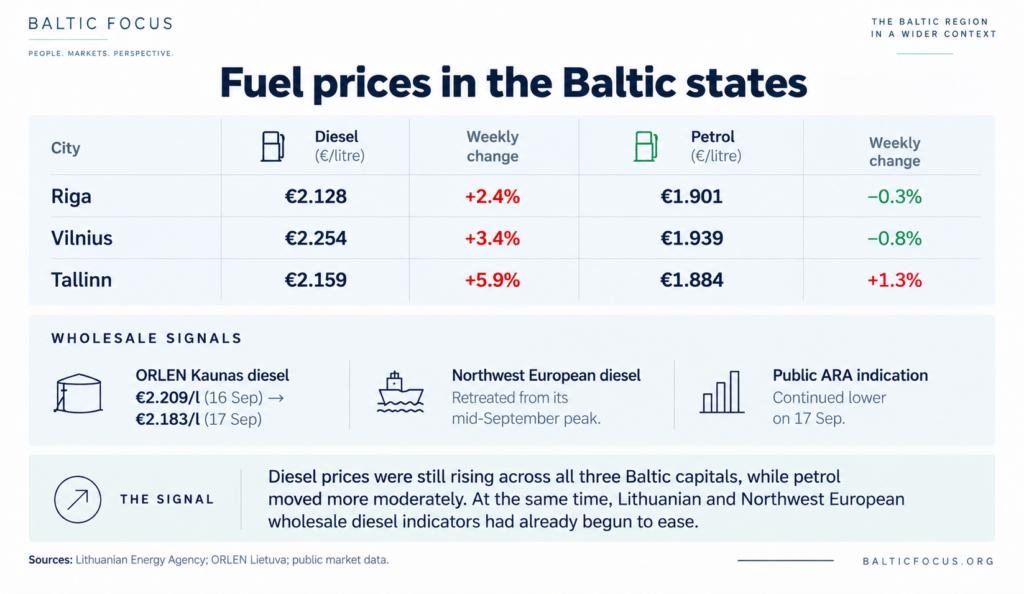
Petrol was moving differently. At the same comparable stations, petrol cost €1.901 per litre in Riga, €1.939 in Vilnius and €1.884 in Tallinn. Over the week, prices fell by 0.3% in Riga and 0.8% in Vilnius, while Tallinn recorded a relatively modest 1.3% increase. The divergence suggests that the current movement is not simply a uniform rise in motor-fuel prices across the region: diesel has been under distinctly stronger pressure.
The same pattern is visible in Lithuania’s broader daily data. On 18 September, the average diesel price reached €2.241 per litre, while the average petrol price slipped to €1.939.
At filling stations, therefore, diesel was still moving clearly upwards at the end of the week. Further up the supply chain, the picture had already become less straightforward.
ORLEN has made its first move lower
ORLEN Lietuva publishes prices for one-off transactions when fuel is loaded into road transport at the OKSETA terminal in Kaunas.
Its published diesel price rose from €1.870 per litre on 28 August to €2.209 on 16 September. On 17 September, it fell to €2.183, leaving the Kaunas price almost 17% above its late-August level but marking its first move lower after the rapid September increase.
A similar change of direction appeared in Northwest Europe.
Platts assessed CIF Northwest European 10 ppm diesel at $1,642.25 per tonne on 15 September, a record for that assessment, before the price eased to $1,608.25 the following day. A public indicative FOB ARA series shows the retreat continuing on 17 September, after prices had also peaked around the middle of the month.
The October forward moved lower as well, suggesting that the change was not confined to a single spot quotation.
These European assessments should not be read as a direct price comparison with the ORLEN terminal quotation. They use different delivery bases, specifications and units, while the Kaunas price also contains local components that an ARA or Northwest European benchmark does not.
They do, however, show something useful about direction. By the second half of the week, European wholesale diesel was no longer rising with Baltic retail prices.
Different parts of the chain move on different clocks
Retail and wholesale fuel prices do not move simultaneously. Baltic fuel turnover is relatively fast, but retailers still price against replacement costs, while wholesale changes pass through contracts, logistics, taxes and margins at different speeds.
The current pattern is consistent with such a lag: European diesel and ORLEN’s Kaunas terminal price rose sharply earlier in September, while Baltic filling stations were still reflecting that increase after upstream prices had begun to ease.
If European diesel and the Kaunas price continue to move broadly together, timing may explain much of the difference. If European quotations fall while the Lithuanian terminal price remains elevated, the focus shifts to local factors such as logistics, product specification, refinery and terminal economics, and supply structure.
In the present market, however, any of these relationships can be disrupted quickly by a new external shock.
Saudi disruption adds another moving part
ORLEN is adjusting its crude supply at the same time.
Saudi Aramco has been one of the group’s largest crude suppliers. Following disruption to Saudi deliveries, ORLEN bought 16 additional cargoes to maintain supplies to its refineries in Poland, Lithuania and the Czech Republic.
The replacement barrels are coming from Norway, Britain, Algeria, Kazakhstan, Azerbaijan and the Americas. ORLEN says its refineries remain fully supplied, and there is no indication that production at Mažeikiai has been reduced.
The disruption should be separated from ORLEN’s longer-term diversification.
On 20 August, before the latest Saudi pipeline disruption, ORLEN signed a three-year agreement with Equinor for crude from Norway’s Johan Sverdrup field. Annual deliveries can range from nearly 5 million tonnes to more than 9 million tonnes, potentially covering up to one quarter of ORLEN Group’s crude demand.
The Equinor agreement was therefore not an emergency response to the September disruption. It was part of a diversification process already under way when the Saudi problem appeared, while the 16 additional cargoes belong to the immediate adjustment that followed.
What those replacement barrels do to ORLEN’s actual refining costs is not visible in public price data. Purchase terms, crude quality, freight, refinery yields and the mix of barrels reaching individual refineries all matter.
Saudi replacement is therefore part of the cost environment around Mažeikiai, but public data do not allow it to be isolated as the explanation for the current Baltic diesel increase.
Diesel has its own supply problem
The divergence between petrol and diesel is also a reason not to reduce the movement to crude oil alone.
The diesel market itself has become unusually tight. Reuters reported this week that half of Russia’s largest diesel-producing refineries had reduced output following drone attacks, while restrictions and disruptions have also affected Russian product exports.
At the same time, European diesel inventories have been tight and refining margins unusually strong. That combination helps explain why diesel has behaved differently from petrol even though both ultimately depend on the crude market.
For the Baltic economies, that distinction matters beyond household fuel bills because diesel remains a major input for road freight, agriculture, construction and regional logistics. A sustained increase can therefore pass relatively quickly from filling stations into business operating costs.
A market snapshot, not a trajectory
By the end of the week, different parts of the diesel market were no longer moving in the same direction.
Baltic retail diesel prices were still rising, while petrol was already moving more moderately and had fallen in two of the three capitals. ORLEN’s Kaunas terminal diesel price had made its first move lower after the September surge, and Northwest European diesel had begun to retreat from its mid-month peak.
This does not establish where prices go next. A renewed disruption to crude supplies, refinery outages, freight problems, currency movements or another geopolitical shock could change the underlying market before the existing adjustment has worked its way through the chain.
What has changed is the structure of the question.
The Baltic diesel market is no longer simply a story of prices rising simultaneously from the European wholesale market through the local supplier to the filling station. The different layers have begun to separate, while petrol is following a different path again.
Whether the present gap closes, persists for local reasons or is overtaken by the next external shock is now the part worth watching.
Sources: ORLEN Lietuva; Lithuanian Energy Agency; LETA/LSM; ORLEN Group; public indicative ARA diesel market data.